 Skip to content
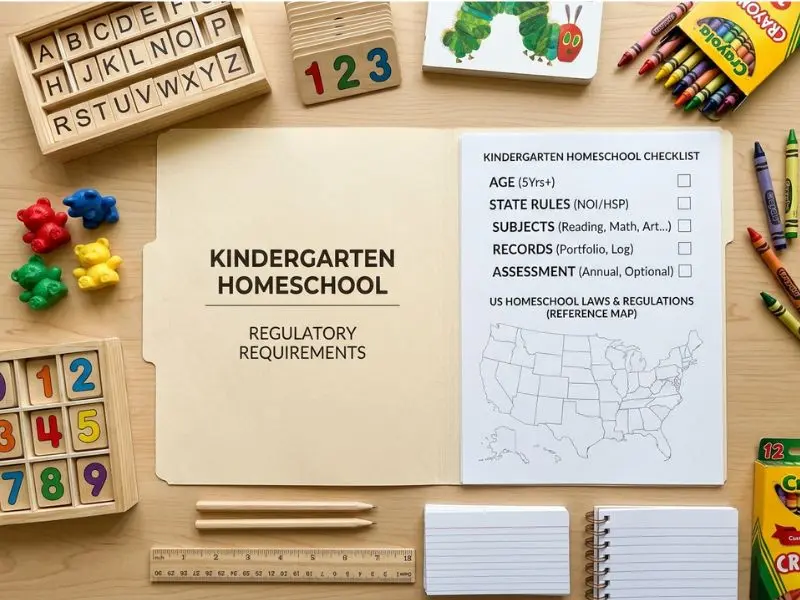
Kindergarten homeschool requirements vary by state. Start by checking your child’s compulsory school age, then confirm whether you need to file paperwork, teach specific subjects, track attendance, keep records, or complete an assessment.
When I research homeschool rules, I separate legal requirements from common advice first. That simple step prevents unnecessary confusion a
bout curriculum, school hours, and testing. This guide shows you what to check before you begin and which choices are usually left to parents.
Quick Answer: Kindergarten homeschool requirements vary by state. Start by checking your child’s compulsory school age. Depending on your state and homeschool option, you may need to file paperwork, teach required subjects, meet instructional-time rules, keep records, or complete an assessment.
- What Are the Requirements for Homeschooling Kindergarten?
- Is Kindergarten Required for Homeschoolers?
- Kindergarten Homeschool Age Requirements
- Understand Your State's Homeschool Laws
- What Paperwork Do You Need to Homeschool Kindergarten?
- What Do You Actually Teach in Kindergarten?
- How Much Time Does Kindergarten Homeschool Take?
- Do You Need a Teaching Degree to Homeschool Kindergarten?
- Does a Homeschool Kindergartener Need Standardized Testing?
- What If Your Kindergartener Needs Special Education Services?
- What Kindergarten Homeschool Records Should You Keep?
- What Kindergarten Homeschool Requirements Should You Check in Your State?
- Choosing a Curriculum Approach for Kindergarten
- Creating a Kindergarten Homeschool Schedule
- Kindergarten Homeschool Requirements Checklist
- Common Kindergarten Homeschool Mistakes to Avoid
- FAQs About Kindergarten Homeschool Requirements
- Conclusion
What Are the Requirements for Homeschooling Kindergarten?
There is no single set of kindergarten homeschool requirements for every family in the United States. States set most homeschool rules, and some states offer more than one legal way to homeschool.
Depending on your state and homeschool option, you may need to:
- Check whether your child has reached compulsory school age
- Choose an available homeschool option
- Submit a notice, affidavit, or other paperwork
- Teach required subjects
- Meet instructional time requirements
- Keep attendance or other records
- Meet parent qualification rules
- Complete testing or another form of assessment
Not every family will need to complete every step on this list.
The best approach is to find out what is legally required first. Curriculum, schedules, workbooks, and teaching styles can come later.
Legal Requirements vs. Good Homeschool Practices
Homeschool advice and homeschool law are not the same thing.
A parent may recommend keeping every worksheet, following a fixed schedule, or buying an all-in-one curriculum. Those choices may be useful, but they are not automatically legal requirements.
| Item | Legal Requirement? | Good Practice? |
|---|---|---|
| Homeschool notification | Depends on state | Not applicable |
| Required subjects | Depends on state | Yes |
| Attendance records | Depends on state | Useful |
| Work samples | Depends on state | Often useful |
| Standardized testing | Depends on state and option | Can be useful |
| Purchased curriculum | Not universally required | Optional |
| Fixed daily schedule | Not universally required | Optional |
| Progress notes | Depends on state | Useful |
When you see a homeschool recommendation online, ask one simple question:
Is this required by my state’s law, or is it simply a helpful way to homeschool?
That distinction can prevent a lot of unnecessary work and confusion.

Is Kindergarten Required for Homeschoolers?
Kindergarten is not automatically compulsory for every 5-year-old in the United States.
The important term to understand is compulsory school age. This is the age when state law requires a child to receive an education through an approved schooling option.
A child may be old enough to enter kindergarten without yet being subject to the same compulsory attendance requirement.
Compulsory School Age Varies by State

Compulsory attendance rules differ across the country.
Parents who want to compare these differences can use the Education Commission of the States’ 50-state compulsory school age comparison, which shows when compulsory education begins and ends in each state.
This means two children of the same age can have different legal requirements because they live in different states.
Before starting kindergarten homeschool, check:
- At what age can children enter kindergarten in your state?
- When does compulsory school attendance begin?
- Is kindergarten itself compulsory?
- Which homeschool requirements apply to your child?
Do not assume that kindergarten eligibility age and compulsory school age are always the same.
Why This Difference Matters
Suppose your child turns five and is eligible for kindergarten. That does not automatically tell you whether you must file homeschool paperwork.
Your state’s compulsory attendance law determines when education becomes legally required. Your state’s homeschool rules then determine how homeschooling must be handled.
Checking these two rules first gives you a much clearer starting point.
Kindergarten Homeschool Age Requirements
Many children begin kindergarten around age five, but age alone does not determine your homeschool responsibilities.
States may use specific cutoff dates for kindergarten eligibility. Compulsory attendance can follow a different age rule.
This is why simply searching for “homeschool requirements for a 5-year-old” may not give you the full answer.
Can You Homeschool a 5-Year-Old?
Yes, homeschooling a 5-year-old is generally possible in the United States, but the legal steps depend on the state.
First, check whether your child has reached compulsory school age. Then identify the homeschool option available to your family and follow the rules connected to that option.
Do not assume another homeschool family’s process applies to you.
Can You Delay Kindergarten When Homeschooling?
Possibly. The answer depends on your state’s rules.
Some parents prefer to delay formal academics because their child needs more time for play, development, or basic readiness skills.
Before delaying kindergarten, check:
- Compulsory attendance age
- Kindergarten attendance rules
- Kindergarten cutoff dates
- Available homeschool options
- Any applicable exemption or waiver process
Delaying kindergarten enrollment does not automatically remove compulsory education requirements.
Understand Your State’s Homeschool Laws
Your state is the best starting point for understanding what you need to do.
Check how your state handles:
- Compulsory attendance
- Homeschool notification
- Parent qualifications
- Required subjects
- Instructional days or hours
- Attendance records
- Portfolios
- Assessments
- Other required documentation
Some states also offer more than one legal homeschool option. The requirements may differ between those options.
Where to Verify Your State’s Requirements
Start with your state’s official education department, education agency, or current state law.
Third-party homeschool websites can be useful for explaining complicated rules in simple language. However, important legal requirements should still be verified against an official source.
Check the date of the information as well. Homeschool laws, forms, and procedures can change.
Examples From Large U.S. States
Looking at a few states shows why a single national checklist cannot provide every legal answer.
Texas
Texas does not use the same homeschool system as states that require detailed annual instructional plans.
Under the legal framework commonly associated with the Leeper decision, a Texas homeschool must be conducted in a bona fide manner and use a written curriculum covering reading, spelling, grammar, mathematics, and good citizenship.
The Texas Education Agency does not regulate or accredit homeschool programs.
New York
New York has a more detailed home-instruction process.
Parents homeschooling children who are subject to compulsory attendance generally need to provide written notice. New York also uses an Individualized Home Instruction Plan, often called an IHIP.
Additional rules cover areas such as instruction, attendance, reports, and assessments.
Florida
Florida families can use different education options.
Families choosing Florida’s home education program should check current requirements for notice, records, portfolio maintenance, and educational evaluation.
The exact process should be verified through current Florida law and official local or state guidance.
Quick Legal Checklist
Before moving on to curriculum planning, make sure you can answer these questions:
- Has my child reached compulsory school age?
- Does kindergarten attendance apply to my child?
- Which homeschool option will I use?
- Do I need to notify an education authority?
- Are there parent qualification requirements?
- Which subjects are required?
- Are there minimum instructional days or hours?
- What records must I maintain?
- Is a portfolio required?
- Does my child need an assessment?
If you cannot answer one of these questions, check your state’s official guidance before moving forward.
What Paperwork Do You Need to Homeschool Kindergarten?
There is no nationwide homeschool registration form.
The documents you need depend on your state, your child’s age, and the homeschool option you use.
Possible paperwork can include:
- Notice of intent
- Homeschool affidavit
- Proof of age or identity
- Instruction plan
- Attendance records
- Portfolio
- Assessment results
- Annual evaluation
- Withdrawal documents
Do not submit paperwork just because another homeschool parent says they filed it.
First confirm that the document applies to your situation.

What If Your Child Is Already Enrolled in School?
If your child is already attending public or private kindergarten, check the proper withdrawal process before switching to homeschool.
Simply keeping a child home may not complete the required process.
Think of this as two separate questions:
- How do I properly withdraw my child?
- What must I do to begin homeschooling?
Follow the rules that apply in your state and keep copies of important documents.
How to Organize Homeschool Paperwork
You do not need a complicated filing system.
Create one physical or digital folder for:
- Notices
- Withdrawal documents
- Confirmation emails or letters
- Attendance records
- Required reports
- Evaluations
- Assessment results
Keeping these documents together makes them easier to find when you need them.
What Do You Actually Teach in Kindergarten?
There is no single national homeschool kindergarten curriculum that every family must follow.
Your state may require instruction in certain subjects. Other subjects may simply be common or recommended for children at this age.
Before building your curriculum, separate these two questions:
What does my state require me to teach?
What else would help my child learn and develop?
Are Public School Kindergarten Standards Required for Homeschoolers?
Public-school learning standards and homeschool requirements are not automatically the same thing.
Your state may require certain homeschool subjects without requiring you to follow every public-school kindergarten standard in exactly the same way.
State learning standards can still be useful planning tools. They can show skills commonly taught at this age.
However, do not assume every public-school standard is legally required for your homeschool.
Reading and Phonics
Early reading instruction commonly includes:
- Letter recognition
- Letter sounds
- Phonemic awareness
- Basic phonics
- Simple words
- Listening to stories
- Reading together
Short lessons can work well for kindergarten children.
Books, games, conversations, and read-alouds can also build early literacy skills.
Math
Kindergarten math commonly introduces:
- Counting
- Number recognition
- Comparing quantities
- Simple addition and subtraction
- Shapes
- Patterns
- Measurement
- Basic time and money concepts
Hands-on objects can help young children understand these ideas without relying only on worksheets.
Writing and Handwriting
Writing activities may include:
- Pencil control
- Writing a name
- Letter formation
- Drawing
- Copying simple words
- Expressing ideas through pictures and early writing
Young children do not need to spend long periods doing handwriting exercises.
Science and Social Studies
Kindergarten science can begin with everyday life.
Children may explore plants, animals, weather, seasons, the human body, and nature.
Social studies can introduce families, communities, maps, occupations, and basic citizenship ideas.
Remember that common kindergarten topics and legally required homeschool subjects are not always identical.
Social-Emotional Learning
Homeschooling does not mean a child must learn alone.
Kindergarten children can practice:
- Listening
- Taking turns
- Sharing
- Following directions
- Communicating
- Solving simple problems
- Working with others
Libraries, sports, homeschool groups, community activities, relatives, and play with other children can provide opportunities for social interaction.
Art and Music
Drawing, painting, crafts, singing, rhythm, and simple music activities can support creativity and fine motor development.
Whether these areas are legally required depends on the homeschool rules that apply to your family.
How Much Time Does Kindergarten Homeschool Take?
There is no single nationwide number of daily homeschool hours for kindergarten.
Parents need to separate legal instructional time from practical learning time.
Legal Instructional Time
Some states set rules for instructional days, hours, or both.
If your state has these requirements, follow the rules for your homeschool option and keep any records that are required.
Do not use another state’s schedule as your legal standard.
Practical Learning Time
Young children often learn well through shorter periods of focused instruction.
A homeschool day can also include:
- Reading together
- Educational games
- Outdoor exploration
- Crafts
- Cooking
- Building
- Conversation
- Hands-on projects
A child does not necessarily need to sit at a desk for the same number of hours spent inside a traditional school building.
Do You Need a Teaching Degree to Homeschool Kindergarten?
There is no nationwide rule requiring every homeschool parent to hold a teaching degree or teaching certificate.
Parent qualifications, however, can differ by state and homeschool option.
Instead of asking:
“Am I qualified enough to homeschool?”
Ask:
“What qualifications does my state require for the homeschool option I am using?”
If your state has a qualification requirement, make sure you meet it.
You can also use curriculum materials, books, tutors, educational programs, libraries, and other resources when you need help teaching a subject.
Does a Homeschool Kindergartener Need Standardized Testing?
Not every homeschool kindergartener has the same testing requirement.
Assessment rules can depend on:
- State
- Homeschool option
- Child’s age
- Grade level
- Enrollment status
Some states require standardized testing or another form of evaluation. Others have different requirements.
North Carolina is one example of why parents need to check carefully. Its current homeschool guidance requires annual nationally standardized testing for students enrolled in an open home school, including enrolled 5- and 6-year-olds.
That does not mean every U.S. kindergartener must take the same test.
It shows why your state’s requirements matter.
When formal testing is not required, parents can still monitor learning through work samples, reading practice, math activities, projects, conversations, and observation.
What If Your Kindergartener Needs Special Education Services?
Parents of children with additional learning needs may have extra questions about homeschooling.
The availability and process for evaluations or special education services can depend on state rules and the services involved.
Do not assume that homeschooling automatically ends every possible form of support. At the same time, do not assume services will work exactly as they would for a child enrolled in public school.
Check your state’s official special education guidance and ask the appropriate local education authority how its rules apply to homeschooled students.
What Kindergarten Homeschool Records Should You Keep?
Start with records your state legally requires.
After meeting those requirements, you can keep additional records that make it easier to track progress.
Useful records may include:
- Attendance
- Curriculum or resource lists
- Books read
- Work samples
- Writing samples
- Math work
- Projects
- Progress notes
- Assessment results
- Copies of official homeschool documents
You do not need to save every worksheet unless your applicable rules require it.
Focus first on required records. Then save a reasonable selection of work that shows how your child is progressing.
Required Records vs. Helpful Records
This distinction matters for first-time homeschool parents.
Required records are documents your applicable law or homeschool option says you must maintain.
Helpful records are materials you choose to keep for organization or progress tracking.
Do not turn optional record keeping into unnecessary paperwork.
What Kindergarten Homeschool Requirements Should You Check in Your State?
When researching your state, focus on the requirement categories that can change from one state or homeschool option to another.
| Requirement | What to Check |
|---|---|
| Compulsory age | When education becomes legally required |
| Kindergarten rule | Whether kindergarten attendance applies |
| Homeschool option | Which legal method your family can use |
| Notification | Whether an authority must be notified |
| Parent qualification | Whether the instructor must meet specific requirements |
| Subjects | Which subjects must be taught |
| Instructional time | Required days or hours, if applicable |
| Records | Attendance, portfolio, or other documentation |
| Assessment | Testing or evaluation requirements |
If your state offers several homeschool options, compare them before choosing one.
Do not assume every option has identical requirements.
Choosing a Curriculum Approach for Kindergarten
Choose your curriculum after you understand your legal requirements.
This order keeps you from buying a program before you know what it needs to cover.
A curriculum is a teaching tool. Purchasing one is not a universal U.S. homeschool requirement.
All-in-One Curriculum Packages
An all-in-one program combines several subjects.
This can make planning easier for a first-time homeschool parent who wants lessons organized in one place.
Before buying one, check whether it covers any subjects your state requires.
Subject-by-Subject Curriculum
You can also choose separate resources for reading, math, science, and other subjects.
This allows you to match each subject to your child’s current skills.
A child may need more support with reading while moving faster in math.
Play-Based and Interest-Led Learning
Kindergarten does not need to consist only of worksheets and formal lessons.
Children can learn through:
- Counting toys
- Building with blocks
- Cooking
- Gardening
- Drawing
- Reading
- Nature walks
- Storytelling
- Educational games
Structured instruction and play-based learning can work together.
Creating a Kindergarten Homeschool Schedule
Create your routine after you understand the requirements and choose your learning resources.
A kindergarten homeschool schedule does not need to copy a traditional classroom.
Formal lessons can be mixed with movement, play, meals, reading, outdoor time, and hands-on activities.
Simple Kindergarten Homeschool Schedule
| Time | Activity |
|---|---|
| 9:00 | Reading and phonics |
| 9:25 | Movement break |
| 9:40 | Math |
| 10:05 | Snack and free play |
| 10:30 | Writing or hands-on learning |
| 10:50 | Read-aloud |
This is an example, not a nationwide legal schedule.
Adjust the routine to your child’s attention, family needs, and any instructional-time requirements that apply to you.
Tips for Making the Schedule Work
Start simple.
Do not fill every hour with formal lessons.
If your child loses focus, shorten the lesson. If a project creates strong interest, give your child more time to explore it.
A routine can provide consistency without making every day rigid.
Kindergarten Homeschool Requirements Checklist

If you are preparing to homeschool kindergarten, work through these steps in order:
- Check your state’s compulsory school age.
- Find out whether kindergarten attendance applies to your child.
- Identify the legal homeschool options available.
- Choose the option your family will use.
- Complete the proper withdrawal process if your child is already enrolled.
- Submit any required homeschool notice or paperwork.
- Check parent qualification requirements.
- Identify required subjects.
- Check instructional days or hours.
- Learn which records you must maintain.
- Check testing or evaluation requirements.
- Save copies of important documents.
- Choose curriculum or learning resources.
- Create an age-appropriate routine.
- Recheck official requirements when necessary.
A simple order to remember is:
Age → Homeschool Option → Paperwork → Subjects → Time → Records → Assessment → Curriculum → Schedule
This keeps legal requirements separate from optional homeschool choices.
Common Kindergarten Homeschool Mistakes to Avoid
Most beginner mistakes come from treating assumptions as rules.
Following Another State’s Requirements
A homeschool friend or online creator may live under completely different laws.
Use their experience for ideas, not as proof of what your family must legally do.
Buying Curriculum Before Checking Requirements
A popular curriculum may be excellent but still not cover everything your state requires.
Check the rules first. Buy or build your curriculum second.
Confusing Public School Standards With Homeschool Law
Public-school standards can be useful planning references, but they are not automatically identical to homeschool requirements.
Verify what actually applies to your homeschool option.
Copying a Full Traditional School Day
A kindergarten child does not need a classroom-style schedule simply because traditional schools use one.
Follow applicable instructional-time requirements while creating a routine that works for learning at home.
Keeping Too Much or Too Little Documentation
Some parents save everything. Others save almost nothing.
Start with the records your state requires. Then keep enough additional work to help you track progress without creating unnecessary paperwork.
FAQs About Kindergarten Homeschool Requirements
Do I Have to Register My Kindergartener for Homeschool?
Not necessarily. Notification, registration, and filing requirements depend on your state, your child’s age, and the homeschool option you use.
Can I Homeschool My 5-Year-Old?
Yes, but the legal steps vary by state. Check compulsory school age and the homeschool rules that apply to your child.
Is Kindergarten Mandatory in Every State?
No single nationwide rule makes kindergarten attendance identical across the United States. Check your state’s kindergarten and compulsory attendance requirements.
Do Homeschool Kindergarteners Have to Follow State Learning Standards?
Not automatically. Public-school standards and homeschool legal requirements can differ. Check the law or homeschool option that applies to your family.
What Subjects Should I Teach My Kindergartener?
Reading, phonics, writing, math, science, social studies, art, and music are common kindergarten learning areas. Legally required subjects depend on your state.
Do I Need to Buy a Kindergarten Curriculum?
A purchased curriculum is not a universal U.S. homeschool requirement. You still need to provide any instruction required under the rules that apply to your homeschool.
Does Kindergarten Homeschool Require Standardized Testing?
Not in every state or situation. Assessment requirements can depend on the state, homeschool option, age, or grade.
How Many Hours Should I Homeschool Kindergarten?
There is no single nationwide daily number. Follow applicable instructional-time rules while keeping your child’s learning routine age-appropriate.
Do Homeschool Parents Need a Teaching Certificate?
There is no nationwide teaching-certificate requirement for every homeschool parent. Some states or homeschool options may have parent qualification rules.
What If My Child Turns Compulsory School Age During the Year?
Check your state’s requirements before your child reaches that age. Your legal responsibilities may change once compulsory attendance begins.
Conclusion
Kindergarten homeschool requirements become much easier once you know what your state actually expects. From researching homeschool rules, I’ve found it helps to verify age, paperwork, subjects, records, and testing first. Then you can choose a curriculum and routine based on your child’s needs rather than rules that may not apply to you.