 Skip to content
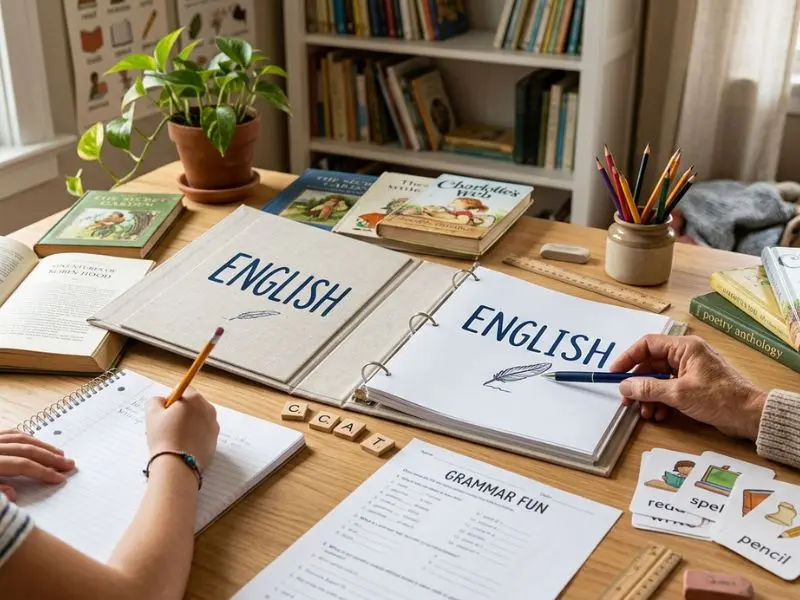
Choosing an English homeschool curriculum gets tricky when one program teaches everything together and another separates reading, writing, grammar, and spelling. I have seen how quickly this creates doubt: Are you covering enough, buying too much, or choosing a level that does not match your child?
When I assess English curriculum options, I start with the student’s actual strengths and gaps. A grade number alone rarely tells the full story. Looking at skill coverage, placement, teaching support, and workload first makes it much easier to narrow the choices without guessing.
Quick Takeaway: Choose an English homeschool curriculum based on your child’s current reading, writing, grammar, and spelling skills—not grade alone. Check what the program includes, its placement guidance, parent involvement, format, and total cost. An all-in-one program offers simplicity, while separate resources provide more flexibility for uneven skills.
- What Is an English Homeschool Curriculum?
- Common Subjects Taught in Homeschool English Curricula
- English Homeschool Curriculum by Grade Level
- Start With Your Child, Not a Curriculum
- How to Find the Right English Curriculum Level
- What If Your Child Is at Different Levels in English?
- Main Types of Homeschool English Curricula
- All-in-One vs. Separate English Programs
- Elements to Consider Before Choosing a Homeschool English Curriculum
- Check the Scope and Sequence Before You Buy
- Teach a Homeschool English Curriculum With Literature
- Homeschool English Curriculum With Charlotte Mason
- Best Homeschool English Curriculum Options
- Steps for Planning a Homeschool English Curriculum
- Example Routine for Homeschool English
- How Online Classes Fit Into a Homeschool English Curriculum
- Curriculum vs. Course vs. Online School
- How to Know If Your Homeschool English Curriculum Is Working
- Frequently Asked Questions About English Homeschool Curriculum
- Conclusion
What Is an English Homeschool Curriculum?
An English homeschool curriculum is a structured plan for teaching language skills at home. Depending on the program, it may cover reading, writing, grammar, spelling, vocabulary, literature, speaking, and listening.
You may also see the terms English Language Arts (ELA) and language arts curriculum. These terms often overlap, but publishers do not always include the same subjects.
For example, one program may combine reading, writing, spelling, and grammar. Another may provide writing and grammar but expect you to choose literature separately.
Always check what is included instead of relying only on the curriculum name.
Common Subjects Taught in Homeschool English Curricula
English includes several connected skills. The balance between them changes as children grow.
Younger students often spend more time learning to read, spell, and form sentences. Older students usually move toward literature, essays, research, analysis, and independent writing.
Not every program needs to teach every skill in one book. What matters is whether your overall English plan covers the skills your child needs.

Reading Aloud
Reading aloud introduces children to vocabulary, sentence patterns, stories, and ideas they may not yet be able to read independently.
It can remain useful after a child becomes an independent reader. You can discuss characters, events, unfamiliar words, and the meaning of a text together.
Phonics and Spelling
Phonics teaches the relationship between letters and sounds. It is especially important for beginning readers.
Spelling helps children recognize and use common spelling patterns. Some curricula combine phonics and spelling, while others teach them separately.
Dictation and Spelling
Dictation asks a student to listen to a sentence or short passage and write it accurately.
It can provide practice with spelling, capitalization, punctuation, and careful listening. The material should fit the skills the child has learned or is currently practicing.
Copywork and Handwriting
Copywork involves carefully copying a short piece of well-written text.
It can provide handwriting, spelling, and punctuation practice. However, copywork should not replace opportunities for children to develop and organize their own ideas in writing.
Living Books
The term living books is commonly associated with Charlotte Mason-style homeschooling. It generally refers to engaging books written by authors who communicate knowledge through rich and interesting writing rather than textbook-style exercises.
Families using this approach may build English lessons around novels, children’s literature, biographies, poetry, and nonfiction.
Narration
Narration asks a child to explain what they have read or heard in their own words.
Younger children may narrate orally. Older students can move toward written summaries and more detailed responses.
Narration can help you see whether your child understood the main ideas without depending only on worksheets or quizzes.
English Homeschool Curriculum by Grade Level
Grade level gives you a useful starting point, but it should not be the only factor when choosing an English curriculum for homeschool.
Children do not always develop reading, writing, grammar, and spelling at the same pace.
Kindergarten–Grade 2
Early English instruction usually focuses heavily on learning to read and developing basic written language skills.
Common areas include:
- phonemic awareness
- phonics
- beginning reading
- handwriting
- basic spelling
- vocabulary
- listening comprehension
- simple sentences
- read-aloud books
A first grader who is still developing reading skills may need more phonics practice than another child of the same age.
Focus on steady progress instead of rushing through a grade-level book.
Grades 3–5
During the elementary years, students gradually move from learning to read toward using reading to learn and communicate.
Common areas include:
- reading comprehension
- independent reading
- paragraph writing
- grammar and punctuation
- spelling
- vocabulary
- different forms of literature
- planning and revising writing
Writing should become more structured during these years. Students can begin organizing their ideas into clear paragraphs and longer compositions.
Grades 6–8
Middle school English usually requires students to think more deeply about what they read and write.
A curriculum may cover:
- novels, short stories, poetry, and nonfiction
- literary elements
- structured composition
- grammar and usage
- vocabulary
- research skills
- evidence-based responses
- revision and editing
Students can also begin taking more responsibility for their work. Reading assignments may become longer, and writing projects may require several steps.
Grades 9–12
High school English often places greater emphasis on literature and composition.
Courses may include:
- literary analysis
- fiction and nonfiction
- poetry and drama
- argumentative writing
- informative writing
- research papers
- grammar and usage
- vocabulary
- citing sources
- revision and editing
High school families should also think about recordkeeping, course descriptions, credits, graduation requirements, and future college or career plans.
Requirements can vary. Check the homeschool rules that apply to your family and any admission requirements that may matter for your student’s future plans.
Start With Your Child, Not a Curriculum
A curriculum can have excellent reviews and still be a poor match for your child.
Before comparing programs, look at what your child can already do and where help is still needed.
Consider:
- reading ability
- reading comprehension
- writing ability
- spelling
- grammar knowledge
- interests
- attention span
- independence
- preferred learning format
A sixth grader, for example, might read challenging novels but struggle to organize a paragraph. Another child may write creative stories easily but need direct spelling instruction.
Knowing these differences can prevent you from buying a complete program simply because the grade number looks right.
How to Find the Right English Curriculum Level
Your child’s age does not always determine the right curriculum level.
Start with a publisher’s placement test when one is available. You can also look at recent writing samples, reading comprehension, spelling, grammar, and independent reading ability.
Sample lessons are useful too. Look at the directions, reading level, writing expectations, and amount of help your child would need.
The work should provide room for growth without being so difficult that every lesson becomes frustrating.
A child may need different levels for different English skills. Placement should consider current ability as well as grade.
What If Your Child Is at Different Levels in English?
Uneven English skills are one reason curriculum selection can be difficult.
A child may read above grade level but struggle with writing. Another student may understand books well but continue to have difficulty with spelling or grammar.
Instead of forcing every skill into one level, identify the area that needs support.

| If Your Child… | Consider Focusing On… |
|---|---|
| Reads well but struggles with writing | Clear, step-by-step composition instruction |
| Writes well but makes frequent grammar errors | Targeted grammar practice |
| Understands books but struggles with spelling | Structured spelling instruction |
| Struggles with assigned reading | Suitable reading instruction and accessible texts |
| Knows grammar rules but does not apply them | Editing and grammar practice through real writing |
This is where a flexible approach can help. Your child might use one level for literature while using another resource for writing, spelling, or grammar.
Main Types of Homeschool English Curricula
There is no single format that works for every homeschool family.
Think about your child’s learning needs, but also consider how much planning and teaching you can realistically manage.
All-in-One English Curricula
An all-in-one program combines several English skills into one curriculum.
It may include reading, grammar, writing, spelling, vocabulary, and literature. Lessons usually follow an organized sequence, which can reduce planning.
The drawback is flexibility. If your child is at different levels across English skills, one part of the program may be too easy while another is too difficult.
Literature-Centered Curricula
A literature-centered curriculum uses books as a major part of English instruction.
Students may learn vocabulary, writing, narration, discussion, and literary concepts through what they read.
This can work well for children who enjoy books. Still, check whether the curriculum provides enough direct instruction in writing, grammar, spelling, or other areas your child needs.
Writing-Focused Curricula
Writing-focused programs place composition at the center of instruction.
Students may learn how to develop ideas, organize paragraphs, write essays, revise drafts, and communicate clearly.
Look for actual writing instruction rather than a program that simply gives writing assignments.
You may need separate literature, grammar, or spelling resources if these areas are not included.
Online or Video-Based Curricula
Online English programs may include recorded lessons, interactive exercises, digital reading, quizzes, or automated grading.
They can reduce some direct teaching and may suit students who work well independently.
However, online does not automatically mean parent-free. Check who evaluates written work and whether your child receives useful feedback.
Project-Based or Integrated Curricula
Integrated programs connect English with subjects such as history, science, or literature.
A student might read historical fiction, research the time period, discuss the book, and write a related report.
This approach can make subjects feel connected. Check the scope and sequence to make sure important English skills are still taught in a clear progression.
All-in-One vs. Separate English Programs
Many parents wonder whether they need one complete program or several separate resources.
Neither approach is automatically better.

| All-in-One Curriculum | Separate Programs |
|---|---|
| Easier to plan | More flexible |
| Fewer materials to manage | Different skill levels can be used |
| Lessons usually follow one sequence | Easier to target weak areas |
| Useful when skills are fairly even | Useful for uneven skills |
| Some material may already be mastered | Requires more planning |
An all-in-one curriculum may be convenient when your child’s skills are close to the same level.
Separate programs may work better when a strong reader needs extra writing instruction or a capable writer needs targeted spelling or grammar practice.
Choose the approach that solves the learning problem without creating an unrealistic workload for your family.
Elements to Consider Before Choosing a Homeschool English Curriculum
Once you understand your child’s needs, compare programs using the same criteria.
This makes it easier to narrow a long list of choices.
Balance of Reading and Writing
Look at how much meaningful reading and writing the curriculum requires.
A large number of lessons does not automatically mean balanced instruction. Check the actual books, passages, writing assignments, and skills being taught.
State Requirements and Documentation
Homeschool requirements vary by state.
Depending on where you live, you may need to keep certain records, teach particular subjects, complete assessments, or meet other requirements.
Check the current rules that apply to your homeschool before planning the year. High school families should also keep organized records of courses and completed work.
Explicit and Supportive Writing Instruction
Giving a child an essay topic is not the same as teaching writing.
Look for lessons that explain how to plan, draft, organize, revise, and edit.
A reluctant or developing writer may need models, examples, smaller steps, and more direct instruction.
Writing Feedback
Find out who will review your child’s writing before choosing a program.
Some curricula provide rubrics, grading guides, sample responses, automated tools, or teacher feedback. Others expect the parent to evaluate most writing.
This becomes more important as students begin writing essays, literary responses, and research assignments.
An independent curriculum can still require significant parent time if you are responsible for reviewing every composition.
Grammar and Vocabulary in Context
Some curricula teach grammar and vocabulary through separate exercises. Others connect these skills with literature and writing.
Either approach can work.
Pay attention to whether your child can apply what was learned. Knowing a grammar rule on a worksheet is different from using it correctly while writing.
Text Complexity
Reading material should provide enough challenge for growth without making every assignment frustrating.
Look at vocabulary, sentence structure, subject matter, and the amount of reading expected.
A sample lesson or book list can help you judge whether the material is appropriate.
Grade Level
Treat grade level as a guide rather than the only placement rule.
Use placement tests, recent work, curriculum samples, and scope and sequence documents when they are available.
Format
Think about how your child learns and how your homeschool day works.
Common formats include:
- printed textbooks
- workbooks
- online lessons
- video instruction
- downloadable materials
- literature and teacher guides
- hybrid print and digital programs
A curriculum only works if your family can use it consistently.
Worldview
Curriculum publishers may approach literature and other topics from different perspectives.
Some programs are secular. Others include religious instruction or a particular faith perspective.
Review sample lessons, reading lists, writing prompts, and publisher information before choosing.
Teaching Method
English curricula may follow traditional, classical, Charlotte Mason, mastery, spiral, literature-based, eclectic, or other approaches.
You do not need to choose a method because it is popular. Consider whether the approach fits the way your child learns.
Parent Involvement
The parent’s workload is part of curriculum fit.
Before buying, find out how much time you will need for:
- lesson preparation
- direct teaching
- reading discussions
- checking assignments
- grading
- writing feedback
Younger students usually need more direct support. Older students may work more independently, but longer writing assignments can still require parent feedback.
Price
Look at the total cost rather than only the price of the main book or subscription.
Additional costs may include:
- student workbooks
- teacher guides
- novels
- subscriptions
- printing
- writing materials
- supplemental resources
A low-cost main curriculum can become expensive if several required materials must be purchased separately.
Check the Scope and Sequence Before You Buy
A scope and sequence shows what a curriculum teaches and how those skills progress through the program.
Check whether it covers the areas your child needs, such as:
- reading
- writing
- grammar
- spelling
- vocabulary
- literature
Then look at when those skills are introduced and how they build over time.
This can help you spot missing areas, unnecessary repetition, or material your child has already mastered.
Compare the scope and sequence with your child’s current skills instead of relying only on a grade label.
If the publisher provides sample lessons, review them too. A real lesson can tell you a lot about difficulty, teaching style, instructions, and workload.

Before You Buy an English Homeschool Curriculum
- Does the level match my child’s actual skills?
- Does it cover the English skills my child needs?
- Are reading and writing both included?
- Will I need separate grammar, spelling, or literature resources?
- Can I review sample lessons before buying?
- Is a placement test available?
- How much direct teaching will I need to provide?
- Who checks and gives feedback on writing?
- Does the format fit how my child learns?
- Does the worldview fit our preferences?
- What is the total cost after required extras?
- Does the scope and sequence show clear skill progression?
Teach a Homeschool English Curriculum With Literature
Literature can connect several English skills naturally. Families interested in this approach can also explore how literature-based homeschool English can connect books with skills such as reading aloud, narration, dictation, spelling, and language study.
A child can read a book, discuss its ideas, learn unfamiliar vocabulary, examine characters, and complete related writing.
This can make English feel more connected than completing unrelated worksheets.
However, reading good books alone does not guarantee complete English instruction. Some students still need direct lessons in composition, grammar, spelling, or other areas.
Check what the literature-based curriculum explicitly teaches before deciding whether you need additional resources.
Homeschool English Curriculum With Charlotte Mason
Charlotte Mason-inspired English instruction often uses living books, narration, copywork, dictation, poetry, and meaningful language instead of relying heavily on worksheets.
A younger student might listen to a story, narrate it aloud, and complete short copywork. Older students can move toward written narration, composition, and deeper literature study.
This approach may suit families that prefer book-centered learning. A child who needs explicit instruction in a particular skill may still benefit from additional support.
Best Homeschool English Curriculum Options
There is no single best homeschool English curriculum for every child.
Instead of beginning with a list of popular brands, begin with the problem you need the curriculum to solve.
| Student or Family Need | Look For |
|---|---|
| Beginning reader | Strong phonics and early reading instruction |
| Reluctant writer | Step-by-step writing instruction |
| Strong reader | Challenging literature and analysis |
| Needs grammar support | Clear grammar instruction and practice |
| Independent learner | Student-friendly directions or guided online instruction |
| Busy parent | Planned lessons with lower preparation |
| Book-loving student | Literature-based curriculum |
| Uneven English skills | Flexible or separate skill placement |
| Family limiting screen time | Print or book-based materials |
| High school student | Literature, composition, research, and clear course structure |
Once you know what you need, create a shortlist of programs that meet those requirements.
How to Compare English Homeschool Curriculum Options
Compare each program using the same questions.
Grade or Skill Level
Does the curriculum match what your child can currently do?
Do not eliminate a suitable program simply because its level number is different from your child’s school grade.
Skill Coverage
Check whether the program includes reading, writing, grammar, spelling, vocabulary, and literature.
If something is missing, decide whether your child actually needs it and what additional resource would cover it.
Format
Decide whether print, online, video, literature-based, or hybrid instruction fits your child and your daily routine.
Parent Involvement
Find out who teaches the lessons, checks daily work, grades assignments, and provides writing feedback.
Worldview
Review the publisher’s approach, sample lessons, book choices, and writing prompts.
Total Cost
Add required books, workbooks, teacher materials, subscriptions, and supplements to the main curriculum price.
Samples and Placement
Use placement information and sample lessons when available.
This gives you a clearer picture of the curriculum than relying only on reviews or marketing descriptions.
Steps for Planning a Homeschool English Curriculum
You do not need a complicated planning system. Start with the skills your child needs and build from there.
Begin With a Clear Picture of Your Learner
Review recent reading and writing work.
Identify what your child already does well and where support is needed.
A publisher’s placement test can help, but use it alongside what you already know about your child’s abilities.
Select Texts With Purpose
Choose reading material that fits your child’s ability while providing room for growth.
Depending on age and goals, this may include fiction, nonfiction, poetry, biographies, essays, and informational texts.
Do not choose books only because they are assigned to a particular grade. Consider whether your child can understand and discuss them.
Set Writing Goals for the Year
Choose a few clear writing goals.
An elementary student might work toward organized paragraphs. A middle school student may develop multi-paragraph compositions. A high school student may work on analysis, argument, research, and revision.
Clear goals make progress easier to see.
Weave Grammar and Vocabulary Into Daily Work
Grammar and vocabulary do not always need long separate lessons.
Students can notice language patterns while reading and apply grammar while editing their own writing. Vocabulary can also grow through meaningful reading.
Use additional direct practice when your child needs it.
Check In and Adjust as You Go
Buying a curriculum does not mean you must follow it unchanged for the entire year.
Check whether your child understands the lessons, applies new skills, and works at a reasonable level of challenge.
Sometimes a small adjustment is enough. In other cases, one weak skill may need a different resource.
Example Routine for Homeschool English
English does not need to look exactly the same every day.
A simple week might include regular reading, several writing sessions, shorter grammar or spelling lessons, vocabulary from current books, and discussion.
For example, a student might read most days, work on writing three days a week, and complete shorter grammar or vocabulary practice on other days.
The right routine depends on age, curriculum design, and attention span. Focus on consistent learning rather than trying to fill a fixed number of hours.
How Online Classes Fit Into a Homeschool English Curriculum
Online classes can provide the main instruction for one area or supplement a broader English curriculum.
They may be helpful when a student needs:
- writing feedback
- live discussion
- literature instruction
- extra accountability
- instruction from another teacher
Check exactly what the class covers before enrolling.
A literature class, for example, may provide excellent reading and discussion but little grammar or composition instruction.
Judge an online option by its actual content, teaching, feedback, and workload rather than assuming that online instruction is automatically complete.
Curriculum vs. Course vs. Online School
These terms are related, but they do not always describe the same thing.
Curriculum refers to the materials and learning plan used to teach a subject.
Course is an organized study of a subject, such as English 9 or American Literature.
Online class delivers instruction through the internet. It may include live teaching, recorded lessons, assignments, or feedback.
Online school is a broader educational program in which students may enroll and take several courses.
This distinction becomes especially important during high school. Before signing up, check what the provider actually offers and what responsibilities remain with the homeschool parent.
How to Know If Your Homeschool English Curriculum Is Working
Finishing the workbook is not the same as mastering English.
Look at what your child can now do that was difficult earlier.
Signs of useful progress may include:
- stronger reading comprehension
- clearer writing
- better organization
- fewer repeated grammar or spelling errors
- stronger editing and revision
- wider vocabulary
- better discussion of reading
- greater independence
Keep a few writing samples from different points in the year. Comparing older and newer work can make progress easier to see.
If your child finishes lessons but cannot apply the skill independently, consider whether more practice, direct instruction, or a different approach is needed.
The goal is growth in real skills, not simply reaching the last lesson.
Frequently Asked Questions About English Homeschool Curriculum
Can I Make My Own Homeschool English Curriculum?
Yes. You can combine books, writing instruction, grammar, spelling, vocabulary, and other resources. Set clear goals and check your overall coverage so important skills are not accidentally missed.
How Much Does a Homeschool English Curriculum Cost?
Costs vary widely. Some families rely heavily on library books and free materials, while others buy complete programs, online subscriptions, teacher guides, or classes. Calculate the full-year cost, including required books and supplements, before buying.
How Do I Assess Learning and Assign Grades in Homeschool English?
You can use reading responses, quizzes, essays, projects, grammar work, discussions, and writing portfolios. For older students, rubrics can help make writing assessment more consistent. Keep appropriate records when grades or course documentation are needed.
Are Online Homeschool English Programs Effective?
Online programs can work well when the instruction matches the learner and provides meaningful reading and writing. Check skill coverage, feedback, workload, and parent responsibilities before deciding whether a program fits your child.
How Does Homeschool English Prepare Students for High School?
Middle school English can develop stronger reading, writing, grammar, vocabulary, research, revision, and independent study skills. Gradually increasing the complexity of reading and writing can help prepare students for high school work.
Is English the Same as Language Arts in Homeschool?
The terms often overlap, but they do not always mean exactly the same thing. An ELA or language arts curriculum may combine reading, writing, grammar, spelling, vocabulary, and literature. Check the contents of each program rather than relying on its name.
Do I Need Separate Grammar and Writing Curricula?
Not always. Some programs teach grammar and writing together. Separate resources may be helpful when your child needs more instruction in one area or works at different levels across English skills.
Conclusion
From comparing homeschool English programs, I have learned that the best fit becomes clearer when you stop chasing the “perfect” curriculum. Check your child’s skills, the program’s scope, writing support, placement, and parent workload. Choose what meets today’s needs, watch for real progress, and adjust when those needs change.