 Skip to content
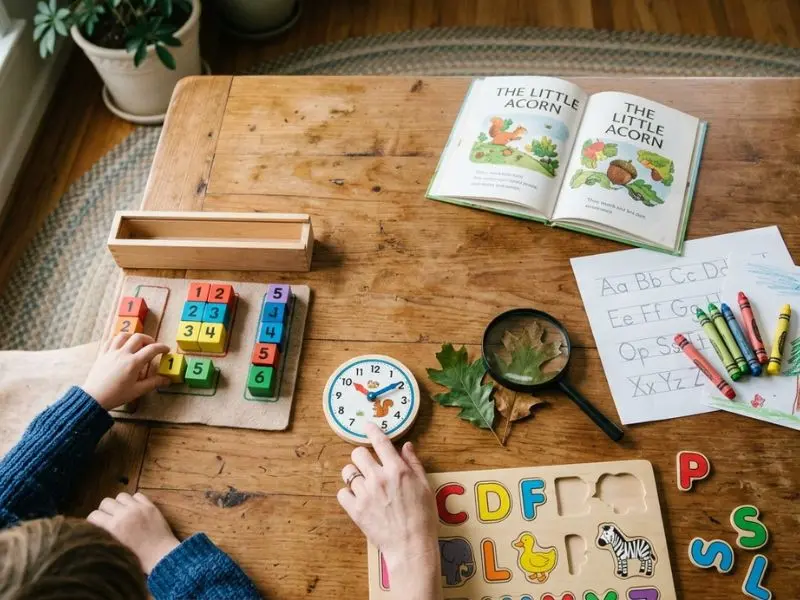
For many families, kindergarten homeschool hours are about 1 to 2 focused hours a day, often split into short lessons. When schoolwork finishes quickly, parents may worry they are not doing enough. I have found that progress and understanding matter more than stretching lessons just to fill the clock.
A kindergartener may finish core lessons in 45 to 90 minutes and keep learning through reading, play, movement, and hands-on activities. The right routine depends on your child and curriculum, along with any homeschool requirements that apply in your state.
- How Many Hours a Day Should You Homeschool Kindergarten?
- Formal Learning Time vs Total Learning Time
- Why Kindergarten Homeschool Can Take Less Time Than a School Day
- Are Shorter Lessons Better for Kindergartners?
- How Much Time Should Kindergarten Subjects Take?
- A Simple Kindergarten Homeschool Time Breakdown
- Sample 90-Minute Kindergarten Homeschool Schedule
- What Can a Kindergarten Homeschool Week Look Like?
- How Many Hours a Week Should You Homeschool Kindergarten?
- What Can Count as Kindergarten Homeschool Time?
- How Do I Know If My Kindergartener Is Learning Enough?
- What If My Kindergartener Can't Sit Still?
- Kindergarten Homeschool Hours With a Toddler or Baby
- Kindergarten Homeschool Hours for Working Parents
- What If Your Kindergarten Schedule Is Not Working?
- Are There Required Kindergarten Homeschool Hours?
- How Long Should a Kindergarten Homeschool Year Be?
- Frequently Asked Questions About Kindergarten Homeschool Hours
- Conclusion
Kindergarten Homeschool Hours at a Glance
- Focused learning: About 1–2 hours a day can be a practical starting point for many families.
- Core lessons: Reading, math, and writing can often fit into short learning blocks.
- Lesson length: Many activities may take around 10–20 minutes.
- Weekly example: Five 1–2 hour days equal about 5–10 focused hours.
- Beyond lessons: Reading, play, movement, art, and hands-on activities can continue throughout the day.
- Most important: Watch your child’s progress instead of stretching lessons just to fill the clock.
- Legal note: Recommended learning time is not the same as your state’s homeschool requirements.
How Many Hours a Day Should You Homeschool Kindergarten?
For many kindergartners, 1 to 2 hours of focused learning per day is a practical starting point. That time does not need to happen all at once.
A simple day might include:
- 15–20 minutes of phonics or early reading
- 10–20 minutes of math
- 5–15 minutes of handwriting or fine motor work
- 15–20 minutes of reading aloud
- A short science, social studies, art, or hands-on activity
These are suggested starting points, not required lesson lengths. Your child may need more or less time depending on the curriculum, skill level, and ability to focus.
If a math lesson takes only 10 minutes and your child understands the concept, there is no need to stretch it to 30 minutes just to fill the schedule.
Finishing early does not automatically mean you are doing too little.
Formal Learning Time vs Total Learning Time
One of the biggest sources of confusion about kindergarten homeschool hours is the difference between formal lessons and total learning time.
Formal learning usually includes activities such as phonics, math, handwriting, and direct instruction. These are the parts of the day parents often think of as “school.”
But learning does not stop when formal lessons end.
A kindergartener may also learn through:
- Reading with a parent
- Building with blocks
- Drawing and painting
- Puzzles
- Cooking
- Outdoor exploration
- Educational games
- Conversations
- Imaginative play
- Simple household activities
For example, your child might complete 75 minutes of focused lessons in the morning and later spend time reading, building, exploring outdoors, or helping measure ingredients while cooking.
So, 1 to 2 homeschool hours does not necessarily describe your child’s entire learning day. It usually describes the more structured part of it.

Why Kindergarten Homeschool Can Take Less Time Than a School Day
A traditional school day includes more than direct academic instruction.
Students move between activities, wait for classmates, follow group routines, eat lunch, attend recess, and take part in other school activities.
Homeschooling works differently.
When teaching one child, you can often provide help immediately. You can move forward when your child understands a skill instead of waiting for an entire class.
There may also be fewer transitions and less waiting.
Because of these differences, focused homeschool lesson time can be shorter than the total length of a traditional school day.
You are not trying to recreate every minute of classroom school at home. You are creating a focused learning routine that fits your child.
Are Shorter Lessons Better for Kindergartners?
Young children often do better when learning is divided into short activities.
A child may happily work on phonics for 15 minutes but lose focus when the same activity continues much longer.
Instead of making every lesson longer, break the day into smaller blocks.
A simple pattern could be:
Phonics → movement break → math → snack → handwriting → read-aloud

A kindergartener also does not need to spend the whole homeschool period sitting at a desk.
Math games, letter activities, reading on the floor, movement, art, and hands-on learning can change the pace.
Watch your child as well as the clock. If your child is engaged and wants to continue, you do not have to stop because a certain number of minutes has passed. If frustration is building, a short break may be more helpful than another worksheet.
How Much Time Should Kindergarten Subjects Take?
There is no universal required lesson length for individual kindergarten subjects. The times below are practical starting points that can be adjusted to your child and curriculum.
Reading and Phonics
A focused reading or phonics lesson might take around 15 to 20 minutes.
Early reading activities may include:
- Letter sounds
- Phonics
- Blending sounds
- Simple words
- Early readers
- Sight words when included in your curriculum
Read-aloud time can happen separately. Reading stories together also supports vocabulary, listening, comprehension, and interest in books.
Math
A kindergarten math lesson might take around 10 to 20 minutes.
Common kindergarten math activities include:
- Counting
- Number recognition
- Comparing quantities
- Simple addition and subtraction
- Shapes
- Patterns
- Sorting
- Basic measurement
Math does not always need to happen on paper. Blocks, toys, counters, and household objects can make basic concepts easier to see and practice.
Writing and Fine Motor Skills
A handwriting or fine motor session might take around 5 to 15 minutes.
Activities may include:
- Letter formation
- Writing a name
- Copying short words
- Drawing
- Tracing
- Cutting
- Other fine motor activities
A short, focused practice session can be more useful than pushing through several pages after a child has lost interest.
Science, Social Studies, Art, and Music
These subjects do not necessarily need separate formal lessons every day.
You can rotate them throughout the week.
For example, science might happen on Monday, art on Tuesday, nature study on Wednesday, and social studies later in the week.
This keeps kindergarten homeschool hours manageable without limiting your child to reading, writing, and math.
A Simple Kindergarten Homeschool Time Breakdown
A basic daily plan might look like this:
| Learning Area | Suggested Starting Time |
|---|---|
| Phonics/reading | 15–20 minutes |
| Math | 10–20 minutes |
| Handwriting/fine motor | 5–15 minutes |
| Read-aloud | 15–20 minutes |
| Science/social studies | 10–20 minutes |
| Art/music | Flexible |
| Outdoor and hands-on learning | Flexible |
These times are not rules.
Some days will be shorter. A science experiment, field trip, art project, or interesting book may make another day longer.
The schedule should support learning rather than forcing every day to look identical.
Sample 90-Minute Kindergarten Homeschool Schedule
Here is one example of how focused learning can fit into a relaxed morning.

8:30–8:45 — Morning Basket
Begin with a story, song, poem, calendar activity, or conversation about the day.
A simple opening routine can help your child know that learning time has started.
8:45–9:05 — Phonics and Reading
Spend about 20 minutes working on phonics or early reading.
If your child understands the lesson sooner, you can stop rather than adding unnecessary work.
9:05–9:25 — Snack and Movement Break
Give your child time to move, eat a snack, stretch, or play outside.
A break can help reset attention before the next lesson.
9:25–9:45 — Math
Use a short lesson followed by hands-on practice when appropriate.
Counting toys, creating patterns, sorting objects, or playing a number game can reinforce the skill.
9:45–10:00 — Handwriting or Fine Motor Practice
Practice letters, drawing, cutting, tracing, or another fine motor activity.
Keep the session manageable.
10:00–10:20 — Read-Aloud
Finish with a story or nonfiction book.
You can talk naturally about the book without turning every read-aloud into a worksheet or formal assignment.
After 10:20 — Play and Everyday Learning
Formal lessons may be finished, but the child’s day is not empty.
Outdoor play, puzzles, building, drawing, chores, imaginative play, books, and conversations can continue throughout the day.
What Can a Kindergarten Homeschool Week Look Like?
Every homeschool day does not need to be identical.
Reading, math, and writing can form the core routine while other activities rotate throughout the week.
| Day | Core Learning | Additional Activity |
|---|---|---|
| Monday | Reading, math, writing | Science |
| Tuesday | Reading, math, writing | Art |
| Wednesday | Reading, math, writing | Nature study |
| Thursday | Reading, math, writing | Social studies |
| Friday | Reading or review | Library, project, or field trip |
This is only an example.
Some families prefer five shorter days. Others may arrange formal learning differently based on work schedules, appointments, siblings, and applicable state requirements.
How Many Hours a Week Should You Homeschool Kindergarten?
If you homeschool for 1 to 2 focused hours on five days, that equals about 5 to 10 hours of focused learning per week.
For another grade-by-grade reference, Outschool’s homeschool hours guide also suggests 1 to 2 hours of structured learning per day for kindergarten, or about 5 to 10 hours per week.
That does not mean every kindergartener needs exactly 5 to 10 hours.
A child completing 60- to 90-minute lessons may spend less time on formal academics. Another family may have longer days because they include projects, enrichment, or other structured activities.
Daily lessons also do not need to happen in one continuous block.
You could complete phonics in the morning, math after lunch, and read together in the evening.
Weekly homeschool hours are best treated as a planning tool unless specific instructional requirements apply to your homeschool.
What Can Count as Kindergarten Homeschool Time?
Not all meaningful learning happens at a desk.
Educational activities can include:
- Phonics and reading lessons
- Reading together
- Math games
- Handwriting
- Science experiments
- Nature study
- Educational games
- Art and crafts
- Physical activity
- Educational field trips
- Practical life activities
A cooking activity, for example, can involve counting, measuring, following directions, and learning new words.
A nature walk can involve observation, conversation, science, and physical activity.

However, there is an important distinction.
An activity can be educational without automatically qualifying as legally countable instructional time under your state’s homeschool rules.
If your state requires instructional hours, days, or attendance records, check what its rules allow you to record.
How Do I Know If My Kindergartener Is Learning Enough?
This is often the real concern behind questions about kindergarten homeschool hours.
You may finish lessons quickly and wonder:
“Are we really doing enough?”
The clock alone cannot answer that question.
Look for gradual progress in skills such as:
- Recognizing letters and sounds
- Developing early reading skills
- Counting and understanding numbers
- Improving handwriting and fine motor control
- Listening to and understanding stories
- Remembering skills taught earlier
- Applying simple concepts independently
- Asking questions and showing curiosity
Children do not develop every skill at the same pace.
One area may move quickly while another requires more practice.
If your child understands the lesson and continues making progress, you do not need to make an activity longer simply to fill more homeschool hours.
If lessons regularly cause frustration or take much longer than expected, look at the lesson difficulty, curriculum, time of day, and your child’s readiness before assuming that more hours are needed.
When to Adjust Kindergarten Homeschool Hours
The clock alone cannot tell you whether your schedule is working. Use your child’s attention, understanding, and progress as practical clues.
| What You Notice | What It May Suggest | What to Try |
|---|---|---|
| Your child understands lessons and stays engaged. | The current schedule may be working well. | Keep the routine and continue watching progress. |
| Lessons finish earlier than planned with good understanding. | Extra lesson time may not be necessary. | Avoid adding busywork only to make the day longer. |
| Attention regularly drops during longer lessons. | The learning blocks may be too long. | Shorten lessons and add movement or rest breaks. |
| The same lessons repeatedly cause frustration. | The pace, difficulty, or time of day may need adjustment. | Change one factor at a time and see what improves. |
| Important skills are not progressing over time. | Your child may need more support or a different approach. | Review the curriculum, pace, lesson format, and your child’s needs. |
Note: These are practical scheduling clues, not a developmental assessment. Legal homeschool requirements should be checked separately for your state.
What If My Kindergartener Can’t Sit Still?
A child does not need to sit quietly at a desk throughout the homeschool day to learn.
Movement can be built into lessons.
Your child might:
- Count while jumping
- Practice letters with hands-on materials
- Read while sitting on the floor
- Sort objects for math
- Take movement breaks between lessons
- Learn outside
If a 15-minute lesson works well, there is little benefit in stretching it just to make the school day look longer.
The goal is productive learning, not keeping a child seated for a certain number of hours.
Kindergarten Homeschool Hours With a Toddler or Baby
Homeschooling kindergarten can feel different when you are also caring for a younger child.
Long blocks of uninterrupted teaching may not be realistic.
Try completing your most focused lesson during a quieter part of the day. This could be during a toddler’s nap, independent play, or another time when interruptions are less likely.
You can also split the day.
Complete reading in the morning, math later, and a family read-aloud in the evening.
A flexible routine is often easier to maintain than trying to protect one long school block every day.
Kindergarten Homeschool Hours for Working Parents
Homeschool lessons do not have to happen only between 8 a.m. and noon.
A working parent might do phonics before work, math in the afternoon, and reading in the evening.
Another family may complete most formal lessons on days when a parent’s schedule is lighter.
The important point is that reading, math, and writing do not have to happen in one continuous morning session.
Build your routine around the time when you can teach consistently and your child can focus, while still meeting any homeschool requirements that apply.
What If Your Kindergarten Schedule Is Not Working?
Even a carefully planned schedule will sometimes fall apart.
Children get tired. Appointments happen. Parents have busy days. Lessons occasionally take longer than expected.
A schedule should help your family, not control it.
We Can’t Finish Everything
First, check how much work you are trying to fit into one day.
Prioritize core learning goals and rotate less urgent activities during the week.
Not every optional workbook page, craft, enrichment activity, or project needs to happen every day.
My Child Hates the Schedule
Look for the specific problem before replacing everything.
A lesson may be:
- Too long
- Too difficult
- Too easy
- Too repetitive
- Scheduled at the wrong time
Try changing one part of the routine and watch what happens.
Our Mornings Are Too Busy
You do not have to start homeschool at the same time as a traditional school.
Try starting later or splitting lessons across the day.
Consistency can be useful, but consistency does not require an 8:00 a.m. start.
Are There Required Kindergarten Homeschool Hours?
There is no single nationwide number of kindergarten homeschool hours that applies to every homeschool family in the United States.
Homeschool requirements are determined mainly at the state level.
Your requirements may depend on:
- Your child’s age
- Compulsory attendance rules
- The homeschool option you use
- Required instructional days
- Required instructional time
- Required subjects
- Attendance rules
- Recordkeeping requirements
Do not assume that the recommended 1 to 2 hours of focused learning is also the legal requirement in your state.
Educational recommendations and legal requirements are two different things.
Kindergarten Age vs Compulsory School Age
Kindergarten age and compulsory school age are not always the same.
A five-year-old may be subject to different requirements depending on the state and the homeschool option the family uses.
Before setting your yearly or daily schedule, check your state’s current compulsory attendance age and homeschool requirements through an official state source when possible.
Do not automatically use public school hours as your homeschool requirement. Rules for public schools and homeschools may differ.
How Long Should a Kindergarten Homeschool Year Be?
There is no single homeschool calendar that every U.S. family must follow.
Some families follow a traditional school-year calendar. Others homeschool year-round and take shorter breaks throughout the year.
A family might also prefer four focused academic days and use another day for projects, field trips, appointments, or enrichment when allowed under applicable requirements.
Your legal obligations may include a certain number of instructional days, hours, records, or other requirements depending on where you live.
Build your yearly schedule around the rules that apply to your homeschool rather than copying another family’s calendar.
Frequently Asked Questions About Kindergarten Homeschool Hours
Is One Hour of Homeschool Enough for Kindergarten?
One hour may be enough for focused formal lessons on some days, depending on your child and curriculum. If your child understands the material and continues making progress, finishing core lessons quickly does not automatically mean you are doing too little. Check state requirements separately.
Is Two Hours of Homeschool Enough for Kindergarten?
For many families, two hours provides plenty of room for short reading, math, handwriting, read-aloud, and enrichment activities. The right amount depends on your child, curriculum, and any legal requirements that apply.
Should Kindergarten Homeschool Take Six Hours?
A homeschool kindergarten day does not generally need to copy the total length of a traditional classroom day. Focused one-to-one lessons can often be completed in less time, while play, reading, movement, and other learning continue throughout the day.
What Time Should Kindergarten Homeschool Start?
There is no universal best starting time. Choose a time when your child is usually rested and able to focus. Some families begin after breakfast, while others start later or divide lessons throughout the day.
Should I Homeschool Kindergarten Five Days a Week?
Not necessarily. Families organize their weeks differently. Your schedule should support your child’s learning and meet any attendance or instructional requirements that apply in your state.
Does Play Count as Kindergarten Homeschool Time?
Play can support language, problem-solving, creativity, social development, movement, and other skills. However, whether a particular activity legally counts toward required instructional time depends on the homeschool rules that apply to your family.
What If We Finish Kindergarten Homeschool Early?
Finishing early is not automatically a problem. If your child understands the lesson and is making progress, there is no need to add busywork just to make the homeschool day longer.
Conclusion
After working through homeschool schedules, I have learned that adding more minutes does not automatically add more learning. One to two focused kindergarten homeschool hours can be a practical starting point. Let progress guide your routine, adjust lessons to your child, and always check the homeschool requirements that apply where you live.