 Skip to content
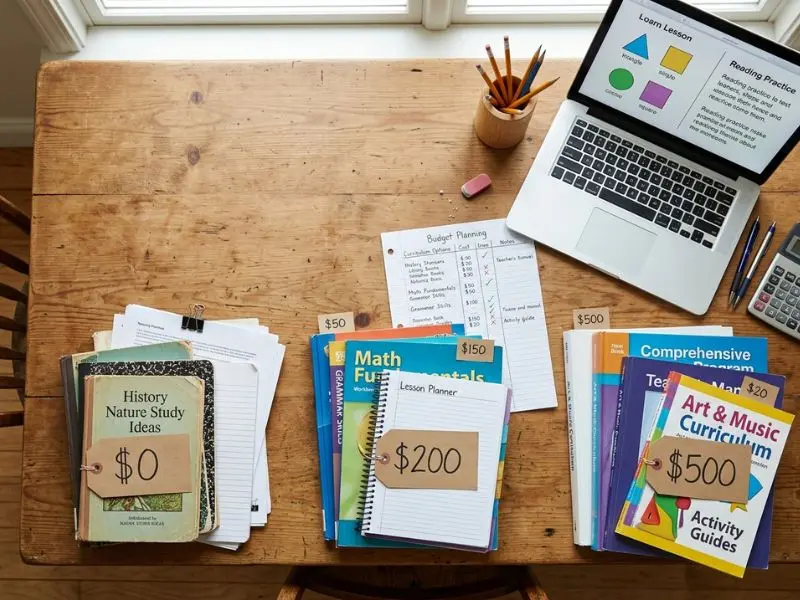
The cheapest homeschool curriculum can cost $0 when you combine free online resources, library books, and open materials. Easy Peasy, Khan Academy, CK-12, and Ambleside Online are useful places to start.
When I compare budget options, I also check printing, books, supplies, and parent time. A free curriculum is not always the cheapest to use. The better choice is one that fits your child without adding unexpected costs later.
- Quick Takeaway
- What Does Homeschool Curriculum Actually Cost?
- Cheapest Homeschool Curriculum Comparison
- The Cheapest Legitimate Curriculum Options
- The $0 Budget: Free Cheap Homeschool Curriculum Options
- How to Build a Full Homeschool Year for Under $200
- Building a Complete Homeschool Year on a $500 Budget
- Cheapest Homeschool Curriculum by Grade Level
- Cheapest Secular Homeschool Curriculum
- Cheapest Christian Homeschool Curriculum
- Affordable Subject-by-Subject Picks
- The Spine and Add-Ons Method
- All-in-One vs Mix-and-Match: Which Is Cheaper?
- Used Homeschool Curriculum: The Best Places to Buy
- What Is the True Cost of a Cheap Homeschool Curriculum?
- Homeschool Supplies: What Do You Really Need?
- Cheapest Homeschool Curriculum for Multiple Children
- Curriculum Packages: When They Are Worth It
- Matching Budget to Fit: The Expensive Mistake
- What Is Worth Paying For?
- 7 Mistakes That Make Cheap Curriculum Expensive
- Affordable Homeschooling Tips: Make Your Budget Stretch
- A Note on Free Homeschool Programs
- Cheapest Homeschool Curriculum by Family Need
- How to Choose the Cheapest Curriculum That Will Actually Work
- Frequently Asked Questions
- Conclusion
Quick Takeaway
- Lowest purchase cost: A mix of free curriculum resources can bring curriculum cost close to $0.
- Best for tight budgets: Use free resources for most subjects and pay only where your child needs more structure.
- Best for busy parents: A low-cost structured or all-in-one program may save planning time.
- Best for multiple children: Look for reusable materials and family licenses.
- Watch for hidden costs: Books, printing, supplies, subscriptions, and consumable workbooks can change the real price.
- Best rule: Compare total yearly cost and curriculum fit, not just the advertised price.
What Does Homeschool Curriculum Actually Cost?
Homeschool curriculum can range from free resources to paid programs that cost hundreds of dollars per child each year.
There is no single amount every family needs to spend.
Your total cost depends on:
- Your child’s grade or skill level
- Number of children
- Subjects you need
- Online or printed materials
- Books and workbooks
- Science and art supplies
- Monthly or yearly subscriptions
- Whether materials can be reused
- How much planning you can do yourself
A free program may work well for one family. Another family may spend a little more for a structured program that saves hours of weekly planning.
The goal is not simply to find the lowest advertised price. Look for the lowest total cost that still works for your child and family.
Cheapest Homeschool Curriculum Comparison
The options below are useful starting points for families trying to reduce curriculum costs.
Some provide broad homeschool structure. Others work better as subject resources inside a larger homeschool plan.
| Curriculum | Cost Type | Format | Worldview | Possible Extra Costs | Best For |
|---|---|---|---|---|---|
| Easy Peasy All-in-One Homeschool | Free online | Online and printable | Christian | Printing and supplies | Families wanting free structure |
| Ambleside Online | Free curriculum plan | Books and online | Christian | Books and printing | Charlotte Mason families |
| Khan Academy | Free | Online | Secular | Device and internet | Math and subject support |
| CK-12 | Free | Online | Secular | Device and printing | Free math and science resources |
| The Good and the Beautiful | Free and paid options | Digital and print | Christian | Printing, books, paid materials | Families wanting structured courses |
Pricing note: Free downloads, subscriptions, included materials, and curriculum prices can change. Check each provider’s current information before purchasing or planning a full school year.
Compare the True Cost, Not Just the Price
A curriculum with a $0 price tag is not always the cheapest option to use.
A better comparison looks at the full cost.
Curriculum price + required books + printing + supplies + subscriptions + required extras = true curriculum cost
Parent planning time should also be considered.
| Cost Factor | What to Check |
|---|---|
| Curriculum price | Free, one-time purchase, or subscription |
| Required books | Included, borrowed, or purchased separately |
| Printing | Paper, ink, and number of pages |
| Supplies | Science, art, workbooks, or manipulatives |
| Parent prep | Time needed to organize and teach |
| Reuse | Whether materials can be used with siblings |
A low-cost paid curriculum may sometimes cost less overall than a free program that requires many extra books, printed pages, and supplies.

The Cheapest Legitimate Curriculum Options
Several established resources can help parents homeschool without buying an expensive curriculum package.
Easy Peasy All-in-One Homeschool
Easy Peasy provides free online homeschool lessons across many subjects and levels.
Lessons are organized for families to follow online. Parents may still choose to purchase printed materials or supplies.
Easy Peasy uses a Christian worldview, so parents should review the content before deciding whether it fits their family.
Best for: Families who want a free curriculum with built-in structure.
Khan Academy
Khan Academy provides free lessons, instructional videos, exercises, and practice activities.
It is especially useful for math. It also includes resources in science, computing, economics, and other areas.
Khan Academy is best treated as an educational resource rather than a complete homeschool curriculum for every subject.
Best for: Families building their own curriculum or needing free support in specific subjects.
CK-12
CK-12 provides free digital learning materials, including textbooks, lessons, simulations, and practice resources.
Its strongest coverage is in math and science.
Families can combine CK-12 with other resources to build a low-cost homeschool plan.
Best for: Families looking for free STEM resources.
Ambleside Online
Ambleside Online provides a free Charlotte Mason-style curriculum plan across multiple levels through high school.
The curriculum plan itself is free, but families may need books.
Library borrowing and public-domain titles can help reduce those costs.
Ambleside Online follows a Christian perspective.
Best for: Families who want literature-rich learning and have access to affordable books.
The Good and the Beautiful
The Good and the Beautiful offers some curriculum materials as free downloads, while other resources are paid.
This can make it affordable for families who are comfortable using digital files or printing some materials themselves.
Check required books, printing needs, and paid materials before deciding whether it is the cheapest choice for your family.
Best for: Families wanting structured courses without purchasing a large high-cost package.
Which Homeschool Budget Fits Your Family?
| Budget Level | What It Can Look Like | Parent Planning | Best Fit |
|---|---|---|---|
| Around $0 | Free online resources + library materials | High | Families with more planning time than money |
| Under $200 | Free resources + 1–2 paid core subjects | Medium | Families wanting affordable structure |
| Around $500 | More structured curriculum + books and supplies | Lower to medium | Families willing to pay more for convenience |
A larger budget does not automatically mean a better education. The right level depends on what your child needs and how much curriculum planning you want to handle.

The $0 Budget: Free Cheap Homeschool Curriculum Options
A family with almost no curriculum budget can still build a useful learning plan.
A $0 curriculum plan could include:
- Khan Academy for math
- CK-12 for science
- Library books for reading and literature
- Free writing activities
- Public-domain books
- Free educational websites
- Free printable materials
- Local library resources
Families can also use free materials from trusted public institutions. The Library of Congress provides free education resources including primary sources, lesson plans, classroom materials, and learning activities that can supplement a low-cost homeschool plan.
This means $0 curriculum purchase cost, not necessarily $0 total homeschool spending.
Internet access, printing, paper, basic supplies, books, and activities may still create expenses.
The Main Trade-Off Is Parent Time
A free plan usually requires more organization.
Parents may need to:
- Find suitable materials
- Match lessons to the child’s level
- Organize weekly work
- Print resources
- Combine several subjects
- Track progress
For families with more time than money, this can work well.
For busy parents, a low-cost structured curriculum may provide better value.
Best fit: Families with very limited budgets who can spend more time planning and organizing lessons.
How to Build a Full Homeschool Year for Under $200
A small budget gives families more flexibility than a completely free plan.
Instead of buying a complete commercial curriculum for every subject, spend money where your child needs the most structure.
Sample Homeschool Budget Under $200
| Category | Example Budget |
|---|---|
| Math | $60 |
| Language Arts | $60 |
| Science | $20 |
| History | $20 |
| Printing and Basic Supplies | $40 |
| Total | $200 |
This is only an example. Your actual cost may be lower or higher.
How to Stay Under Budget
- Choose one or two subjects worth paying for.
- Use free resources for other subjects.
- Borrow books from the library.
- Buy used teacher guides when practical.
- Avoid unnecessary workbooks and extras.
- Try samples before purchasing.
- Reuse materials when the license and format allow it.
Best fit: Families who want some paid structure without buying a full expensive curriculum package.
Building a Complete Homeschool Year on a $500 Budget
A $500 budget gives families more room for printed books, structured courses, supplies, and paid resources.
That does not mean you need to spend all $500.
Start with the subjects where your child needs the most support.
Sample $500 Homeschool Budget
| Category | Example Budget |
|---|---|
| Core Curriculum | $250 |
| Books and Readers | $75 |
| Science and Art Supplies | $75 |
| Printing | $50 |
| Flexible Reserve | $50 |
| Total | $500 |
This is a sample plan, not a required target.
A child who needs strong math support may benefit more from a paid math course than from a large bundle filled with materials your family will not use.
Best fit: Families who want more convenience and structure while still controlling yearly curriculum costs.
Cheapest Homeschool Curriculum by Grade Level
The cheapest approach changes as children get older.
Preschool may require almost no formal curriculum. High school may require more advanced courses, records, and specialized materials.

Preschool
Preschool homeschooling can be very inexpensive.
Young children learn through play, reading, conversation, counting, drawing, music, and everyday activities.
Library books and simple household materials can cover many early learning needs.
Cheapest approach: Library books, play-based learning, and activities using materials you already own.
Kindergarten
Kindergarten families can combine free phonics, early math activities, handwriting practice, read-aloud books, and hands-on learning.
Focus on basic skills instead of purchasing large curriculum bundles.
Cheapest approach: Free phonics and math resources, library books, and basic handwriting materials.
Elementary School
Elementary grades have many free and low-cost options.
A structured free program can provide a starting point. Khan Academy and CK-12 can support certain subjects, while library books can reduce reading and history costs.
Cheapest approach: Use a free curriculum spine, library books, and free subject resources.
Middle School
Middle school students often need deeper subject instruction.
Free resources can still cover many needs, especially in math and science.
Some families may decide to pay for writing, foreign language, or advanced math.
Cheapest approach: Use free core resources and spend only on subjects that need more structure.
High School
High school may cost more because students can need advanced courses, science materials, test preparation, or outside instruction.
Free resources can still reduce costs.
Families should also consider state homeschool requirements, record keeping, transcripts, graduation plans, and future college or career goals.
Cheapest approach: Combine free core resources with carefully chosen paid courses where advanced instruction is needed.
Cheapest Secular Homeschool Curriculum
Families looking for secular resources can use Khan Academy and CK-12 as parts of a broader homeschool plan.
A low-cost secular approach may combine:
- Free math lessons
- Free science resources
- Library literature
- Free writing resources
- Parent-selected history materials
- Free electives
This approach can have a very low cash cost.
The trade-off is that parents may need to combine several resources and create their own structure.
Best fit: Families comfortable building a curriculum from different secular resources.
Cheapest Christian Homeschool Curriculum
Christian families also have free and low-cost choices.
Easy Peasy provides free Christian homeschool lessons with built-in structure.
Ambleside Online provides a free Charlotte Mason-style curriculum plan with a Christian perspective.
The Good and the Beautiful also offers some free downloadable materials alongside paid resources.
Compare printing, required books, supplies, and optional materials before deciding which one offers the lowest true cost.
Best fit: Families looking for faith-based materials without paying for an expensive curriculum package.
Affordable Subject-by-Subject Picks
Buying curriculum one subject at a time can sometimes cost less than purchasing a full package.
Math
Math is one area where structure can matter.
Khan Academy and CK-12 provide free math resources across multiple levels.
Some families may choose to spend money on a structured math program while keeping other subjects free.
Check your child’s skill level before purchasing.
Language Arts and Reading
The public library can reduce reading costs significantly.
Borrow books for literature and read-aloud time.
Then use free or inexpensive phonics, grammar, vocabulary, and writing resources where needed.
Science
CK-12 and other open educational resources can reduce textbook costs.
Hands-on science may still require household materials or experiment supplies.
Check supply lists before treating a science program as completely free.
History and Social Studies
History can use library books, biographies, maps, primary sources, documentaries, and free educational materials.
A simple curriculum spine can help organize those resources into a clear order.
Electives
Art, music, coding, typing, and other electives do not always require paid courses.
Start with free resources.
Spend money only when your child needs instruction, equipment, or materials that free options cannot provide.
The Spine and Add-Ons Method
The spine-and-add-ons method helps families avoid buying too much.
A curriculum spine is the main resource that gives your homeschool structure.
You then add only what is missing.
Step 1: Pick a Spine
Choose one main resource that provides structure.
It could be an all-in-one program or a strong curriculum covering your most important subjects.
The spine should make planning easier, not create more work.
Step 2: Add Only What You Need
Do not automatically buy every optional workbook, reader, activity pack, or supplement.
Find the gaps first.
Then use free resources or purchase only the materials that solve a specific need.
All-in-One vs Mix-and-Match: Which Is Cheaper?
A free mix-and-match approach can have a very low cash cost, but it often requires more parent planning.
A budget all-in-one curriculum may cost more upfront but can reduce preparation time.
| Approach | Money Cost | Parent Planning | Flexibility | Best For |
|---|---|---|---|---|
| Free mix-and-match | Very low | High | Very high | Tight budgets |
| Low-cost mix-and-match | Low | Medium | High | Families wanting balance |
| Budget all-in-one | Moderate | Lower | Moderate | Busy parents |
If you have more planning time than money, mixing free resources may work well.
If your time is limited, paying for structure may be worth the extra cost.
Used Homeschool Curriculum: The Best Places to Buy
Used curriculum can lower costs for textbooks, teacher guides, readers, and reusable materials.
Families may find used resources through:
- Homeschool groups
- Local curriculum sales
- Online marketplaces
- Homeschool co-ops
- Other homeschool families
Before buying used curriculum, check the edition and condition.
Also check whether online access codes can be reused or transferred.
Consumable workbooks may need to be purchased new.
What Is the True Cost of a Cheap Homeschool Curriculum?
A curriculum with a low price can still create extra expenses.
Common hidden costs include:
- Printer ink
- Paper
- Workbooks
- Required books
- Art supplies
- Science materials
- Internet access
- Devices
- Online subscriptions
Printing is especially easy to overlook.
If a free course requires hundreds of printed pages, compare that expense with the cost of buying an inexpensive printed resource.
Parent Planning Time Matters Too
Free curriculum often costs more in time.
You may need to find books, organize lessons, print worksheets, combine subjects, and track progress.
A low-cost paid curriculum may cost more upfront but save several hours of planning.
For busy families, time should be part of the value comparison.
Homeschool Supplies: What Do You Really Need?
You do not need to recreate a classroom at home.
Start with basic supplies such as:
- Pencils
- Paper
- Notebooks
- Folders
- Coloring materials
- Age-appropriate learning tools
Use what you already own before buying more.
Buy specialized supplies only when a lesson actually requires them.
This prevents unused materials from turning a cheap homeschool plan into an expensive one.
Cheapest Homeschool Curriculum for Multiple Children
The cheapest option can change when you homeschool more than one child.
A curriculum that looks expensive for one student may offer better long-term value if it can be reused.
Before buying, check whether the curriculum is:
- Reusable
- Consumable
- Licensed per child
- Licensed per family
- Subscription based
- Available as printable files
Reusable vs Consumable Curriculum
Reusable curriculum includes materials that may be used again with another child, such as textbooks and teacher guides.
Some digital resources may also be reusable if the license allows it.
Consumable curriculum includes materials a student writes in or uses up, such as workbooks.
These may need to be purchased again for each child.
Think About Cost Per Child
A $120 reusable curriculum used by three children can have better long-term value than a $60 workbook that must be purchased three times.
Look beyond the first-year price.
Best fit for larger families: Materials that can legally and practically be reused across siblings.
Curriculum Packages: When They Are Worth It
Curriculum packages can save planning time because many materials arrive together.
But convenience can become expensive when the package contains books or subjects your child will not use.
Before buying a bundle, ask one question:
Will we actually use most of this package?
If the answer is no, buying individual subjects may cost less.
Matching Budget to Fit: The Expensive Mistake
The cheapest curriculum is expensive if your child cannot use it.
A $30 workbook that gets abandoned may provide less value than a $60 program your child uses consistently.
Learning level, independence, parent involvement, teaching style, and subject difficulty all matter.
Price should be part of the decision, not the whole decision.
A good budget curriculum is both affordable and usable.
What Is Worth Paying For?
Not every subject needs to be free.
It may make sense to spend money where your child needs more structure or support.
That could include:
- Structured phonics
- Math instruction
- Writing feedback
- Advanced high school subjects
- Science lab materials
- Foreign language instruction
- Automatic grading
- Record-keeping tools
For example, a family might use free history and science resources, borrow literature from the library, and spend most of the budget on math.
Spend where structure solves a real problem.
Save where free resources already meet your needs.
7 Mistakes That Make Cheap Curriculum Expensive
1. Buying Before Trying Samples
A low price is not a bargain if the curriculum does not fit your child.
2. Printing Everything
Print only the pages you actually need.
3. Buying Every Optional Extra
Teacher extras, activity packs, and supplements can quickly increase the final cost.
4. Ignoring Used Materials
Reusable books and teacher guides may be available secondhand.
5. Buying Only by Grade
Choose materials based on your child’s skills as well as grade level.
6. Switching Curriculum Too Often
Replacing programs again and again can cost more than choosing carefully at the start.
7. Looking Only at the Advertised Price
Include printing, books, supplies, subscriptions, and other required materials in your comparison.
Affordable Homeschooling Tips: Make Your Budget Stretch
Set your budget before you start shopping.
Use your public library regularly.
Borrow books instead of building a large home library all at once.
Reuse non-consumable materials when possible.
Look for curriculum samples and free trials before buying.
Combine paid resources with free ones instead of assuming every subject needs a commercial curriculum.
Most importantly, stop buying when your plan already covers what your child needs.
A Note on Free Homeschool Programs
A tuition-free online public school is generally a public-school option, not automatically independent homeschooling.
These programs may have public-school rules, testing requirements, schedules, attendance expectations, or state curriculum requirements.
Before enrolling, check how your state classifies the program and what legal requirements apply to your family.
Cheapest Homeschool Curriculum by Family Need
There is no single cheapest curriculum for every family.
The best choice changes based on your budget, number of children, available planning time, learning preferences, and curriculum goals.
| If You Need… | Budget Approach to Consider |
|---|---|
| Lowest possible curriculum cost | Free mix-and-match resources |
| Less parent planning | Budget all-in-one curriculum |
| Secular resources | Free secular subject resources |
| Christian curriculum | Free or low-cost Christian programs |
| Curriculum for several children | Reusable or family-license materials |
| Mostly offline learning | Library books and reusable print resources |
| Strong help in one subject | Spend on that subject and save elsewhere |
The goal is not to choose whatever costs the least today.
Choose the option that avoids unnecessary spending while still working for your family.
How to Choose the Cheapest Curriculum That Will Actually Work
Use a simple process before buying.
Step 1: Set Your Maximum Yearly Budget
Decide what you can comfortably spend before looking at curriculum packages.
This makes it easier to ignore options that do not fit your budget.
Step 2: Decide What Type of Curriculum You Want
Choose between:
- Secular or faith-based
- Online or printed
- All-in-one or mix-and-match
- Parent-led or more independent learning
Step 3: Find the Subjects That Need More Structure
Your child may need stronger support in math but do well with free history resources.
Do not spend the same amount on every subject just for the sake of balance.
Step 4: Decide How Much Planning Time You Have
A completely free curriculum may require more parent organization.
If your schedule is already full, a low-cost structured program may be easier to maintain.
Step 5: Calculate the Real Cost
Include:
- Curriculum price
- Books
- Printing
- Supplies
- Subscriptions
- Required extras
Do not compare only the advertised price.
Step 6: Check Whether Materials Can Be Reused
This is especially important for families with several children.
Reusable resources can lower the cost per child over time.
Step 7: Try Samples Before Buying
Use free samples, previews, or trial lessons when available.
A few test lessons can save you from buying a curriculum that does not fit.
Before You Buy a Cheap Homeschool Curriculum
- Check what subjects are actually included.
- Confirm that the level fits your child’s current skills.
- Add the cost of required books and workbooks.
- Estimate printing and supply costs.
- Check whether pricing is per child or per family.
- Find out whether materials can be reused with siblings.
- Consider how much parent preparation is required.
- Try a free sample or trial when available.
- Check cancellation or refund terms before paying for a subscription.
- Compare the total cost, not just the advertised price.

Frequently Asked Questions
What Is the Cheapest Homeschool Curriculum?
Free resources such as Easy Peasy, Khan Academy, CK-12, Ambleside Online, library materials, and open educational resources can reduce curriculum purchase costs close to $0. Extra expenses may still include books, printing, supplies, and internet access.
Can You Really Homeschool for Free?
Families can build a curriculum with almost no purchase cost by combining free educational resources and library materials. However, printing, internet access, supplies, books, and activities may still cost money.
Is Cheap Homeschool Curriculum Lower Quality?
Not necessarily. Price does not determine whether a curriculum fits a child. A free or inexpensive curriculum can work well when its content, level, structure, and teaching approach meet the student’s needs.
What Is the Cheapest Online Homeschool Curriculum?
Free online resources can reduce curriculum costs close to $0. Easy Peasy offers broader homeschool structure, while Khan Academy and CK-12 can support specific subjects. Parents should check whether an option is a complete curriculum, individual resource, or public virtual school.
What Is the Cheapest Offline Homeschool Curriculum?
A low-cost offline plan can use library books, used textbooks, reusable teacher guides, inexpensive workbooks, and household materials. Families should compare book and printing costs before assuming offline learning will cost less.
What Is the Cheapest Way to Homeschool High School?
Combine suitable free online resources, library materials, open educational resources, and carefully chosen paid courses. Families should also consider state requirements, records, graduation plans, and future college or career goals.
Is Free Homeschool Curriculum Better Than Paid Curriculum?
Neither is automatically better. Free curriculum can reduce spending, while paid programs may provide more structure, support, grading, or convenience. The better choice depends on the child and the parent’s available time.
How Can I Afford Homeschool Curriculum for Multiple Children?
Choose reusable materials, family licenses, library books, and free resources where possible. Compare the total cost across several children and several years instead of looking only at the first purchase price.
Is an All-in-One Homeschool Curriculum Cheaper?
Sometimes. A budget all-in-one program may cost less than buying several individual programs. A mix of free and low-cost resources can cost less in cash but often requires more parent planning.
Is the Cheapest Homeschool Curriculum Accredited?
Curriculum itself is not always accredited in the same way a school or educational institution may be. If accreditation matters to your family, check whether you are enrolling in an accredited school or program rather than assuming a curriculum product is accredited.
Conclusion
After comparing these options, I have learned to check the full cost before calling any curriculum cheap. Books, printing, supplies, planning time, and future reuse all matter. My approach is simple: spend where structure truly helps, use free resources where they work, and choose a curriculum you will not need to replace.