 Skip to content
The hardest part of homeschooling is not teaching, it is planning the day. Many parents feel stuck trying to figure out what comes first and how long everything should take. Without a clear plan, the day can quickly feel scattered and stressful.
What changed everything for me was using sample daily homeschool schedules as a starting point. Instead of guessing, I had a simple direction. Over time, I learned to adjust it based on real life, and that is when homeschooling finally started to feel manageable.
- Key Takeaways
- Here is a sample daily homeschool schedule:
- What Is a Homeschool Schedule?
- Why You Need a Homeschool Schedule
- How to Create a Homeschool Schedule
- Types of Homeschool Schedules
- Sample Daily Homeschool Schedule
- Our Typical Homeschool Day
- Homeschool Daily Routine Examples
- Sample Weekly Homeschool Schedule
- Homeschool Schedule for Multiple Kids
- Homeschool Schedule for Working Parents
- Flexible Homeschool Schedule
- Homeschool Schedule vs Routine
- How Many Hours a Day Should You Homeschool?
- Recommended Daily Hours by Age
- Tips for Creating Your Schedule
- Simple Daily Homeschool Schedule Template
- Common Scheduling Mistakes
- Signs Your Homeschool Schedule Needs Adjustment
- How to Adjust a Homeschool Schedule
- Creating a Schedule That Works
- FAQs
- Conclusion
Key Takeaways
- A perfect homeschool schedule is not needed.
- Most homeschool days take about 2–5 focused hours.
- Simple routines often work better than strict plans.
- Breaks and flexibility help children learn better.
- You can adjust your schedule anytime based on your child’s needs.
Here is a sample daily homeschool schedule:
9:00 – Math
10:00 – Reading
11:00 – Break
11:30 – Science
12:30 – Writing
Total: 3–4 hours
What Is a Homeschool Schedule?
A homeschool schedule is a simple plan for your day. It shows when your child studies, takes breaks, and does activities. It does not have to be strict. Most families use it as a guide, not a rulebook. If you want a complete step-by-step breakdown, you can also read our Homeschool Schedule & Daily Routine Guide for a deeper understanding.
Why You Need a Homeschool Schedule
A schedule brings clarity to your day. It helps both you and your child know what comes next.
Without a plan, the day can feel rushed or unorganized. With a simple structure, learning becomes smoother and less stressful.
How to Create a Homeschool Schedule
Start small. You do not need to plan every minute.
Follow these steps:
- Choose 3–5 main subjects
- Decide your start time
- Add short breaks
- Keep total hours realistic
Watch your child’s energy and leave room for real-life commitments. Some children learn better in the morning, while others need a slower start. Experienced homeschoolers also recommend building your homeschool schedule around regular family commitments before filling the remaining time with lessons and activities.
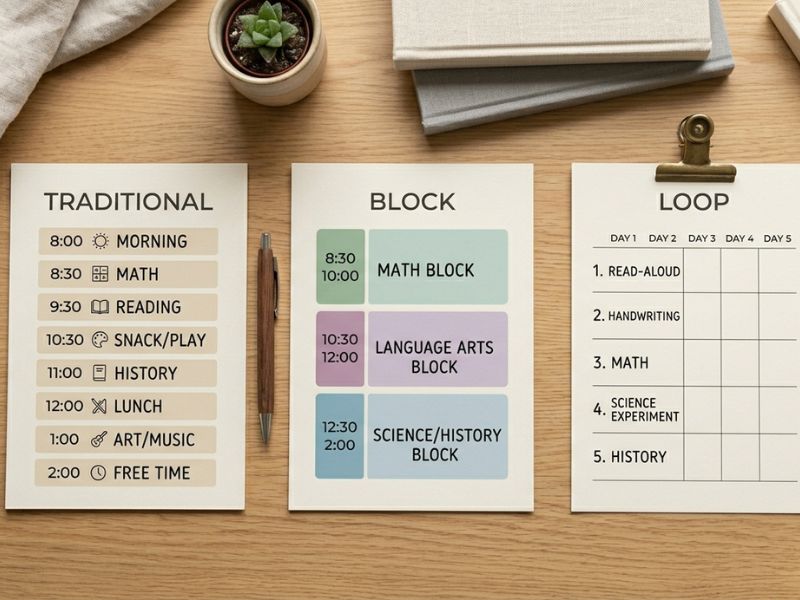
Types of Homeschool Schedules
Traditional Schedule
This looks like a school day. Each subject has a fixed time.
Block Schedule
You focus on fewer subjects each day but spend more time on them.
Loop Schedule
Subjects rotate in a loop. If something is missed, you simply continue the next day.
Year-Round Schedule
You spread learning across the year with shorter breaks.
Sample Daily Homeschool Schedule
Example for Elementary Student
9:00 – Math
10:00 – Reading
11:00 – Break
11:30 – Science
12:30 – Writing
Total: Around 3–4 hours
Alternative Simple Schedule Example
9:00 – Math Practice
10:00 – Reading Time
11:00 – Break
11:30 – Hands-on Science
12:30 – Writing Activity
Total: 3–4 hours
Our Typical Homeschool Day
Morning Time Routine
Start with light learning. This can include reading together, reviewing past work, or simple discussion.
Independent Work Time
Children work on subjects like math or writing. This is a good time to give focused attention to one child while others work independently.
Afternoon Activities
Use this time for creative work, projects, or outdoor learning. This keeps the day balanced and less tiring.

Homeschool Daily Routine Examples
Homeschool Daily Routine Examples
Daily routines can look very different as children grow. Younger students usually need shorter lessons and more breaks, while older students can handle longer periods of focused and independent work. These examples give you a practical starting point for each stage. You can also see what typically changes from one age to the next in our Homeschooling by Grade Level guide.
Sample Schedule for Elementary Students
8:30 – Morning routine and read-aloud
9:00 – Math
9:45 – Short break
10:00 – Reading and language arts
10:45 – Snack and outdoor break
11:15 – Science or history
12:00 – Lunch
1:00 – Art, project, or independent reading
Total focused learning time: About 2–4 hours
Sample Schedule for Preschool Students
9:00 – Play-based Learning
9:30 – Story Time
10:00 – Break
10:30 – Colors and Numbers Activity
11:00 – Outdoor Play
Total: 1–2 hours
Sample Schedule for Middle School Students
9:00 – Math
10:00 – Language Arts
11:00 – Break
11:30 – Science
12:30 – History
Total: 4–5 hours
Sample Schedule for High School Students
8:30 – Math
9:30 – English
10:30 – Break
11:00 – Science
12:00 – History
1:00 – Elective
Total: 5–6 hours
Sample Weekly Homeschool Schedule
Not every subject needs to happen every day. A weekly homeschool schedule can spread lessons across the week while keeping core subjects consistent.
| Day | Main Subjects |
|---|---|
| Monday | Math, Reading, Science |
| Tuesday | Math, Writing, History |
| Wednesday | Math, Reading, Science |
| Thursday | Math, Writing, History |
| Friday | Review, Projects, Art, or Field Trips |
This approach works well when a daily schedule feels too crowded. You can keep math and language arts regular while rotating science, history, electives, and hands-on activities.
Homeschool Schedule for Multiple Kids

Teaching more than one child can feel overwhelming at first.
A simple way to manage this is:
- Teach shared subjects together
- Give older kids independent work
- Rotate your attention
Sample Schedule for Multiple Kids
| Time | Younger Child | Older Child |
|---|---|---|
| 9:00 AM | Reading with parent | Independent math |
| 9:30 AM | Play or activity | Math with parent |
| 10:00 AM | Shared science | Shared science |
| 11:00 AM | Break | Break |
| 11:30 AM | Art or quiet play | Writing or reading |
| 12:30 PM | Lunch | Lunch |
The goal is not to teach every child separately all day. Combine subjects such as science, history, art, and read-alouds when possible. Then rotate one-on-one time for math, reading, and other age-specific lessons.
You do not need to do everything at once. A flexible approach makes it easier.
Homeschool Schedule for Working Parents
If you are working, your homeschool day may look different and that is okay.
You can:
- Study in the morning or evening
- Use weekends for projects
- Focus on fewer subjects each day
Sample Homeschool Schedule for Working Parents
| Time | Activity |
|---|---|
| 7:00 AM | Breakfast and independent reading |
| 7:30 AM | Math |
| 8:15 AM | Language Arts |
| Daytime | Independent reading or assigned activities |
| 5:30 PM | Science or History |
| Weekend | Projects, experiments, or field trips |
A working parent’s schedule does not have to look like a traditional school day. Lessons can be divided between mornings, evenings, and weekends depending on work hours, the child’s age, and how much independent work the child can handle.
Even a short, consistent schedule can work well over time.
Flexible Homeschool Schedule

Not every day will go as planned. That is completely normal.
A flexible schedule allows:
- Adjustments based on mood
- More time for difficult subjects
- Less pressure on both parent and child
Many families find that flexibility leads to better learning.
Sample Relaxed Homeschool Schedule
A relaxed schedule follows the order of activities instead of exact times.
Morning: Breakfast → Math → Reading → Break
Late Morning: Writing → Science or History
Afternoon: Lunch → Outdoor Time → Projects or Electives
If one lesson takes longer than expected, simply move the next activity forward. This gives your family structure without making the day depend on the clock.
Homeschool Schedule vs Routine
A schedule is time-based. It follows fixed hours.
A routine is more flexible. It focuses on order instead of exact time.
Most homeschool families use a mix of both to keep things balanced.
How Many Hours a Day Should You Homeschool?
Homeschooling often takes less time than traditional school because learning is more focused.
Typical hours:
- Preschool: 1–2 hours
- Elementary: 2–4 hours
- Middle School: 3–5 hours
- High School: 4–6 hours
Focus on steady progress, not long hours.
Recommended Daily Hours by Age
| Level | Hours per Day |
|---|---|
| Preschool | 1–2 hours |
| Elementary | 2–4 hours |
| Middle | 3–5 hours |
| High School | 4–6 hours |
Tips for Creating Your Schedule
- Keep it simple
- Add breaks
- Watch your child’s energy
- Stay consistent but flexible
A good schedule should feel manageable, not stressful.
Simple Daily Homeschool Schedule Template
Use this simple template as a starting point, then change the times and subjects to match your child’s age and learning pace.
| Time | Subject or Activity | Done |
|---|---|---|
| ______ | Morning Routine | ☐ |
| ______ | Math | ☐ |
| ______ | Reading or Language Arts | ☐ |
| ______ | Break | ☐ |
| ______ | Science or History | ☐ |
| ______ | Lunch | ☐ |
| ______ | Project or Elective | ☐ |
| ______ | Outdoor or Independent Time | ☐ |
Today’s Priority: ______________________
Needs More Practice: ______________________
Move to Tomorrow: ______________________
Do not worry if every box is not checked. Move unfinished work to another day rather than making the homeschool day unnecessarily long.

Common Scheduling Mistakes
Avoid these mistakes:
- Trying to copy school timing
- Overloading the day
- Skipping breaks
- Being too strict
Simple and realistic plans work better.
Signs Your Homeschool Schedule Needs Adjustment
A homeschool schedule should make your day easier, not harder. If your routine feels stressful every day, it may need a small change.
- Your child feels tired or frustrated often.
- You are rushing to finish every subject.
- The day feels stressful instead of calm.
- You skip subjects regularly because the plan is too full.
- Your child needs more breaks than the schedule allows.
If this happens, simplify your plan. Remove extra pressure, shorten lessons, and focus on the subjects that matter most.
How to Adjust a Homeschool Schedule
The first schedule you create may not work perfectly, and that is normal. Watch your child’s energy and progress for a week or two before making changes.
Try these simple adjustments:
- Short attention span: Use shorter 15–30 minute lessons.
- Independent learner: Add longer independent work periods.
- Needs movement: Put active breaks between harder subjects.
- Morning learner: Schedule math and writing earlier.
- Slow starter: Begin with reading or another lighter subject.
- Multiple children: Combine shared subjects and rotate individual lessons.
Change one or two things at a time instead of rebuilding the entire schedule. The goal is to find a daily rhythm your family can realistically maintain.
Creating a Schedule That Works
A working schedule fits your real life. It should match your child’s pace and your daily routine.
Start small. Adjust often. Over time, your own rhythm will develop naturally.
FAQs
Do you need a strict schedule for homeschooling?
No, most families follow a flexible schedule that adjusts based on the child’s pace and daily needs.
What is the best homeschool schedule for beginners?
A simple 2–4 hour schedule with core subjects and short breaks works best for beginners.
Can you homeschool without a schedule?
Yes, many families use a routine instead of a strict schedule to keep learning more natural.
How long should a homeschool day be?
It usually ranges from 1–2 hours for preschool to 4–6 hours for high school.
What time should homeschooling start?
There is no fixed time; most families start between 8:00 AM and 10:00 AM based on their routine.
Conclusion
A homeschool schedule should fit your life, not the other way around. From what I have seen and practiced, the most effective approach is keeping things simple and adaptable. Using sample daily homeschool schedules gives you a base, but your daily rhythm is what truly makes it work over time.