 Skip to content
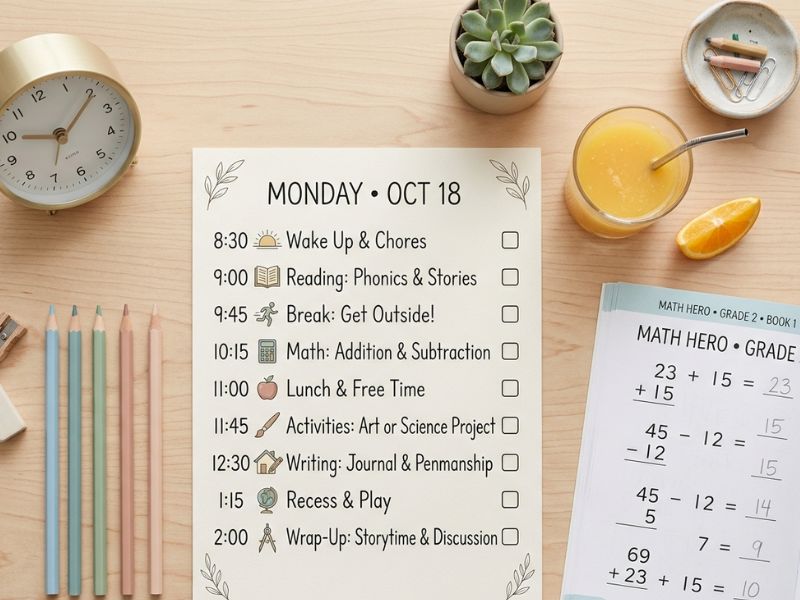
Planning a 2nd grade homeschool schedule can feel messy at first. I remember trying to fit everything into one day and feeling like I was always behind. It made learning stressful instead of enjoyable, for both me and my child.
What changed everything was simplifying the day. I stopped chasing a perfect plan and focused on short, meaningful lessons. Once I followed a flexible routine, our homeschool days became calmer, more focused, and much easier to manage.
- Quick Takeaway
- Daily Rhythm
- What Should a 2nd Grader Learn?
- Types of 2nd Grade Homeschool Schedules
- Morning Time
- Language Arts
- Math
- Science
- Social Studies
- Independent Work
- Family Subjects
- Art
- Physical Activity
- Afternoon Activities
- How Many Hours Should a 2nd Grader Homeschool?
- Sample 2nd Grade Homeschool Schedule
- More 2nd Grade Homeschool Schedule Examples
- Weekly 2nd Grade Homeschool Schedule
- How to Start a 2nd Grade Homeschool Schedule (Beginner Guide)
- Tips for Creating a Simple Schedule
- Common Mistakes to Avoid
- Signs Your Homeschool Schedule Needs Adjusting
- Do vs Don’t for a 2nd Grade Homeschool Schedule
- Free 2nd Grade Homeschool Schedule Template
- How to Customize for Your Child
- Homeschool Schedule Tips for Different Situations
- FAQs About 2nd Grade Homeschool Schedule
- Parent Reminder
- Conclusion
Quick Takeaway
- A 2nd grade homeschool schedule should be simple and flexible.
- 2 to 4 hours of daily learning is usually enough.
- Focus on core subjects first, like reading, math, and writing.
- Add breaks and keep lessons short.
- Adjust the schedule based on your child’s needs.
Daily Rhythm
A daily rhythm is not about strict timing. It is about flow. Your day should feel natural, not forced.
A simple rhythm can look like:
- Morning learning (core subjects)
- Midday break and play
- Afternoon light activities
This approach helps reduce stress and keeps learning consistent without pressure. You don’t need to control every minute, just follow a gentle routine.
What Should a 2nd Grader Learn?
A 2nd grade homeschool schedule usually gives the most time to reading, writing, and math. Science, social studies, art, and physical activity can be added throughout the week instead of fitting every subject into every day.
A simple weekly plan may include:
- Reading: fluency and comprehension
- Writing: sentences, short paragraphs, and handwriting
- Math: place value, addition, subtraction, measurement, and problem-solving
- Science: nature, life science, earth science, and simple experiments
- Social Studies: communities, maps, geography, and basic history
- Extras: art, music, physical activity, and life skills
These are general learning areas, not strict rules. Your child’s curriculum, pace, interests, and state requirements may affect what you include.
Types of 2nd Grade Homeschool Schedules
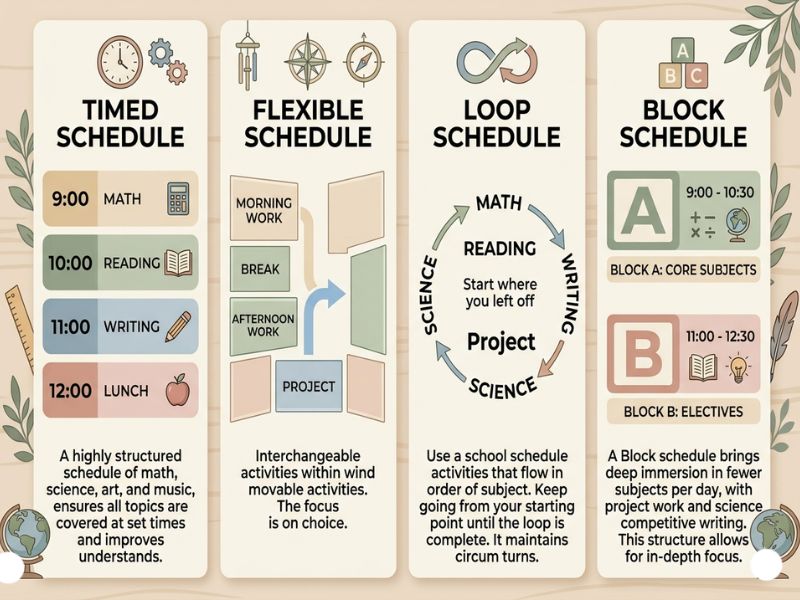
Not every family follows the same routine. Choosing the right type of schedule can make your homeschool day easier and more effective.
Timed Schedule
This follows fixed time blocks for each subject. It works well for families who like structure and routine.
Flexible Schedule
This focuses on flow instead of strict timing. You move to the next subject when the current one is complete. This works well for parents who want less pressure.
Loop Schedule
Subjects are placed in a loop instead of fixed days. If you miss a subject, you simply continue from where you left off. This is helpful for busy families.
Block Schedule
You focus on fewer subjects each day. For example, Math and Reading one day, Science and Writing the next.
Choose the type that fits your lifestyle and your child’s learning style.
Morning Time
Morning time sets the tone for the day. It helps your child ease into learning.
You can include:
- Reading together
- Calendar or date practice
- Simple discussions
- Quiet or reflection time
Keep this short and calm. Around 15–20 minutes is enough. A peaceful start can make the rest of the day easier.
Language Arts
Language Arts builds strong reading and writing skills.
Focus on:
- Reading practice
- Phonics or spelling
- Short writing tasks
Keep lessons around 20–30 minutes so your child stays focused. If your child struggles, go slower and keep it simple.
Math
Math should be simple and consistent. Daily practice builds confidence.
Focus on:
- Addition and subtraction
- Counting and patterns
- Simple problem-solving
Hands-on tools can make learning easier and more fun. If your child gets frustrated, take breaks and return later.
Science
Science should feel like exploration, not pressure.
Try:
- Nature walks
- Simple experiments
- Watching and discussing topics
Curiosity matters more than perfection here.
Social Studies
Social studies helps children understand the world.
Teach:
- Maps and places
- Community roles
- Basic history stories
Short and simple lessons work best.
Independent Work
This is time when your child works alone. It builds confidence and focus.
Examples:
- Worksheets
- Quiet reading
- Small tasks
Start with 10–15 minutes and increase slowly. Independence grows over time.
Family Subjects
These are subjects you can learn together.
Examples:
- History
- Science discussions
- Group reading
This works well for families with multiple children. You don’t need separate lessons for everything.
Art
Art supports creativity and gives a break from core subjects.
Ideas:
- Drawing
- Painting
- Crafts
Let your child enjoy the process without pressure.
Physical Activity
Movement should be part of your child’s daily routine. The CDC recommends at least 60 minutes of physical activity each day for children ages 6 to 17.
This can include:
- Outdoor play
- Bike riding
- Running or walking
- Simple exercises
- Active games
You do not need to fit all 60 minutes into one homeschool block. Movement can be spread throughout the day through play, exercise, outdoor time, and family activities.
Afternoon Activities
Afternoons should be lighter. Avoid heavy subjects.
Good options:
- Free play
- Reading
- Creative activities
- Life skills
This keeps the day balanced and relaxed.
How Many Hours Should a 2nd Grader Homeschool?
Most 2nd graders need only 2 to 4 hours per day. Young children learn better with short, focused sessions instead of long school-style hours.
Suggested Lesson Lengths for 2nd Grade
| Subject | Suggested Starting Time |
|---|---|
| Reading | 20–30 minutes |
| Math | 20–30 minutes |
| Writing / Handwriting | 10–20 minutes |
| Spelling / Phonics | 10–20 minutes |
| Science | 20–30 minutes |
| Social Studies | 20–30 minutes |
| Independent Reading | 15–20 minutes |
These times are starting points, not strict rules. Some children can focus longer, while others do better with shorter lessons and more breaks. Adjust each subject based on your child’s attention, progress, and learning needs.
This time includes:
- Core subjects
- Breaks
- Activities
You don’t need a full school day to homeschool successfully.
Sample 2nd Grade Homeschool Schedule

Morning
- Morning Time – 15 minutes
- Language Arts – 25 minutes
- Math – 25 minutes
Midday
- Break + Snack – 30 minutes
- Science or Social Studies – 20 minutes
Afternoon
- Art / Music – 20 minutes
- Physical Activity – 30 minutes
- Reading – 15 minutes
More 2nd Grade Homeschool Schedule Examples
Simple 2–3 Hour Schedule
- Morning Time – 10 minutes
- Reading – 20 minutes
- Math – 20 minutes
- Break – 20 minutes
- Writing – 15 minutes
- Activity / Play – 30 minutes
Working Parent Schedule
- Morning: Reading – 20 minutes
- Afternoon: Math – 25 minutes
- Evening: Science / Reading – 20 minutes
- Weekend: Projects and activities
This works well if you have limited time during the day.
Relaxed Homeschool Schedule
- Morning: Reading and discussion
- Midday: Math and light writing
- Afternoon: Play, art, outdoor time
A relaxed schedule reduces stress and keeps learning enjoyable.
Multiple Kids Schedule
- Group learning: Morning Time + Reading
- One-on-one: Math separately
- Afternoon: Shared subjects like science and art
You don’t need separate schedules for every child.
4-Day Homeschool Schedule
Some families complete their main lessons Monday through Thursday and leave Friday open for field trips, projects, appointments, catch-up work, or family activities.
| Day | Main Focus |
|---|---|
| Monday | Reading, Writing, Math, Science |
| Tuesday | Reading, Math, Social Studies, Art |
| Wednesday | Reading, Writing, Math, Science |
| Thursday | Reading, Math, Social Studies, Review |
| Friday | Field trips, projects, catch-up, or day off |
A four-day routine can give families more flexibility, but your weekly plan should still meet any homeschool requirements that apply in your state.
Weekly 2nd Grade Homeschool Schedule
| Day | Focus |
|---|---|
| Monday | Math + Reading |
| Tuesday | Writing + Science |
| Wednesday | Math + Art |
| Thursday | Reading + Social Studies |
| Friday | Review + Fun Activities |
How to Start a 2nd Grade Homeschool Schedule (Beginner Guide)
If you are new to homeschooling, start simple. You do not need a perfect plan.
Follow these steps:
- Start with 2–3 core subjects
- Keep total time under 3 hours
- Add breaks between lessons
- Watch your child’s focus level
- Adjust slowly over time
Starting small helps you stay consistent without feeling overwhelmed.
Tips for Creating a Simple Schedule
- Keep lessons short
- Add breaks
- Stay flexible
- Follow your child’s pace
- Focus on consistency
Simple systems work best for most families.
Common Mistakes to Avoid

- Over-scheduling the day
- Copying school routines
- Skipping breaks
- Expecting too much too fast
Homeschooling should feel calm, not overwhelming.
Signs Your Homeschool Schedule Needs Adjusting
A schedule may look good on paper but still feel difficult in real life. Give your routine some time, then watch how your child responds.
Consider making changes if:
- Lessons regularly take much longer than expected.
- Your child loses focus during most subjects.
- Math or reading is often pushed to the end of the day.
- You regularly skip science, social studies, or activities.
- Your child needs more movement between lessons.
- You feel rushed trying to finish everything.
Change one thing at a time. You may need to shorten a lesson, move a difficult subject earlier, add another break, or remove unnecessary work. A good schedule should make your homeschool day easier to manage.
Do vs Don’t for a 2nd Grade Homeschool Schedule
| Do | Don’t |
|---|---|
| Keep lessons short | Overload your schedule |
| Take regular breaks | Skip rest time |
| Stay flexible | Follow strict school routines |
| Focus on progress | Expect perfection |
Free 2nd Grade Homeschool Schedule Template
You can use this simple and flexible template to plan your homeschool day. Fill it based on your child’s needs and your daily routine.
Daily Homeschool Template
Morning (Core Learning)
- Morning Time: __________________
- Reading / Language Arts: __________________
- Math: __________________
Midday (Light Learning + Breaks)
- Break / Snack: __________________
- Science or Social Studies: __________________
- Writing / Practice: __________________
Afternoon (Creative + Activity Time)
- Art / Music: __________________
- Physical Activity: __________________
- Reading / Quiet Time: __________________
Weekly Planning Template
| Day | Main Focus | Notes |
|---|---|---|
| Monday | __________________ | __________________ |
| Tuesday | __________________ | __________________ |
| Wednesday | __________________ | __________________ |
| Thursday | __________________ | __________________ |
| Friday | __________________ | __________________ |
Simple Planning Tips
- Keep total learning time between 2–4 hours
- Add short breaks between subjects
- Adjust based on your child’s energy
- Focus on progress, not perfection
How to Customize for Your Child
Every child learns differently.
You can adjust by:
- Slowing down difficult subjects
- Adding breaks for active kids
- Keeping lessons shorter if needed
Homeschool Schedule Tips for Different Situations
For Working Parents
Use short lessons and focus on evenings or weekends.
For Busy Moms
Keep things flexible and focus on core subjects first.
For Active Kids
Add more movement and shorter lessons.
For Struggling Learners
Slow down and give more time to one subject.
FAQs About 2nd Grade Homeschool Schedule
How long should a 2nd grade homeschool day be?
A homeschool day usually lasts 2 to 4 hours including breaks.
Is a strict schedule necessary?
No. A flexible routine works better for most families.
What subjects should be included in a 2nd grade homeschool schedule?
Most schedules include reading, writing, math, science, and social studies. You can also add art and physical activity for balance.
Can I change my homeschool schedule every day?
Yes. Many families adjust their schedule daily based on their child’s mood, energy, and progress. Flexibility is one of the biggest benefits of homeschooling.
What if my child does not follow the schedule?
This is normal. If your child struggles, shorten lessons, add breaks, or change the timing. A schedule should support your child, not create stress.
Parent Reminder
You are not behind. Every child learns at a different pace. A simple and consistent routine is more valuable than a perfect schedule. Focus on progress, not pressure.
Conclusion
A 2nd grade homeschool schedule becomes easier once you stop trying to do everything at once. In my experience, focusing on a few key subjects and keeping lessons short creates better results than long, crowded days.
As you continue, your routine will naturally improve. Pay attention to your child’s energy and progress. A schedule that adapts over time will always work better than one that stays fixed.