 Skip to content
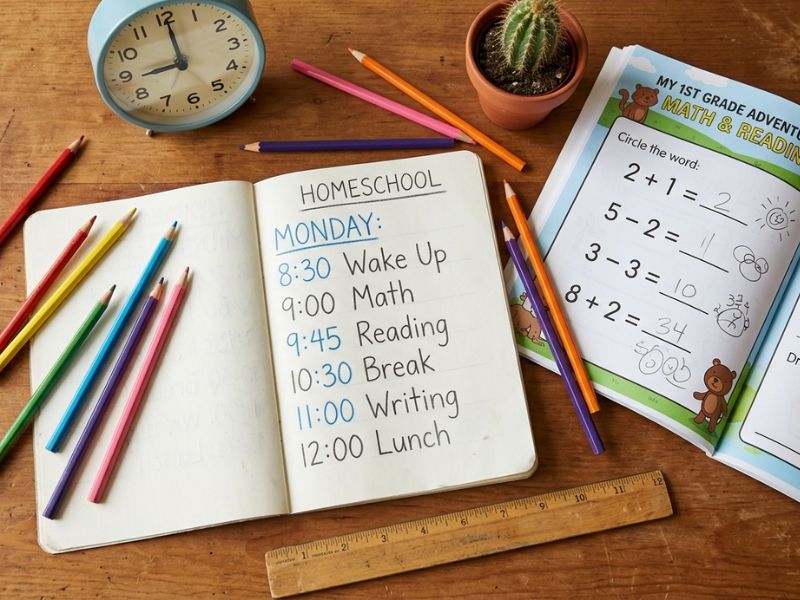
Planning a 1st grade homeschool schedule can feel harder than expected. I remember trying to fit everything into one day and still feeling like it wasn’t enough. The confusion about time, subjects, and structure can quickly turn into stress for both parent and child.
With experience, I realized that first grade does not need a heavy plan. A calm, simple routine works far better than a strict one. This guide will help you build a schedule that feels natural, manageable, and easy to follow every day.
- Key Takeaways
- What Should a 1st Grader Learn
- What Subjects Are Taught in 1st Grade
- Which Subjects Should a 1st Grader Do Every Day?
- How Long Should a 1st Grader Homeschool
- Worried You're Not Doing Enough?
- What Counts as Learning in First Grade?
- How Long Should Lessons Be
- Ideal Time Breakdown for Each Subject
- Sample Daily Homeschool Schedule
- 1st Grade Homeschool Daily Schedule at a Glance
- Different Types of Homeschool Schedules
- Weekly Homeschool Schedule
- Weekly Homeschool Plan at a Glance
- Morning Routine
- Tips for Creating a 1st Grade Homeschool Schedule
- Step-by-Step: Create Your Own Homeschool Schedule
- Common Mistakes to Avoid
- How to Adjust the Schedule When It Isn’t Working
- A Real-Life Example of a Homeschool Day
- Frequently Asked Questions
- Conclusion
Key Takeaways
- A 1st grade homeschool schedule usually needs only 2 to 4 hours a day.
- Short lessons of 15 to 25 minutes work better for young children.
- Reading, math, and writing should be your main focus.
- Breaks and play time are an important part of the day.
- A simple and flexible routine often works better than a strict schedule.
What Should a 1st Grader Learn
In first grade, children focus on basic reading, writing, and math skills that create a foundation for later learning. For example, the Common Core Grade 1 math standards include addition and subtraction, place value, measurement, time, data, and basic geometry.
Here are the main subjects:
- Reading and phonics
- Writing and simple sentences
- Basic math (addition and subtraction)
- Science (nature and simple concepts)
- Social studies (family, community)
Most homeschool families rotate subjects during the week instead of teaching everything every day. This keeps learning simple and less stressful.
What Subjects Are Taught in 1st Grade
A typical 1st grade homeschool schedule includes:
- Reading: Learning words and improving fluency
- Math: Counting, addition, subtraction
- Writing: Letters, words, and short sentences
- Science: Hands-on learning and exploration
- Creative time: Art, music, or play
Keep lessons short and fun. Young children learn best through activity.
Which Subjects Should a 1st Grader Do Every Day?
Reading, phonics, writing, and math usually need the most regular practice in first grade. These core skills improve through short, consistent lessons rather than long study sessions.
Science, social studies, art, music, and other activities do not always need to happen every day. You can rotate them during the week. For example, teach science on Tuesday, social studies on Thursday, and use Friday for art, nature study, or another hands-on activity.
This keeps the schedule balanced without asking your child to complete every subject each day.
How Long Should a 1st Grader Homeschool
Many 1st grade homeschool routines use about 2 to 3 hours of focused learning, divided into short lessons, breaks, reading, and hands-on activities. Some children may need less or more depending on the curriculum, learning style, and daily routine.
Homeschool requirements also vary by state, so parents should check their local rules when planning required instructional days or hours.
This includes:
- Lessons
- Breaks
- Play time
If you are worried about doing enough, remember this: short and focused learning is more effective than long hours.
Worried You’re Not Doing Enough?
Short homeschool days are normal for first grade. Many families only spend 2 to 3 focused hours on lessons. What matters most is steady progress, not long study time.
What Counts as Learning in First Grade?
First grade learning does not have to happen only at a desk. Reading together, educational games, nature walks, simple science experiments, art, cooking, and hands-on math can all support the skills your child is developing.
This is one reason a homeschool day may look shorter than a traditional school day. Focused lessons can take only part of the day, while learning continues through reading, play, conversation, and everyday activities.
Keep in mind that homeschool attendance and instructional requirements vary by state, so always check your local rules when keeping official records.
How Long Should Lessons Be
Children at this age have short attention spans.
A good rule:
- 15–25 minutes per subject
- Short breaks between lessons
Example:
- Reading: 20 minutes
- Math: 20 minutes
- Writing: 15 minutes
Keep it simple. Stop before your child feels tired.
Ideal Time Breakdown for Each Subject
To make your 1st grade homeschool schedule more effective, it helps to follow a simple time structure.
Here is a recommended daily breakdown:
| Subject | Recommended Time |
|---|---|
| Reading | 20–30 minutes |
| Math | 15–25 minutes |
| Writing | 10–20 minutes |
| Science/Activities | 20–30 minutes |
| Breaks & Play | 1–2+ hours |
This structure keeps lessons short and focused. It also matches a child’s natural attention span.
Sample Daily Homeschool Schedule

Here is a simple daily routine you can follow:
Morning Routine
- Wake up and breakfast
- Get ready for the day
Learning Time
- Reading (20 minutes)
- Math (20 minutes)
- Break (10 minutes)
- Writing (15 minutes)
Afternoon
- Science or activity (20–30 minutes)
- Free play or outdoor time
This schedule is flexible. You can adjust it anytime.
1st Grade Homeschool Daily Schedule at a Glance
| Time | Activity |
|---|---|
| 9:00 AM | Reading |
| 9:30 AM | Math |
| 10:00 AM | Break |
| 10:15 AM | Writing |
| 10:45 AM | Science or Activity |
| 11:15 AM | Free Play |
Different Types of Homeschool Schedules

Not every family follows the same routine. You can choose a schedule that fits your lifestyle.
1. Traditional Schedule
- Fixed times for each subject
- Best for structured learners
2. Loop Schedule
- Subjects rotate daily
- You pick up where you left off
- Great for flexible families
3. Relaxed Schedule
- No strict timing
- Focus on natural learning
- Good for beginners
4. Working Parent Schedule
- Learning in mornings or evenings
- Short focused sessions
- Helps parents with limited time
5. Minimalist Schedule
- Only 2–3 core subjects daily
- Around 2 hours total
- Best for simple homeschooling
Weekly Homeschool Schedule
You do not need to teach every subject daily.
Here is a simple weekly plan:
- Monday: Reading, Math, Writing
- Tuesday: Reading, Math, Science
- Wednesday: Reading, Writing, Art
- Thursday: Math, Science, Activity
- Friday: Review and fun learning
This rotation keeps learning balanced and prevents overload. As your child moves through different stages, schedules will naturally change, which is why understanding homeschooling by grade level can help you plan ahead with confidence.
Prefer a 4-Day Homeschool Week?
Some families complete their main lessons Monday through Thursday and keep Friday flexible. That extra day can be used for library visits, field trips, nature walks, co-op activities, unfinished lessons, or a lighter learning day.
A four-day routine can work well when reading, math, writing, and other important skills are still practiced consistently during the week.
Weekly Homeschool Plan at a Glance
| Day | Focus Subjects |
|---|---|
| Monday | Reading, Math, Writing |
| Tuesday | Reading, Math, Science |
| Wednesday | Reading, Writing, Art |
| Thursday | Math, Science, Activity |
| Friday | Review and Fun Learning |
Morning Routine
A good morning routine helps your day start smoothly.
Simple steps:
- Wake up at the same time
- Eat breakfast
- Get dressed
- Start learning at a fixed time
A routine builds discipline and focus.
Tips for Creating a 1st Grade Homeschool Schedule
A good schedule should fit your child instead of forcing your child to fit the schedule.
- Start with reading, writing, and math as your core subjects.
- Keep most lessons short and focused.
- Add breaks before your child becomes tired.
- Rotate science, social studies, art, and other subjects.
- Schedule harder lessons when your child has the most energy.
- Leave room for play, outdoor time, and hands-on learning.
- Change the routine when something consistently causes stress.
Start simple and add more only when your current routine is working well.
Step-by-Step: Create Your Own Homeschool Schedule
If you want to build your own schedule, follow these simple steps:
- Choose your daily learning time (2–4 hours)
- Start with core subjects like reading and math
- Keep each lesson short (15–25 minutes)
- Add breaks between subjects
- Include play and creative activities
- Adjust based on your child’s energy and progress
This method helps you create a schedule that actually works.
Common Mistakes to Avoid
Many parents make small mistakes when planning a 1st grade homeschool schedule. Avoid these to make learning easier:
- Over-scheduling too many subjects
- Making lessons too long
- Copying traditional school routines
- Skipping breaks and playtime
- Being too strict with timing
Keeping things simple leads to better results.
How to Adjust the Schedule When It Isn’t Working
A homeschool schedule should make the day easier, not more stressful. If your child regularly becomes tired, distracted, or frustrated, the routine may need a small adjustment.
Start by shortening difficult lessons or moving reading and math to the time of day when your child focuses best. You can also add a movement break between subjects or move science, art, and social studies to alternate days.
Give the new routine several days before changing it again. Small adjustments often work better than rebuilding the entire schedule at once.
A Real-Life Example of a Homeschool Day

Here is what a real homeschool day might look like:
- Morning reading with a parent (20 minutes)
- Short math lesson using games (20 minutes)
- Snack and break (15 minutes)
- Writing practice (15 minutes)
- Outdoor play or activity (30–60 minutes)
- Afternoon learning through play or science
This kind of routine feels natural and keeps children engaged.
Frequently Asked Questions
How many hours should I homeschool a 1st grader?
Many families spend around 2 to 3 hours on focused first grade learning, but the right amount depends on your child, curriculum, and state requirements.
Do I need a strict schedule?
No. A flexible routine works better for young learners.
Can learning happen through play?
Yes. Play is an important part of learning at this age.
Conclusion
From my experience, the best 1st grade homeschool schedule is the one that fits your child, not a perfect plan on paper. Simple routines, short lessons, and regular breaks often bring better results than long, structured days.
Focus on consistency, not perfection. When learning feels natural and enjoyable, your child will progress with confidence.