 Skip to content
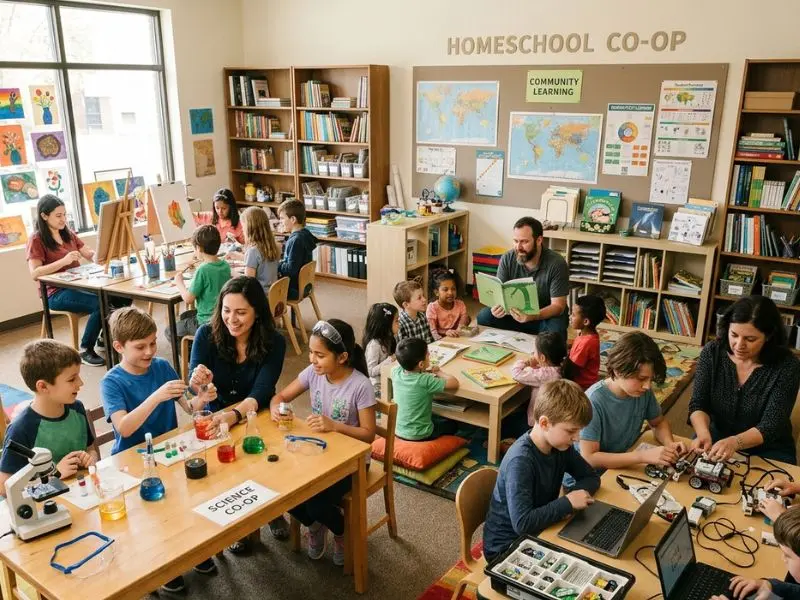
Choosing to homeschool feels exciting, but many parents soon discover that teaching every subject, planning engaging lessons, and creating social opportunities can become overwhelming. Questions about support, confidence, and balance often appear during the first year. You are not alone in feeling this way while building your homeschool routine every single week at home today.
Co-op Schools Explained shows how homeschool co-ops work, what families should expect, and which questions matter before joining. After researching successful homeschool communities, one lesson stands out: the right co-op supports learning, friendships, and parent confidence when its values match your family’s goals and daily schedule from the beginning with informed decisions together confidently forward.
- Quick Answer: What Is a Co-op School?
- Co-op Schools at a Glance
- Co-op School vs. Cooperative Education
- What Is a Homeschool Co-op? Clarifying the Concept
- How Do Homeschool Co-ops Work?
- Types of Homeschool Co-ops
- What Subjects Can Students Take?
- Who's in Charge of a Homeschool Co-op?
- Who Teaches Classes in a Homeschool Co-op?
- Are Homeschool Groups and Homeschool Co-ops the Same Thing?
- Why Consider Joining a Homeschool Co-op?
- Pros and Cons of Homeschool Co-ops
- Are There Age Restrictions to Joining a Co-op?
- Does It Cost Anything to Be in a Co-op?
- What Should Families Ask Before Joining a Homeschool Co-op?
- How Do I Join a Homeschool Co-op?
- How Can I Find a Homeschool Co-op?
- Practical Tips for Joining and Participating
- How Are Homeschool Co-ops Different From Pods, Microschools, or Hybrid Programs?
- Is a Homeschool Co-op Right for Your Family?
- Common Mistakes Parents Make Before Joining a Co-op
- Red Flags to Watch For
- Myth vs. Fact: Homeschool Co-ops
- Frequently Asked Questions
- Homeschool Co-op Checklist for Parents
- Questions to Ask Yourself Before Joining a Homeschool Co-op
- Conclusion
Quick Answer: What Is a Co-op School?
A co-op school, often called a homeschool co-op, is a group of homeschooling families who work together to provide educational classes, enrichment activities, and social learning opportunities. Parents often share teaching, planning, or volunteer responsibilities while students learn alongside other homeschooled children. Most homeschool co-ops are not accredited schools, and parents remain legally responsible for following their state’s homeschool laws.
Co-op Schools at a Glance
| Feature | What It Usually Means |
|---|---|
| Best For | Homeschool families who want shared learning and community support |
| Parent Involvement | Usually medium to high |
| Accreditation | Usually not accredited |
| Common Schedule | Weekly, monthly, or several days per week |
| Main Benefit | Shared teaching, group learning, and social opportunities |
| Legal Responsibility | Parents usually remain responsible for homeschool compliance |
Co-op School vs. Cooperative Education
The term “co-op school” can be confusing because it has more than one meaning.
For homeschooling families, a co-op school almost always refers to a homeschool co-op, where parents cooperate to organize classes, activities, and learning experiences for their children.
In colleges and universities, however, cooperative education (co-op education) is a completely different program. It combines classroom learning with paid or unpaid work experience related to a student’s career field.
If you’re researching homeschooling, this guide focuses on homeschool co-ops, which are designed to support families who educate their children at home.
What Is a Homeschool Co-op? Clarifying the Concept
A homeschool co-op is a cooperative learning community created by homeschooling families. Instead of one parent teaching every subject at home, several families work together to share their knowledge, skills, and teaching responsibilities.
For example, one parent may teach science because of their professional background, while another teaches literature, music, art, coding, or history. This collaborative approach gives children access to different teaching styles and learning experiences.
Many people use the terms co-op school and homeschool co-op interchangeably. In reality, most co-ops are not independent schools. They are organizations that help homeschooling families learn together while parents continue directing their children’s education.
Depending on the group, homeschool co-ops may meet once a week, several times each month, or multiple days every week.
Key Features of a Homeschool Co-op
Although every homeschool co-op is unique, most share several common features.
- Families work together instead of teaching independently.
- Parents share teaching or volunteer responsibilities.
- Students learn with children of similar ages or skill levels.
- Classes include both academic and enrichment subjects.
- Group activities encourage collaboration and social interaction.
- Field trips, clubs, and community events are often included.
- Parents remain legally responsible for their child’s homeschool education.
Because each homeschool co-op creates its own policies, schedules, and teaching methods, no two groups operate exactly the same way.
How Do Homeschool Co-ops Work?

A homeschool co-op operates through teamwork. Families join the organization, choose classes, and attend scheduled learning days throughout the school year. Rather than relying on a single teacher, parents and instructors work together to provide a wider variety of educational experiences.
Some homeschool co-ops focus on core academic subjects such as math, science, English, history, and foreign languages. Others emphasize enrichment classes like art, music, robotics, coding, drama, cooking, or physical education.
Parents usually contribute in one or more ways.
- Teaching a class
- Assisting another instructor
- Supervising students
- Planning field trips
- Organizing special events
- Managing registration
- Helping with classroom setup and cleanup
Some larger homeschool co-ops also hire outside teachers for advanced or specialized subjects. In these groups, parents may volunteer in administrative or classroom support roles instead of teaching.
The amount of parent involvement depends on the co-op’s structure. Some require every family to volunteer regularly, while others offer drop-off programs with fewer parent responsibilities.
How a Homeschool Co-op Can Reduce the Pressure on Parents
One of the biggest challenges new homeschooling families face is trying to teach every subject on their own. Planning lessons, preparing activities, and keeping children engaged throughout the week can quickly become overwhelming.
A homeschool co-op helps reduce that pressure by allowing families to share responsibilities. For example, one parent may teach science while another leads art or history. This teamwork gives children access to experienced instructors while allowing parents to focus on subjects they feel most confident teaching.
Instead of homeschooling alone, families become part of a supportive learning community where responsibilities and ideas are shared.
Where Do Homeschool Co-ops Meet?
Unlike traditional schools, homeschool co-ops can meet in many different locations. Most choose spaces that are affordable, accessible, and large enough for group learning.
Common meeting places include:
- Churches
- Community centers
- Public libraries
- Family homes
- Recreation centers
- Private learning facilities
- Parks and outdoor classrooms
- Rented meeting spaces
Some homeschool co-ops meet at the same location throughout the year, while others rotate between different venues depending on the activities planned.
What Does a Typical Co-op Day Look Like?
Although schedules vary, many homeschool co-ops follow a routine similar to the example below.
| Time | Activity |
|---|---|
| 9:00 AM | Arrival and Morning Meeting |
| 9:30 AM | Science Class |
| 10:30 AM | Snack Break |
| 10:45 AM | Language Arts |
| 11:45 AM | Art or Music |
| 12:30 PM | Lunch and Social Time |
| 1:15 PM | Physical Education or Clubs |
| 2:00 PM | Dismissal |
A structured schedule helps students balance academic learning, creative activities, and social interaction throughout the day.
Types of Homeschool Co-ops

Not every homeschool co-op follows the same model. Some emphasize academics, while others focus on enrichment, outdoor learning, or specialized instruction. Understanding these differences can help families choose a co-op that matches their educational goals.
Academic Co-op
Academic co-ops provide structured instruction in core subjects such as math, science, English, history, and foreign languages. Many follow a planned curriculum and may include homework, projects, or assessments.
These co-ops are a good option for families who want additional academic support while continuing to homeschool.
Enrichment Co-op
Enrichment co-ops focus on subjects that are often more enjoyable to learn in groups.
Popular classes include:
- Art
- Music
- Drama
- Robotics
- Coding
- Cooking
- Public speaking
- Physical education
These activities encourage creativity, teamwork, and hands-on learning.
Faith-Based Co-op
Faith-based homeschool co-ops combine academic instruction with religious education and shared beliefs. Lessons, discussions, and activities often reflect the values of the sponsoring church or participating families.
Secular Co-op
Secular homeschool co-ops welcome families from different backgrounds without including religious instruction. Their primary focus is academic learning, enrichment classes, and community building.
Parent-Led Co-op
In a parent-led homeschool co-op, parents teach most classes and share leadership responsibilities. Because families volunteer their time, this model is often one of the most affordable options.
Teacher-Led Co-op
Some homeschool co-ops hire certified teachers, tutors, or subject specialists to teach advanced classes such as chemistry, higher-level math, foreign languages, or computer science.
Parents may still volunteer, but professional instructors lead many lessons.
Drop-Off Co-op
Drop-off homeschool co-ops allow parents to leave their children during scheduled classes instead of remaining on campus. These programs often charge higher fees because they employ additional staff or instructors.
Outdoor or Nature-Based Co-op
Outdoor homeschool co-ops use nature as part of the learning experience. Students may participate in hiking, gardening, wildlife observation, environmental science, and outdoor projects.
This model is popular with families who prefer experiential, hands-on education.
What Subjects Can Students Take?
The subjects available depend on each homeschool co-op, but most offer a combination of academic and enrichment classes.
Academic subjects commonly include:
- Math
- Science
- English
- History
- Geography
- Foreign languages
Enrichment classes often include:
- Art
- Music
- Drama
- Robotics
- Coding
- Financial literacy
- Cooking
- Public speaking
- Physical education
- Gardening
Many homeschool co-ops also organize science labs, debate clubs, book clubs, service projects, and educational field trips to give students practical learning experiences beyond traditional lessons.
Which Type Is Best?
The best homeschool co-op depends on your child’s learning style, your family’s schedule, and the level of parent involvement you prefer.
Some families want strong academic instruction, while others value enrichment classes, social interaction, or flexible participation. Visiting several homeschool co-ops and asking thoughtful questions can help you compare your options before making a decision.
In the next section, you’ll learn who manages homeschool co-ops, how classes are taught, the differences between homeschool groups and co-ops, and what parents should expect before becoming members.
Who’s in Charge of a Homeschool Co-op?
Unlike a traditional school, a homeschool co-op is usually managed by the families who belong to it. Parents work together to organize classes, create schedules, plan events, and make decisions that keep the co-op running smoothly.
The leadership structure varies from one homeschool co-op to another. Smaller groups often rely entirely on volunteers, while larger co-ops may have a board, elected leaders, or paid administrators.
Common leadership roles include:
- Co-op director or coordinator
- Board members
- Parent volunteers
- Class coordinators
- Treasurer
- Membership coordinator
- Event planner
- Communications coordinator
Some homeschool co-ops also hire teachers for advanced subjects, but parents usually continue supporting the program through volunteer work.
Understanding how a co-op is managed helps families know what responsibilities they may have before joining.
How Are Decisions Made?
Most homeschool co-ops encourage families to work together when making important decisions. Depending on the organization, leaders or committees may handle areas such as:
- Choosing classes
- Selecting curriculum
- Creating the yearly calendar
- Planning field trips
- Setting membership fees
- Organizing volunteer schedules
- Establishing classroom expectations
Some co-ops ask members to vote on major decisions, while others allow a leadership team to manage daily operations.
Who Teaches Classes in a Homeschool Co-op?
One of the first questions many new homeschooling parents ask is, “Who will actually teach my child?”
The answer depends on the homeschool co-op.
In many parent-led co-ops, families teach subjects based on their knowledge, experience, or interests. For example, one parent may teach biology, while another leads art, music, writing, or history.
Larger homeschool co-ops sometimes invite experienced educators or community professionals to teach specialized classes.
These instructors may include:
- Certified teachers
- Retired educators
- College professors
- Tutors
- Local business professionals
- Guest speakers
This variety allows students to learn from people with different backgrounds while parents continue directing their overall homeschool education.
Are Homeschool Groups and Homeschool Co-ops the Same Thing?
Many parents assume homeschool groups and homeschool co-ops are identical, but they serve different purposes.
A homeschool group mainly focuses on bringing families together for friendship, support, and community activities. These groups often organize park days, holiday parties, field trips, and parent meetups.
A homeschool co-op goes one step further by providing organized classes where parents or instructors teach students on a regular schedule.
The comparison below highlights the difference.
| Feature | Homeschool Group | Homeschool Co-op |
|---|---|---|
| Main Purpose | Community and support | Shared learning |
| Regular Classes | Usually no | Yes |
| Parent Teaching | Rarely | Often |
| Volunteer Commitment | Low | Moderate to high |
| Academic Instruction | Limited | Common |
| Social Activities | Yes | Yes |
| Field Trips | Yes | Yes |
Some organizations offer both support groups and homeschool co-op classes, making it helpful to ask exactly what services are included before joining.
Why Consider Joining a Homeschool Co-op?
Homeschooling offers freedom and flexibility, but it can also place a lot of responsibility on parents. Planning lessons, teaching multiple subjects, and finding social opportunities can become difficult over time.
A homeschool co-op helps families share those responsibilities while creating a supportive learning community.
Access to Specialized Classes
Not every parent feels comfortable teaching advanced subjects like chemistry, algebra, coding, or foreign languages.
A homeschool co-op often includes parents, tutors, or instructors with different skills, allowing students to learn subjects that may be difficult to teach at home.
More Social Opportunities
One of the biggest reasons families join a homeschool co-op is to help children build friendships through regular interaction.
Students often participate in:
- Group classes
- Team projects
- Clubs
- Science labs
- Sports
- Educational field trips
- Holiday celebrations
- Community service projects
These shared experiences help children develop communication, teamwork, and leadership skills.
Building Friendships Beyond the Classroom
Many parents worry that homeschooling might limit their child’s opportunities to make friends. A homeschool co-op creates consistent opportunities for children to spend time together throughout the school year.
Instead of meeting only occasionally, students often build lasting friendships through weekly classes, shared projects, lunch breaks, clubs, and family events. Parents also develop valuable support networks by connecting with other homeschooling families.
Shared Teaching Responsibilities
Rather than teaching every subject alone, families divide responsibilities based on their strengths.
For example:
- One parent teaches science.
- Another teaches literature.
- Another leads art.
- Another organizes physical education.
- Another coordinates field trips.
This collaborative approach reduces the workload while giving children a wider variety of learning experiences.
How a Homeschool Co-op Can Reduce the Pressure on Parents
Many new homeschooling parents quickly discover that planning every lesson, teaching multiple grade levels, and finding enrichment activities requires significant time and energy.
A homeschool co-op helps reduce that pressure by allowing families to work together. Instead of trying to become an expert in every subject, parents can rely on the strengths of other members while contributing in areas where they feel most confident.
For many families, this teamwork makes homeschooling more sustainable and enjoyable over the long term.
Encouragement for Parents
Homeschooling can sometimes feel lonely, especially during the first year.
Joining a homeschool co-op connects parents with families facing similar challenges. Members often exchange curriculum ideas, teaching strategies, local resources, and encouragement that can make homeschooling feel less overwhelming.
Pros and Cons of Homeschool Co-ops
Like every educational option, homeschool co-ops have advantages and disadvantages. Looking at both sides can help families make an informed decision.
Pros
- Shared teaching responsibilities
- More social interaction
- Access to specialized classes
- Hands-on learning opportunities
- Affordable enrichment programs
- Strong homeschool community
- Group field trips and clubs
- Parent support and encouragement
Cons
- Volunteer responsibilities may be required.
- Fixed schedules reduce daily flexibility.
- Teaching quality may vary between classes.
- Membership fees can increase costs.
- Some co-ops have waiting lists.
- Parents may need to teach or supervise.
- Rules differ from one co-op to another.
Visiting a homeschool co-op before joining is one of the best ways to decide whether it matches your family’s expectations.
Are There Age Restrictions to Joining a Co-op?
Every homeschool co-op sets its own age requirements.
Some welcome children from preschool through high school, while others focus on specific age groups.
Programs commonly include:
- Preschool
- Kindergarten
- Elementary school
- Middle school
- High school
- Multi-age family learning
Some homeschool co-ops even provide nursery care for younger siblings while older children attend classes.
Before enrolling, ask whether the co-op offers programs for every child in your family.
Do Students Learn by Grade Level?
Not always.
Many homeschool co-ops organize classes according to:
- Age
- Academic ability
- Subject knowledge
- Student interests
This flexible approach allows students to learn at a pace that matches their individual abilities rather than following a traditional classroom model.
Does It Cost Anything to Be in a Co-op?
Most homeschool co-ops charge some type of membership fee, although costs vary widely based on the location, class offerings, facilities, and whether outside instructors are hired.
Volunteer-led homeschool co-ops are usually less expensive than programs employing professional teachers.
Common expenses include:
- Annual registration
- Membership dues
- Semester tuition
- Classroom supplies
- Facility rental
- Insurance
- Science lab materials
- Field trips
- Club activities
Estimated Cost Range
| Type of Homeschool Co-op | Typical Cost |
|---|---|
| Volunteer-led community co-op | Free to $100 per year |
| Small academic co-op | $100–$500 per semester |
| Teacher-led co-op | $500–$2,000+ per year |
These figures are general estimates. Actual costs vary by location, class selection, volunteer requirements, and the services offered by each homeschool co-op.
Is a Homeschool Co-op Worth the Cost?
The answer depends on your family’s goals.
Some parents join mainly for enrichment classes, while others value the shared teaching responsibilities, specialized instruction, and supportive homeschool community.
When comparing costs, think beyond the membership fee. Consider the educational opportunities, friendships, field trips, and access to experienced instructors that your child may receive throughout the year.
Can Parents Reduce Costs?
Many homeschool co-ops keep costs affordable by asking parents to volunteer.
Volunteer opportunities often include:
- Teaching classes
- Assisting instructors
- Organizing events
- Classroom setup and cleanup
- Library management
- Technology support
- Fundraising
- Administrative work
Families who actively participate often help create a stronger homeschool community while reducing the overall cost of operating the co-op.
In the next section, you’ll learn how to evaluate a homeschool co-op before joining, where to find one near you, and how homeschool co-ops compare with homeschool pods, microschools, and hybrid schools so you can choose the best fit for your family.
What Should Families Ask Before Joining a Homeschool Co-op?
Choosing a homeschool co-op is an important decision. Every group has its own teaching style, leadership, volunteer expectations, and educational philosophy. Asking thoughtful questions before joining can help you find a co-op that matches your child’s needs and your family’s goals.
What Subjects Are Offered?
Not every homeschool co-op teaches the same classes. Some focus on core academics, while others emphasize enrichment or hands-on learning.
Ask whether the co-op offers subjects such as:
- Math
- Science
- English
- History
- Geography
- Foreign languages
- Art
- Music
- Coding
- Robotics
- Physical education
- Life skills
If your child needs support in a specific subject, make sure those classes are available before enrolling.
How Much Parent Participation Is Required?
One of the biggest differences between homeschool co-ops is the level of parent involvement.
Ask questions such as:
- Do parents have to teach?
- Are volunteer hours required?
- Can parents drop off their children?
- How many volunteer hours are expected each semester?
- Can another family member volunteer instead?
Knowing these expectations early helps prevent scheduling conflicts later.
What Curriculum Is Used?
Every homeschool co-op chooses its own teaching approach.
You may want to ask:
- Is the curriculum faith-based or secular?
- Who selects the curriculum?
- Are textbooks required?
- Is homework assigned?
- Are grades or assessments given?
- Is learning project-based or lecture-based?
Understanding the teaching philosophy helps you choose a homeschool co-op that fits your family’s educational values.
How Are Classes Organized?
Students may be grouped in different ways depending on the co-op.
Common methods include:
- Age
- Grade level
- Academic ability
- Student interests
Some homeschool co-ops even allow students to join higher-level classes when they are academically ready.
What Are the Membership Rules?
Every homeschool co-op has policies that members are expected to follow.
Before joining, ask about:
- Attendance requirements
- Volunteer commitments
- Membership fees
- Refund policies
- Classroom expectations
- Technology policies
- Safety procedures
- Parent responsibilities
Understanding these rules helps families avoid misunderstandings after enrollment.
How Do I Join a Homeschool Co-op?

Joining a homeschool co-op is usually straightforward, but each organization has its own enrollment process.
Following a step-by-step approach can help you find the right fit instead of choosing the first available option.
Step 1: Research Local Homeschool Co-ops
Start by making a list of homeschool co-ops in your area.
Visit their websites, read reviews, and learn about:
- Class offerings
- Age groups
- Educational philosophy
- Parent involvement
- Meeting schedules
Comparing several homeschool co-ops gives you a better understanding of your local options.
Step 2: Contact the Co-op
Reach out to the coordinator before applying.
Ask about:
- Enrollment periods
- Available classes
- Waiting lists
- Membership fees
- Volunteer expectations
- Open house dates
Most homeschool co-ops are happy to answer questions from prospective families.
Step 3: Attend an Open House or Visit a Class
Whenever possible, visit before making your decision.
Observing a homeschool co-op in person allows you to:
- Meet teachers
- Talk with current parents
- Watch students interact
- See how classes are organized
- Experience the learning environment
A visit often provides insights that a website cannot.
Step 4: Complete Registration
If the homeschool co-op feels like a good fit, complete the required paperwork and pay any registration or membership fees.
Some organizations may also ask parents to:
- Sign volunteer agreements
- Review family handbooks
- Complete background checks
- Attend orientation meetings
Step 5: Participate Actively
After joining, attend classes consistently and fulfill any volunteer commitments.
Families who actively participate often enjoy stronger relationships, better communication, and a more rewarding homeschool experience.
How Can I Find a Homeschool Co-op?
Finding a homeschool co-op has become much easier thanks to online communities and local homeschooling networks.
Search Online
Start with search terms such as:
- Homeschool co-op near me
- Homeschool co-op in my state
- Local homeschool classes
- Homeschool enrichment programs
Many organizations have websites where families can review classes, schedules, and membership information.
Join Local Homeschool Facebook Groups
Many homeschool communities organize activities through Facebook.
Parents often share information about:
- New homeschool co-ops
- Enrollment opportunities
- Open houses
- Field trips
- Educational events
These groups are often one of the fastest ways to connect with homeschooling families nearby.
Ask Other Homeschool Families
Personal recommendations remain one of the most reliable ways to find a quality homeschool co-op.
Experienced homeschool parents can often recommend groups that match your child’s age, learning style, and educational goals.
Check State Homeschool Organizations
Many state homeschool associations maintain directories of homeschool support groups and co-ops. If you want broader homeschool research and educational resources, national homeschool organizations also provide valuable information about homeschool communities, learning models, and family support to help parents make informed decisions.
These directories can save time and help you discover established organizations in your area.
Should You Visit More Than One Co-op?
Yes.
Every homeschool co-op has its own culture, teaching methods, volunteer expectations, and classroom environment.
Visiting more than one organization allows you to compare:
- Teaching quality
- Parent involvement
- Student engagement
- Class variety
- Overall atmosphere
Choosing the right homeschool co-op is easier when you compare several options instead of enrolling in the first one you find.
Practical Tips for Joining and Participating
A little preparation can make your homeschool co-op experience much more enjoyable.
Visit Before Making a Commitment
Attend an open house or trial class whenever possible.
Watching classes in person helps you understand whether the learning environment fits your child’s personality and learning style.
Understand Volunteer Expectations
Volunteer responsibilities vary widely.
Before joining, make sure you understand:
- Teaching requirements
- Classroom assistance
- Event planning
- Cleanup duties
- Fundraising expectations
Knowing these responsibilities ahead of time helps avoid surprises later.
Communicate With Leaders
Good communication creates a better experience for everyone.
Stay in touch with coordinators if your schedule changes, your child needs additional support, or you have questions about classes.
Respect the Co-op’s Policies
Every homeschool co-op has guidelines regarding attendance, behavior, classroom conduct, and technology use.
Following these policies helps maintain a positive learning environment for all families.
Build Relationships
One of the greatest benefits of a homeschool co-op is the community it creates.
Take time to:
- Meet other parents.
- Encourage your child to make friends.
- Participate in family events.
- Support volunteer activities.
Strong relationships often become just as valuable as the educational opportunities.
How Are Homeschool Co-ops Different From Pods, Microschools, or Hybrid Programs?

Many parents researching homeschool co-ops also compare other alternative education models.
Although these options share some similarities, they are designed for different educational needs.
| Feature | Homeschool Co-op | Homeschool Pod | Microschool | Hybrid School |
|---|---|---|---|---|
| Primary Teacher | Parents or shared instructors | Parent or tutor | Professional teachers | Certified teachers and parents |
| Parent Involvement | High | Moderate to high | Low to moderate | Moderate |
| Schedule | Usually weekly | Flexible | Regular school schedule | Split between home and campus |
| Curriculum | Selected by the co-op | Flexible | School-directed | School-directed |
| Legal Responsibility | Parent | Parent | Depends on the school | Shared between school and parents |
| Primary Goal | Shared learning and community | Small-group instruction | Personalized education | Blended learning |
Which Option Is Right for Your Family?
Every child learns differently, so the best choice depends on your family’s goals rather than current trends.
A homeschool co-op may be the right fit if you:
- Enjoy working with other homeschooling families.
- Want to share teaching responsibilities.
- Value affordable enrichment classes.
- Want your child to build friendships through regular group learning.
A homeschool pod may work better if you prefer a smaller learning group with greater scheduling flexibility.
A microschool may be ideal for families looking for a structured classroom led by professional educators.
A hybrid school may be the better option if you want your child to attend campus classes while continuing part of their education at home.
Think About Your Child’s Learning Style
Before making a decision, consider how your child learns best.
Some children thrive in structured classrooms with regular routines, while others enjoy hands-on projects, creative learning, or small-group discussions.
Rather than choosing the most popular option, focus on the environment where your child will feel confident, engaged, and motivated to learn.
In the next section, we’ll help you decide whether a homeschool co-op is the right choice for your family by answering common questions and providing practical tools to make your final decision with confidence.
Is a Homeschool Co-op Right for Your Family?
A homeschool co-op can be a great option for families who want to keep the freedom of homeschooling while giving their children more opportunities to learn with others. It works well for many families, but it is not the right choice for everyone.
The best decision depends on your child’s learning needs, your family’s schedule, and the amount of time you can contribute to the co-op.
A homeschool co-op may be a good fit if you:
- Want your child to learn alongside other homeschool students.
- Would like help teaching certain subjects.
- Value hands-on classes and group activities.
- Want more field trips, clubs, and enrichment opportunities.
- Enjoy being part of a homeschool community.
- Can meet the group’s volunteer expectations.
A homeschool co-op may not be the best fit if you:
- Need complete flexibility every day.
- Prefer teaching every subject at home.
- Have limited time for volunteering.
- Live too far from available co-ops.
- Want a full-time accredited school.
If you’re unsure, visit a few homeschool co-ops before making a decision. Watching a class, meeting the families, and asking questions can help you find the environment that feels right for your child.
Common Mistakes Parents Make Before Joining a Co-op
Not all homeschool co-ops operate the same way. Choosing one without learning how it works can lead to disappointment later.
Before joining, avoid these common mistakes:
- Enrolling without visiting a class.
- Choosing a co-op only because someone recommended it.
- Assuming every co-op uses the same curriculum.
- Not asking about volunteer expectations.
- Ignoring extra costs such as supplies or field trips.
- Overlooking the group’s teaching approach.
- Forgetting to check whether the schedule fits your family.
- Believing a co-op replaces your homeschool legal responsibilities.
Spending a little extra time comparing different homeschool co-ops can help you find one that truly fits your family’s needs.
Red Flags to Watch For
Most homeschool co-ops are welcoming and well organized, but it is still worth looking closely before joining.
Take time to ask more questions if you notice:
- Membership fees are not explained clearly.
- Volunteer expectations keep changing.
- Communication is slow or inconsistent.
- There are no written classroom or behavior guidelines.
- Classes are canceled regularly without notice.
- Safety procedures are unclear.
- The learning environment does not match your family’s goals.
A well-run homeschool co-op should explain its expectations clearly and answer your questions openly.
Myth vs. Fact: Homeschool Co-ops
Many first-time homeschooling parents hear different opinions about homeschool co-ops. Understanding the facts can make your decision easier.
| Myth | Fact |
|---|---|
| A homeschool co-op is the same as a traditional school. | Most homeschool co-ops support homeschooling but do not replace it. |
| Every parent has to teach classes. | Some co-ops require teaching, while others offer different volunteer roles or hire instructors. |
| All homeschool co-ops follow the same curriculum. | Every co-op decides its own curriculum, schedule, and teaching style. |
| Homeschool co-ops are only for younger children. | Many welcome students from preschool through high school. |
| Joining a co-op meets homeschool legal requirements. | Parents are still responsible for following their state’s homeschool laws. |
Frequently Asked Questions
Is a homeschool co-op the same as a school?
No. A homeschool co-op supports homeschooling by offering shared classes and activities. Parents remain responsible for directing their child’s education and meeting state homeschool requirements.
Do parents have to teach at a homeschool co-op?
It depends on the co-op. Some expect parents to teach or volunteer, while others hire instructors or allow drop-off classes with fewer parent responsibilities.
Are homeschool co-ops accredited?
Most homeschool co-ops are not accredited because they are not independent schools. If accreditation is important to your family, ask the co-op how its program is organized.
How often do homeschool co-ops meet?
Meeting schedules vary. Some meet once a week, while others meet several times each week or only for selected classes and activities.
Can homeschooled children join a co-op during the school year?
Some homeschool co-ops accept new families throughout the year, while others only enroll students before a new semester or school year begins.
Do homeschool co-ops give grades?
Some academic co-ops provide quizzes, grades, or progress reports. Others leave all record keeping and assessment to parents.
Can my child attend more than one homeschool co-op?
Yes. Some families join one co-op for academic classes and another for enrichment activities such as art, music, sports, or science labs.
Homeschool Co-op Checklist for Parents
Use this checklist before making your decision.
- Visit a class or open house.
- Compare more than one homeschool co-op.
- Learn about the curriculum and teaching style.
- Understand the volunteer requirements.
- Review all fees and extra costs.
- Read the attendance and behavior policies.
- Make sure the schedule fits your family.
- Speak with current members.
- Think about whether your child will enjoy the environment.
- Choose the co-op that best supports your family’s goals.
A checklist like this can help you compare different homeschool co-ops and make your decision with confidence.
Questions to Ask Yourself Before Joining a Homeschool Co-op

Before you enroll, think about what matters most to your family.
Ask yourself:
- Will my child enjoy learning in this environment?
- Does the teaching style match my child’s needs?
- Can I meet the volunteer expectations?
- Does the schedule fit our routine?
- Are the costs manageable?
- Do I feel comfortable with the co-op’s approach to learning?
- Will this co-op help my child grow both academically and socially?
There are no perfect homeschool co-ops. The best choice is the one that fits your family’s goals and supports your child’s development.
Conclusion
After comparing different homeschool co-ops and learning how families use them, one thing becomes clear: every co-op offers a different experience. Taking time to visit, ask questions, and compare options helps you choose a community that supports your child’s learning while making your homeschooling journey more manageable and rewarding.