 Skip to content
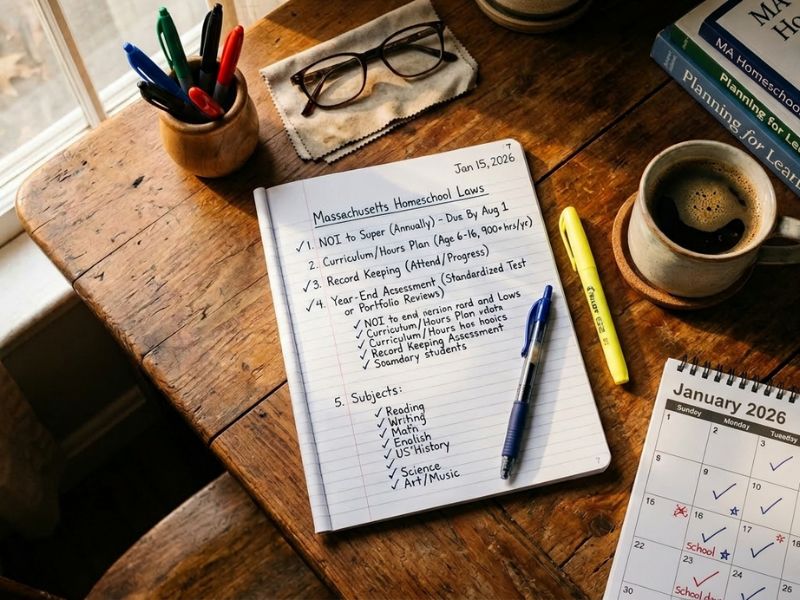
Pulling a child from school in Massachusetts sounds exciting until the legal questions begin. Many parents become nervous after discovering that homeschooling needs district approval, especially when every website explains the rules differently.
During research into Massachusetts homeschool laws and district review patterns, one reality kept appearing. Families who submit thoughtful education plans and understand local expectations early usually move through the approval process with much less frustration and uncertainty.
- Key Takeaways: Massachusetts Homeschool Laws
- Is Homeschooling Legal in Massachusetts?
- Massachusetts Homeschool Laws at a Glance
- Massachusetts Homeschool Laws
- Why Homeschool Rules Can Vary by District
- What Can a Massachusetts School District Legally Ask For?
- Massachusetts Homeschool Requirements
- Step-by-Step: How to Start Homeschooling in Massachusetts
- How Many Hours Are Required for Homeschooling?
- Notification Requirements / Notice of Intent
- What Happens After You Submit Your Homeschool Plan?
- Required Subjects
- Parent Qualifications
- Homeschool Record Keeping
- High School, Graduation, and Transcripts
- Testing and Evaluation Requirements
- Can Homeschoolers Get Special Education Services?
- Can Homeschooled Students Join Public School Activities?
- Common Mistakes to Avoid
- Frequently Asked Questions
- Conclusion
Key Takeaways: Massachusetts Homeschool Laws
- Homeschooling is legal in Massachusetts but requires district approval.
- You must submit a detailed homeschool plan before starting.
- Each school district may have slightly different expectations.
- Parents do not need a teaching degree.
- Students must show progress through evaluation or testing.
- Starting without approval can lead to truancy issues.
Is Homeschooling Legal in Massachusetts?

Yes. Homeschooling is legal in Massachusetts.
However, it is not automatic. Parents must get approval from their local school district before they begin homeschooling.
This means you cannot withdraw your child and start homeschooling right away. You need to follow a process and submit a plan.
Massachusetts Homeschool Laws at a Glance
| Requirement | Details |
|---|---|
| Legal Status | Yes, homeschooling is legal |
| Approval Required | Yes (from local school district) |
| Notice of Intent | Required with detailed homeschool plan |
| Required Subjects | Core subjects similar to public schools |
| Testing / Evaluation | Required (method approved by district) |
| Parent Qualifications | No formal degree required |
Massachusetts Homeschool Laws
Massachusetts homeschooling is governed by state law and shaped by court decisions such as Care and Protection of Charles.
The law allows parents to homeschool, but it also gives school districts the right to review and approve homeschool plans.
Because of this, each school district may handle homeschooling a little differently. But the main idea stays the same:
- Parents can homeschool
- The school district must approve the plan
Why Homeschool Rules Can Vary by District

In Massachusetts, homeschool rules are not exactly the same everywhere.
Each school district has its own process. Some districts are simple and flexible. Others may ask for more details.
For example:
- One district may approve plans quickly
- Another may ask for detailed curriculum and schedules
Because of this, it is important to contact your local school district and understand their expectations.
Rules can differ across locations, it may help to understand how regulations vary nationwide by reviewing a broader guide on homeschooling laws by state.
What Can a Massachusetts School District Legally Ask For?
Under Massachusetts homeschool laws, school districts can review homeschool plans to make sure children receive proper instruction. However, districts should not create unnecessary demands that go beyond educational oversight.
In many districts, the superintendent or school committee reviews homeschool plans before approval is granted. The district mainly checks whether the child will receive regular instruction in important academic subjects.
Most districts may ask for:
- Subjects you plan to teach
- Curriculum or learning materials
- Number of school days or teaching hours
- Method of evaluation or assessment
- Basic homeschool schedule or education plan
This process comes from the Massachusetts court case Care and Protection of Charles. The court explained that school districts can review whether a homeschool program provides proper education, but they should not control every part of homeschooling. Parents who want to review a detailed legal summary of Massachusetts homeschool approval requirements can consult HSLDA’s Massachusetts homeschooling law guide.
Some districts may ask for more details than others. For example, one district may approve a simple homeschool outline, while another may request curriculum descriptions or lesson plan samples.
School districts can review homeschool plans, but requests should stay reasonable and connected to education. Massachusetts courts have explained that approval requirements should protect educational standards without placing unnecessary pressure on homeschool families.
In general, Massachusetts districts should not require:
- Parents to hold a teaching license
- Mandatory home visits without a valid reason
- Approval of every teaching method
- Public school curriculum followed exactly the same way
Parents still have flexibility in how they teach at home. The school district mainly wants to confirm that the child is receiving consistent instruction in core subjects.
Because Massachusetts homeschool laws are handled at the local level, it is important to stay organized, clear, and professional when communicating with your district. A detailed homeschool plan often helps parents avoid delays, confusion, or requests for revisions.
Massachusetts Homeschool Requirements
To homeschool legally in Massachusetts, parents must:
- Submit an education plan
- Get approval from the local school district
- Provide instruction in required subjects
- Show proof of student progress
These requirements help the school district ensure that the child is receiving proper education.
Step-by-Step: How to Start Homeschooling in Massachusetts
- Prepare your homeschool plan with subjects, materials, and schedule.
- Submit the plan to your local school district.
- Wait for approval before beginning homeschooling.
- Start teaching according to your approved plan.
- Track progress and complete the required evaluation.

How Many Hours Are Required for Homeschooling?
Massachusetts does not set a strict number of hours for homeschooling in the same way as public schools.
However, many districts expect homeschool programs to follow a similar structure to public schools.
This often means:
- Around 180 school days
- About 900 hours of learning per year
Your homeschool plan should show that your child is receiving regular and consistent instruction.
Notification Requirements / Notice of Intent
In Massachusetts, this is not just a simple notice. It is part of the approval process.
Parents must submit a homeschool plan to the school district. This is often called a notice of intent, but it must include more details than just a notification.
Your plan usually includes:
- Subjects you will teach
- Books and materials you will use
- Number of teaching days or hours
- Method of evaluation
You must wait for approval before starting homeschooling.
What Happens After You Submit Your Homeschool Plan?

After you submit your homeschool plan, the school district will review it.
There are usually three possible outcomes:
- Approved → You can begin homeschooling
- Request for changes → You need to update your plan
- Not approved → You must fix issues before starting
The district may check:
- Subjects you plan to teach
- Learning materials
- Number of school days or hours
- How you will track progress
This step is very important. You should not start homeschooling until your plan is approved.
Required Subjects
Massachusetts expects homeschool instruction to cover the same core areas as public schools and to show similar progress.
Common subjects include:
- Reading
- Writing
- English grammar
- Math
- Science
- History and social studies
- Physical education
Some districts may expect additional subjects. It is always best to check with your local school district.
Because subject requirements can vary widely, some families choose to compare how different states handle homeschooling and often review best states for homeschooling, locations where homeschool rules are less restrictive.
Parent Qualifications
Massachusetts does not require parents to have a teaching degree.
However, the school district may check if the parent is capable of teaching the child. This does not mean formal education is required.
In most cases, showing a clear and structured plan is enough.
Homeschool Record Keeping
Parents should keep clear homeschool records.
Good records include:
- Attendance records
- Samples of student work
- Lesson plans
- Progress reports
Even if your district does not ask for all of these, keeping records helps you stay organized and prepared.
High School, Graduation, and Transcripts
In Massachusetts, homeschool students do not follow a state-issued graduation system.
Parents are responsible for:
- Tracking high school courses
- Keeping academic records
- Creating transcripts
When a student finishes high school, parents can issue a homeschool diploma.
Colleges usually accept homeschool transcripts, especially when they are clear and well organized.
Keeping detailed records during high school years is very important.
Testing and Evaluation Requirements
Massachusetts requires parents to show that the child is making progress.
There are different ways to do this:
- Standardized testing
- Portfolio of student work
- Written progress reports
The method of evaluation must be agreed upon with the school district.
Families usually need to provide the progress proof or assessment method approved by their district.
Can Homeschoolers Get Special Education Services?
Yes. Homeschooled students in Massachusetts may still receive special education services.
If a child has special learning needs, the school district must still evaluate the child when needed.
Some districts may also allow access to:
- Therapy services
- Learning support programs
However, services can vary by district. It is best to ask your local school office for details.
Can Homeschooled Students Join Public School Activities?
In Massachusetts, some school districts allow homeschool students to take part in:
- Sports teams
- Clubs
- Certain classes
However, this is not guaranteed. Each district decides its own rules.
Some districts allow full participation, while others may not offer access at all.
Always check with your local school district to know what is available.
Common Mistakes to Avoid
- Starting homeschooling without district approval
- Submitting an incomplete or unclear homeschool plan
- Not including a proper evaluation method
- Ignoring district-specific expectations
- Failing to keep basic homeschool records
Frequently Asked Questions
Do you need approval to homeschool in Massachusetts?
Yes. Parents must get approval from their local school district before starting homeschooling.
How do homeschoolers show progress?
Progress can be shown through tests, portfolios, or reports, depending on what the district accepts.
Is Massachusetts a strict homeschool state?
Yes. Compared to many states, Massachusetts has a stricter system because it requires approval from the school district.
Conclusion
At first glance, Massachusetts homeschool laws can appear difficult because of approval requirements and district oversight. Yet after examining how homeschool families successfully navigate the system, a consistent pattern emerges: parents who stay organized, document progress carefully, and communicate clearly often build a stable and legally confident homeschool experience.