 Skip to content
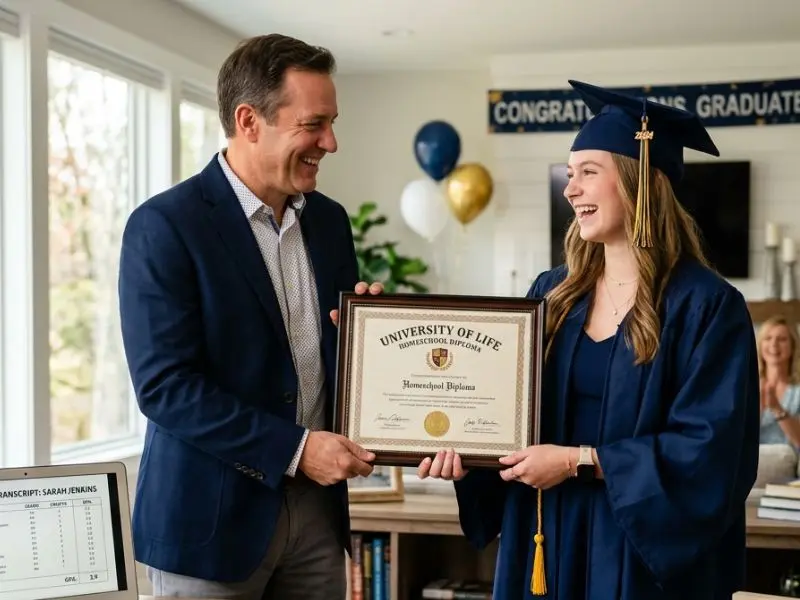
Graduation is exciting until one question changes everything: Is a homeschool diploma valid? Many parents worry that years of homeschooling could be questioned by colleges, employers, or financial aid offices. That uncertainty often creates more stress than planning the graduation itself.
After researching homeschool laws, graduation standards, and admission practices, I’ve found that successful homeschool graduates share one thing in common: well-kept records. A valid diploma is supported by transcripts and compliance with state homeschool laws. This guide explains exactly what parents need to know before graduation.
- Quick Answer
- Why Parents Ask This Question
- What Is a Homeschool Diploma and Who Issues It?
- Understanding the Legality of a Homeschool Diploma
- How State Homeschool Laws Affect Diploma Validity
- Will the Local Public School Issue a Diploma for My Student?
- How to Ensure the Validity of a Homeschool Diploma
- Creating a Homeschool High School Transcript
- Meeting Graduation Requirements
- How State Homeschool Laws Affect Diploma Validity
- Why Colleges Look Beyond the Diploma
- Homeschool Diplomas and College Admissions: What You Need to Know
- What Employers Really Want to Know
- How Employers Perceive a Homeschool Diploma
- Entering the Workforce or Military With a Homeschool Diploma
- Can Homeschool Graduates Apply for FAFSA and Federal Financial Aid?
- Flexibility vs. Accreditation
- Do Homeschoolers Need a GED?
- Myths and Misconceptions Surrounding Homeschool Diplomas
- What Can Make a Homeschool Diploma Invalid?
- Celebrating Graduation: Creating a Homeschool Diploma and Ceremony
- What Should Parents Do Next?
- Homeschool Diploma Acceptance at a Glance
- Before Issuing Your Homeschool Diploma: Final Checklist
- Frequently Asked Questions
- Key Takeaways
- Conclusion
Quick Answer
Yes. A homeschool diploma is valid when the student completes homeschooling according to the homeschool laws of their state. In most states, parents can legally issue a homeschool diploma after their student meets the family’s graduation requirements. Colleges, employers, trade schools, military recruiters, and financial aid offices often evaluate the student’s complete academic record, including the transcript, rather than the diploma alone.
Why Parents Ask This Question
Imagine homeschooling your child for four years, carefully planning lessons, grading assignments, tracking credits, and preparing for graduation. As graduation day approaches, one question suddenly becomes more important than everything else:
“Will my child’s homeschool diploma actually be accepted?”
This concern is one of the biggest reasons parents search for this topic. They want reassurance that their child will have the same opportunities as graduates from traditional schools.
The encouraging news is that homeschool graduates attend respected colleges, begin successful careers, receive scholarships, qualify for federal financial aid, and join the military every year. Understanding how homeschool diplomas are recognized can help you move forward with confidence instead of uncertainty.
What Is a Homeschool Diploma and Who Issues It?

A homeschool diploma is an official document showing that a student has completed high school through a homeschool program. Unlike a public school diploma, it is usually issued by the parent, homeschool administrator, umbrella school, correspondence school, or accredited online homeschool program.
The diploma confirms that the student has successfully completed high school and may be used when applying for:
- Colleges and universities
- Employers
- Trade schools
- Apprenticeships
- Scholarships
- Military service
- Career training programs
Many first-time homeschool parents believe a government office or local school district must approve the diploma before it becomes valid. This is one of the most common misunderstandings about homeschool graduation.
In reality, most homeschool diplomas receive their legal standing because the homeschool operated according to state homeschool laws—not because a government agency printed or signed the diploma.
From Their Local Public School
In most situations, local public schools do not issue diplomas to homeschool graduates because they were not enrolled as full-time public school students.
Some school districts may allow unique graduation arrangements through dual enrollment or special partnerships, but these situations are uncommon and depend on local policies and state law.
Families should never assume that a public school will automatically issue a diploma after homeschooling.
From an Umbrella School, Correspondence School, or Virtual School
Some homeschool families choose an umbrella school or accredited online program to oversee their student’s education.
When students complete that program’s graduation requirements, the organization may issue the diploma.
This option often provides additional administrative support, but it does not automatically make the diploma more valuable than one issued by parents. Colleges and employers usually review the student’s entire academic record rather than focusing only on who issued the diploma.
From Their Parents
For independent homeschool families, parents are usually responsible for issuing the diploma. This is the most common graduation path across the United States.
Parents also prepare and maintain important graduation records such as:
- High school transcript
- Credit records
- Course descriptions
- Graduation date
- Student portfolio, when appropriate
When these records are accurate and the homeschool follows state law, a parent-issued diploma is widely accepted.
Understanding the Legality of a Homeschool Diploma
One of the biggest concerns parents have is whether a homeschool diploma is legally recognized.
The answer depends on one important factor: whether the homeschool operated legally under the laws of the student’s state.
Unlike public schools, homeschooling is regulated primarily by state law rather than one nationwide graduation system. Every state has its own homeschool requirements covering areas such as notification, recordkeeping, testing, or evaluations.
Once those legal requirements have been met, parents generally have the authority to graduate their student and issue a homeschool diploma.
This means a homeschool diploma does not become valid because it has a gold seal, expensive paper, or professional design. Its legal value comes from completing a lawful homeschool education.
Homeschool Laws
Every state approaches homeschooling differently.
Some states require families to:
- Submit a notice of intent
- Maintain attendance records
- Complete annual assessments
- Keep student portfolios
- Report academic progress
Other states have far fewer reporting requirements.
Because homeschool laws differ across the country, families should understand the requirements where they live long before graduation. Following those laws helps demonstrate that the student’s homeschool education was completed legally.
Must My Student Comply With State or School District Requirements in Order to Receive a Diploma?
Students should complete any homeschool requirements required by their state’s homeschool law.
These may include:
- Required subjects
- Recordkeeping
- Assessments
- Notifications
- Annual evaluations
Public school graduation requirements usually do not apply to homeschool students unless state law specifically requires them.
Parents often have the flexibility to establish graduation requirements that meet both legal expectations and their student’s future educational goals.
How State Homeschool Laws Affect Diploma Validity
A homeschool diploma is not judged by one national graduation standard. Instead, its validity is closely connected to the homeschool laws of the state where the student completed high school.
Some states require annual evaluations or portfolio reviews, while others allow parents much greater flexibility in designing their homeschool program. These differences do not make one diploma more valuable than another. They simply determine the legal steps families must follow during homeschooling.
Parents who understand and follow their state’s homeschool laws can confidently issue a diploma that reflects a legally completed homeschool education.
Will the Local Public School Issue a Diploma for My Student?
Most homeschool students should expect to receive their diploma from their parent or homeschool program rather than their local public school.
Public schools generally award diplomas only to students who complete that district’s graduation requirements while enrolled there.
If a homeschooled student transfers back into public school before graduation, the district may review previous coursework to determine whether graduation requirements have been met.
For students who remain homeschooled through graduation, a parent-issued diploma is the normal and expected path.
How to Ensure the Validity of a Homeschool Diploma
A homeschool diploma is only one part of graduation. What gives it real value is the education behind it and the academic records supporting it.
Parents can strengthen the credibility of their student’s diploma by staying organized throughout high school instead of waiting until senior year.
Keep accurate records from the beginning. Save transcripts, grades, course descriptions, reading lists, volunteer work, dual enrollment credits, standardized test scores, and important projects whenever possible.
These documents help colleges, employers, scholarship providers, and military recruiters understand the student’s educational background.
Consistency is equally important.
Update transcripts every semester.
Track credits as courses are completed.
Store both printed and digital copies of graduation records.
Organized documentation makes graduation much easier and helps answer questions if verification is ever requested.
The diploma itself should include:
- Student’s full legal name
- Name of the homeschool
- Statement confirming completion of high school
- Graduation date
- Parent or homeschool administrator’s signature
The information on the diploma matters far more than decorative borders or expensive printing.
Where Do I Get a Diploma?
Parents have several options when preparing a homeschool diploma.
Some families design their own diploma using professional templates, while others purchase blank certificates from homeschool organizations or educational suppliers. Families enrolled in umbrella schools or accredited online homeschool programs may receive a diploma directly from those organizations.
No matter where the diploma comes from, maintaining complete academic records remains far more important than the appearance of the certificate.
Can I Make My Own Diploma?
Yes.
In most states, parents who legally homeschool their children may create and issue their own homeschool diploma.
Many families choose this option because it reflects the education they personally supervised. A professionally designed diploma may look more formal, but accurate transcripts and graduation records carry much greater importance.
What Should I Write on the Diploma?
Most homeschool diplomas contain simple graduation information rather than detailed academic records.
A typical diploma includes:
- Student’s full legal name
- Homeschool name
- Statement confirming completion of high school
- Graduation date
- Parent or homeschool administrator’s signature
The transcript contains the student’s academic history, while the diploma simply confirms graduation.
Who Must Sign the Diploma?
The diploma is usually signed by the parent acting as the homeschool administrator.
If the student graduates through an umbrella school, correspondence school, or accredited online homeschool program, an authorized representative of that organization may sign the diploma instead.
Government approval or a public school signature is generally not required.
Can I Sign the Diploma Even if I Did Not Personally Teach All My Child’s Classes?
Yes.
Many homeschool students learn from tutors, co-ops, online courses, community colleges, or outside instructors during high school.
Even when others provide instruction, parents typically remain responsible for supervising the homeschool program and maintaining graduation records. Because of that responsibility, parents can usually sign the diploma as the homeschool administrator.
Can a Homeschooled Student Create Their Own Diploma?
No.
The diploma should be issued by the parent, homeschool administrator, umbrella school, or educational program responsible for confirming that graduation requirements have been completed.
Students should not issue their own diploma because it does not serve as an official graduation record recognized by colleges, employers, or other organizations.
Creating a Homeschool High School Transcript

Many parents believe the diploma is the most important graduation document. In reality, colleges, employers, scholarship providers, and some military recruiters often spend more time reviewing the student’s transcript.
Think of the diploma as proof that graduation happened. The transcript explains how the student reached graduation.
A complete transcript tells the student’s academic story. It shows the courses completed, the credits earned, the grades received, and the overall progress made during high school. For many homeschool graduates, this document becomes even more valuable than the diploma itself.
From my experience researching homeschool graduation practices, families who keep their transcript updated throughout high school usually have a much easier time applying for college, scholarships, and employment.
A homeschool transcript should normally include:
- Student’s full legal name
- Homeschool name
- Parent or administrator contact information
- Graduation date
- Courses completed
- Credits earned
- Final grades
- Grade Point Average (GPA), if used
- Total credits completed
Many families also include additional information such as:
- Standardized test scores
- Dual enrollment coursework
- Honors or Advanced Placement classes
- Volunteer service
- Extracurricular activities
- Academic awards
- Career certifications
Keeping the transcript updated every semester is much easier than trying to recreate four years of coursework just before graduation.
Homeschool Diploma vs. Transcript
Although these documents are connected, they serve different purposes.
| Homeschool Diploma | Homeschool Transcript |
|---|---|
| Confirms graduation | Shows complete academic history |
| Usually one page | Usually one or more pages |
| Issued after graduation | Updated throughout high school |
| Lists basic graduation information | Lists courses, grades, credits, and GPA |
| Used as proof of graduation | Used by colleges, employers, and scholarship programs |
Parents should think of the diploma as the graduation certificate and the transcript as the student’s complete academic record.
Meeting Graduation Requirements
One advantage of homeschooling is the flexibility parents have when designing a high school education. However, flexibility also means families must plan carefully.
Students preparing for college may need different coursework than students entering a trade school, apprenticeship, military service, or the workforce.
Creating a four-year high school plan before ninth grade helps ensure students complete the courses needed for their future goals.
Most homeschool programs include subjects such as:
- English
- Mathematics
- Science
- Social Studies
- Health
- Physical Education
- Fine Arts
- Foreign Language
- Career and Technical Education
- Electives
The number of required credits varies because every state has different homeschool laws. Parents should understand both their state’s legal requirements and the admission requirements of the colleges or career programs their student plans to pursue.
Students can also strengthen their graduation record through:
- Volunteer work
- Community service
- Internships
- Apprenticeships
- Community college classes
- Career certifications
- Independent research projects
These experiences help demonstrate responsibility, practical skills, and real-world learning.
Graduation Planning Tips
Good graduation planning begins long before senior year.
Parents should:
- Track credits every semester.
- Update the transcript regularly.
- Save course descriptions.
- Keep samples of important assignments.
- Store digital and printed copies of records.
- Review college entrance requirements before the final year of high school.
Planning ahead reduces stress and helps avoid missing important graduation documentation.
How State Homeschool Laws Affect Diploma Validity
One of the biggest concerns parents have is whether homeschool graduation requirements are the same across the country.
The answer is no.
Each state establishes its own homeschool laws. These laws determine how families legally homeschool their children, but they do not create one nationwide graduation standard.
Some states require:
- Annual notices
- Student evaluations
- Attendance records
- Academic portfolios
Other states require very little reporting.
The important point is not whether one state has more rules than another. What matters is following the homeschool requirements where your student is educated.
Parents who comply with their state’s homeschool laws can confidently issue a homeschool diploma supported by accurate academic records.
Why Colleges Look Beyond the Diploma
Many parents worry that admissions officers will judge their child based only on a parent-issued diploma.
Fortunately, that is not how most colleges evaluate homeschool applicants.
Admissions officers understand that homeschooling follows a different educational path than traditional schools. Instead of focusing only on the diploma, they review the student’s complete academic background.
This approach gives homeschool students an opportunity to demonstrate their abilities through coursework, grades, extracurricular activities, essays, and other achievements.
Homeschool Diplomas and College Admissions: What You Need to Know

Yes, most colleges and universities accept homeschool graduates.
Every year, thousands of homeschooled students enroll in community colleges, public universities, private colleges, and highly competitive institutions. Parents comparing colleges can also use the college scorecard to explore graduation rates, costs, and other important information before making a college decision.
Rather than asking whether the diploma came from a public school, admissions officers usually ask questions such as:
- What courses did the student complete?
- Is the transcript well organized?
- Has the student completed college-preparatory coursework?
- Are there standardized test scores or dual enrollment credits?
- Does the application demonstrate academic readiness?
Because of this, the transcript often becomes the most important homeschool graduation document.
Depending on the college, applicants may also submit:
- Homeschool transcript
- Course descriptions
- SAT or ACT scores, when required
- Standardized test results
- Personal essays
- Letters of recommendation
- Dual enrollment transcripts
- Portfolios for specialized majors
A complete and organized application helps colleges evaluate homeschool students fairly.
Job & College Applications
Many applications simply ask whether the applicant earned a high school diploma.
Homeschooled students who completed a legal homeschool education should generally select High School Diploma rather than GED.
If additional documentation is requested, applicants can provide:
- Homeschool transcript
- Graduation date
- Parent-issued diploma
- Supporting academic records
The application process is usually very similar to that of traditional high school graduates.
Preparing for College With a Homeschool Diploma
Families who begin preparing early often experience a much smoother college admission process.
Students should focus on:
- Completing strong academic coursework.
- Maintaining an accurate transcript.
- Participating in extracurricular activities.
- Taking college entrance exams when required.
- Building leadership experience.
- Recording volunteer service.
- Considering dual enrollment opportunities.
Students interested in competitive colleges may also benefit from:
- Honors courses
- Advanced Placement (AP) classes
- College-level writing
- Research projects
- Academic competitions
These experiences help demonstrate college readiness regardless of where the student earned a diploma.
What Employers Really Want to Know
Parents sometimes worry that employers will reject a homeschool diploma simply because it was issued by a parent.
In reality, most employers are asking a much simpler question:
Can this person successfully perform the job?
Employers generally care more about a candidate’s skills, communication, reliability, and work experience than about where the high school diploma was issued.
For many graduates, the diploma helps open the first opportunity. After that, work experience, certifications, and continued education usually become much more important.
How Employers Perceive a Homeschool Diploma
Most employers recognize homeschool diplomas as legitimate proof of high school completion.
For entry-level positions, employers may simply ask whether the applicant graduated from high school.
If additional verification is needed, applicants can provide their homeschool transcript and supporting academic records.
Parents often worry that employers will question a parent-issued diploma. However, homeschooling has become much more common, and many employers have hired homeschool graduates for years.
Employers usually evaluate applicants based on:
- Communication skills
- Professional attitude
- Technical abilities
- Reliability
- Previous work experience
- Certifications
- Education and training
These qualities often have a much greater influence on hiring decisions than the type of high school diploma.
How Employers Verify a Homeschool Diploma
Some employers verify education during the hiring process.
This does not mean they doubt homeschooling. Verification is a routine step used for applicants from many educational backgrounds.
An employer may request:
- Homeschool diploma
- High school transcript
- Graduation date
- Parent or homeschool administrator contact information
- Background verification
Keeping graduation records organized makes this process simple and straightforward.
Can a Homeschool Diploma Be Verified?
Some parents worry that a homeschool diploma cannot be verified because it was not issued by a public school.
In practice, verification usually focuses on the student’s academic records rather than the diploma itself.
If a college, employer, scholarship provider, or military recruiter requests additional information, they may review documents such as:
- High school transcript
- Course descriptions
- Credit summary
- Graduation date
- Parent or homeschool administrator contact information
- Standardized test scores, when available
- Dual enrollment transcripts
- Student portfolio for specialized programs
Families who maintain complete records throughout high school rarely experience problems verifying a homeschool education.
Who May Request Your Graduation Records?
Not every organization will ask to see the diploma itself. Different colleges, employers, and programs may request different records based on their application process.
| Organization | Documents They May Request |
|---|---|
| College or university | Transcript, course descriptions, diploma, test scores, or dual enrollment records |
| Employer | Diploma, transcript, or confirmation of the graduation date |
| Military recruiter | Diploma, transcript, and supporting graduation records |
| Scholarship provider | Transcript, grades, awards, volunteer work, and academic achievements |
| Trade or vocational school | Diploma, transcript, placement scores, or required course records |
Keeping these records in both printed and digital form can make future applications and education checks much easier.
Skills Matter More Than the Diploma
As graduates continue through college or build professional experience, employers place increasing value on demonstrated ability rather than the diploma itself.
Over time, employers are much more interested in:
- Professional skills
- Problem-solving ability
- Work ethic
- Leadership
- Industry certifications
- College education
- Career accomplishments
A homeschool diploma helps open the first door, but the student’s knowledge, character, and achievements are what build long-term success.
Entering the Workforce or Military With a Homeschool Diploma

One of the biggest questions parents ask after graduation is, What happens next?
They want to know whether a homeschool diploma will help their child move into college, employment, military service, or career training without unnecessary obstacles.
The encouraging news is that homeschool graduates successfully pursue all of these paths every year. What makes the biggest difference is not where the diploma came from, but whether the student has completed a legal homeschool education and can provide organized academic records when requested.
Families who prepare transcripts, credit records, and graduation documents throughout high school usually find the transition after graduation much smoother.
Military
Many parents worry that a parent-issued diploma will prevent their child from joining the military.
Fortunately, homeschool graduates have successfully enlisted in every branch of the U.S. military for many years.
Like all applicants, homeschooled students must meet the branch’s enlistment requirements. Recruiters may request additional educational documents to verify graduation before processing an application.
Depending on the situation, recruiters may ask for:
- Homeschool diploma
- High school transcript
- Graduation date
- Parent-issued academic records
- Standardized test scores, if applicable
Military recruiting policies can change over time. Families planning this path should speak with a recruiter well before graduation to understand the most current documentation requirements.
Vocational and Trade Schools
Many homeschool graduates choose career training instead of a traditional four-year college.
Trade schools, technical colleges, apprenticeship programs, and career certification programs generally accept homeschool graduates who meet their admission requirements.
Admissions offices often request:
- Homeschool diploma
- High school transcript
- Placement test scores
- Previous coursework
- Career certifications, if available
Fields such as healthcare, welding, information technology, construction, automotive repair, electrical work, and cosmetology often place greater emphasis on practical skills than on where the high school diploma was earned.
Can Homeschool Graduates Apply for FAFSA and Federal Financial Aid?
Many parents fear that homeschooling could prevent their child from receiving financial aid for college.
The good news is that homeschooled students may qualify for federal financial aid if they meet the eligibility requirements and complete homeschooling according to their state’s homeschool laws.
Receiving a homeschool diploma does not automatically prevent a student from applying for grants, loans, or other forms of federal student aid.
Each college may have its own process for reviewing homeschool applicants, so students should complete financial aid applications early and respond promptly if additional documentation is requested.
What Documents May Colleges Request for Financial Aid?
During the financial aid process, some colleges may ask homeschooled students to provide documentation confirming that they completed a homeschool education.
Depending on the institution, requested documents may include:
- Homeschool diploma
- High school transcript
- Graduation date
- Parent certification of graduation
- Dual enrollment transcript, if applicable
Having these records organized before applying can make the financial aid process much easier.
Flexibility vs. Accreditation
One of the most common myths about homeschooling is that every homeschool diploma must come from an accredited school.
This is not true.
Accreditation and legal homeschooling are two different concepts.
Accreditation is a voluntary quality review process used by many schools and educational institutions. Homeschooling, however, is governed primarily by state homeschool laws.
Many homeschool graduates receive parent-issued diplomas from independent homeschool programs that are not accredited. These students still attend colleges, obtain employment, receive financial aid, and enter career training because they completed homeschooling legally and maintained strong academic records.
Some families prefer accredited homeschool programs because they offer structured curricula and school-issued diplomas. Others prefer independent homeschooling because it allows greater flexibility and personalized learning.
Neither option is automatically better. The right choice depends on the student’s goals and the family’s educational preferences.
Which Option Is Right for Your Family?
The best graduation path depends on how your student is homeschooled and what they plan to do after high school.
| Your Situation | Best Choice |
|---|---|
| Independent homeschool following state laws | Parent-issued diploma |
| Want structured curriculum and school support | Accredited homeschool program |
| Returning to public school before graduation | Ask the district how homeschool credits will transfer |
| Left high school without completing graduation requirements | A GED may be appropriate |
| Planning to apply to competitive colleges | Strong transcript, challenging courses, and complete records |
No option is automatically best for every family. Choose the path that follows your state homeschool laws and supports your student’s future goals.
Does Accreditation Matter?
Accreditation may be useful in some situations, but it is not required for every homeschool student.
An accredited homeschool program may provide:
- Structured curriculum
- Professional transcript preparation
- School-issued diploma
- Academic counseling
- College planning assistance
Independent homeschooling often provides:
- Flexible scheduling
- Customized learning
- Parent control over graduation requirements
- Personalized course selection
- Individual learning pace
Before choosing either option, families should research the expectations of the colleges, employers, or career programs their student plans to pursue.
Do Homeschoolers Need a GED?
Another common concern is whether homeschool graduates should earn a GED after graduation.
For most homeschool students, the answer is no.
A homeschool diploma already recognizes successful completion of high school. A GED is designed for individuals who did not graduate from high school and need a high school equivalency credential.
If a student already has a valid homeschool diploma, earning a GED usually provides little additional value.
Homeschool Diploma vs. GED
Although these credentials both relate to high school education, they are not the same.
| Homeschool Diploma | GED |
|---|---|
| Awarded after completing homeschool graduation requirements | Earned by passing a series of standardized exams |
| Issued by parents or an educational program | Issued after successful completion of GED testing |
| Recognizes completion of a homeschool high school education | Provides a high school equivalency credential |
| Accepted by many colleges and employers | Also accepted by many colleges and employers |
| Does not usually require additional testing | Requires passing multiple subject exams |
A homeschool diploma reflects years of completed coursework, while a GED measures academic knowledge through testing.
Should a Homeschooler Get a GED?
Most homeschool graduates do not need a GED.
There are only a few situations where someone might choose this option, such as:
- Incomplete homeschool records
- Leaving high school before graduation
- Meeting a unique employer requirement
- Personal educational goals
Before deciding to pursue a GED, families should first determine whether it is actually required.
Should I Skip the Diploma and Have My Child Take a GED Test Instead?
For nearly all homeschool families, the answer is no.
A homeschool diploma represents the successful completion of a homeschool high school education. Replacing it with a GED may create unnecessary confusion because the GED is intended for people who did not graduate from high school.
Unless a college, employer, licensing agency, or government program specifically requires a GED, completing homeschool graduation and issuing a diploma is generally the better choice.
Myths and Misconceptions Surrounding Homeschool Diplomas
Even though homeschooling has grown significantly across the United States, several misconceptions continue to worry parents.
Understanding the facts helps families make informed graduation decisions with greater confidence.
Myth 1: Parent-Issued Diplomas Are Not Legal
This is one of the most common misunderstandings.
Parents who legally homeschool their children generally have the authority to issue a homeschool diploma after graduation requirements have been completed.
The diploma’s legal standing comes from complying with state homeschool laws, not from receiving approval from a public school.
Myth 2: Colleges Reject Homeschool Graduates
Thousands of homeschool graduates enroll in colleges and universities every year.
Admissions officers usually evaluate transcripts, coursework, essays, recommendations, extracurricular activities, and test scores—not simply the diploma.
Myth 3: Employers Do Not Accept Homeschool Diplomas
Most employers focus on skills, professionalism, work experience, and education rather than questioning whether a diploma was issued by parents.
Many homeschool graduates have successful careers across nearly every profession.
Myth 4: Every Homeschool Must Be Accredited
Legal homeschooling and accreditation are different.
Many homeschool families legally educate their children without using an accredited homeschool program.
Following state homeschool laws is generally far more important than accreditation.
Myth 5: A Fancy Diploma Is More Official
Some companies sell expensive diploma packages that appear highly professional.
While a formal design may look attractive, it does not make the diploma more legally valid.
Accurate transcripts, organized academic records, and compliance with homeschool laws are much more valuable than decorative certificates.
What Can Make a Homeschool Diploma Invalid?
Parents often ask the opposite question as well:
“What could create problems with my student’s diploma?”
A homeschool diploma is rarely questioned simply because parents issued it. Problems usually arise when families fail to maintain proper academic records or do not follow applicable homeschool laws.
Situations that may create difficulties include:
- Not following state homeschool requirements
- Missing or incomplete transcripts
- No record of completed coursework
- Purchasing certificates from diploma mills
- Providing inaccurate graduation information
- Losing important academic records
Most of these issues are preventable.
Keeping organized documentation throughout high school helps protect the student’s future educational and career opportunities.
Celebrating Graduation: Creating a Homeschool Diploma and Ceremony
Graduating from homeschool is a significant achievement that deserves celebration.
Many homeschool families choose to recognize this milestone with a graduation ceremony just as traditional schools do.
Some families organize private celebrations at home, while others participate in community homeschool graduation ceremonies with multiple families.
Popular graduation traditions include:
- Presenting the homeschool diploma
- Wearing a cap and gown
- Inviting family and friends
- Student speeches
- Graduation slideshow
- Award presentations
- Senior photo displays
- Graduation dinner or celebration
Celebrating graduation reminds students that years of dedication and hard work have prepared them for the next stage of life.
Graduation Document Checklist
Before graduation day arrives, parents should make sure every important record has been completed and safely stored.
Keep copies of:
- Homeschool diploma
- Final high school transcript
- Credit summary
- Course descriptions
- Reading list, if maintained
- Student portfolio or work samples
- Standardized test scores
- Dual enrollment transcripts
- Awards and certificates
- Volunteer and extracurricular records
Store both digital and printed copies whenever possible.
Well-organized graduation records make future college admissions, employment verification, financial aid applications, licensing, and military recruitment much easier.
What Should Parents Do Next?
If your child is still in high school, now is the best time to prepare for graduation. Many parents wait until senior year to organize transcripts, calculate credits, and create a diploma. This often leads to unnecessary stress and last-minute questions.
Instead, build good habits throughout high school. Update your student’s transcript each semester, save important coursework, track credits, and understand your state’s homeschool laws. By graduation day, you will already have the records colleges, employers, scholarship providers, and military recruiters may request.
Taking these simple steps now helps ensure your student’s homeschool diploma is supported by complete and organized documentation.
Homeschool Diploma Acceptance at a Glance
This quick table answers the most common questions parents have about homeschool diploma recognition in the United States.
| Question | Short Answer |
|---|---|
| Is a homeschool diploma legal? | Yes, when the homeschool follows applicable state laws. |
| Can parents issue the diploma? | Yes, in most states. |
| Do colleges accept it? | Yes, although colleges often focus more on the transcript and coursework. |
| Do employers accept it? | Yes, and some employers may request supporting records. |
| Can the student apply for FAFSA? | Yes, if the student meets federal financial aid eligibility requirements. |
| Can the student join the military? | Yes, if the student meets the branch’s enlistment requirements. |
| Does the diploma need accreditation? | Usually no, unless a specific program requires it. |
| Does the student also need a GED? | Usually no, if the student already has a valid homeschool diploma. |
Before Issuing Your Homeschool Diploma: Final Checklist

Before presenting your student’s diploma, take a few minutes to confirm that every graduation requirement has been completed.
A final review helps prevent problems later when applying for college, employment, financial aid, or military service.
Use this checklist before graduation:
- Graduation requirements have been completed.
- High school transcript is accurate and up to date.
- Credits have been calculated correctly.
- Course descriptions have been saved.
- Important assignments and portfolios are organized.
- Standardized test scores are stored, if applicable.
- Dual enrollment records have been added.
- The diploma includes the student’s full legal name.
- The graduation date is correct.
- The parent or homeschool administrator has signed the diploma.
- Printed and digital copies of all graduation documents have been stored safely.
Completing these steps gives families confidence that they are prepared for whatever opportunities come after graduation.
Frequently Asked Questions
Does a homeschool diploma expire?
No, a homeschool diploma remains valid permanently after it is legally issued.
Can homeschool students apply to public universities?
Yes, public universities across the U.S. generally accept qualified homeschool applicants.
Is a homeschool diploma accepted by trade schools?
Yes, most trade schools accept homeschool diplomas if the applicant meets their admission requirements.
Who keeps homeschool graduation records?
Parents or the homeschool administrator are usually responsible for maintaining graduation records and transcripts.
Key Takeaways
If you remember only a few points from this guide, make them these:
- A homeschool diploma is valid when homeschooling is completed according to state homeschool laws.
- Parents can legally issue a homeschool diploma in most states.
- The high school transcript is often more important than the diploma itself.
- Colleges, employers, trade schools, and military recruiters usually review the student’s complete academic record.
- Most homeschool graduates do not need a GED.
- Accreditation is not automatically required for a homeschool diploma to be recognized.
- Organized graduation records make future applications much easier.
Conclusion
Every homeschool journey ends with a milestone, not just a diploma. In researching this topic, I found that parents gain the most confidence when they stay organized long before graduation. Strong records, thoughtful planning, and following state homeschool laws help ensure your student’s achievements are ready to open doors to future opportunities.