 Skip to content
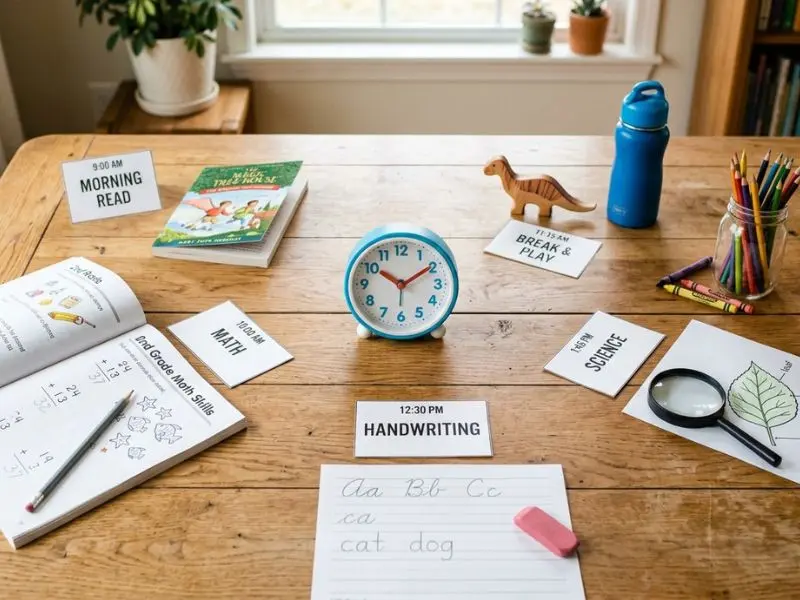
2nd grade homeschool hours often fall around 2–4 hours a day, while focused lessons may take less time. If your child finishes quickly, that does not automatically mean you are doing too little.
While reviewing second-grade homeschool schedules, I found that progress matters more than filling a clock. Your child’s pace, workload, breaks, and state requirements should guide the actual length of the day.
- How Many Hours a Day Should You Homeschool a Second Grader?
- What Subjects Are Typically Taught in Second Grade?
- What to Include in a 2nd-Grade Homeschool Schedule
- Sample 2nd Grade Homeschool Schedule
- Sample of a Weekly 2nd-Grade Homeschool Schedule
- Why Homeschool Hours Can Be Shorter Than a Traditional School Day
- Homeschoolers Need Breaks
- Homeschool at the Best Time of Day
- Dealing With Interruptions During Homeschool
- 2nd Grade Homeschool Hours Vary by Child
- Hands-On Learning Is Valuable Too
- When a 2nd Grade Homeschool Day Feels Too Long
- How Do I Find Local State Requirements for Second-Grade Homeschooling?
- Frequently Asked Questions
- Conclusion
Quick Answer
A 2nd grade homeschool day can often be planned around 2–4 hours, while focused academic lessons may take less time. Some children finish core work in about two hours. Others need longer for reading, projects, breaks, or extra practice. Use your child’s progress and your state’s requirements to guide the schedule.
How Many Hours a Day Should You Homeschool a Second Grader?
A 2–4 hour homeschool day can be a useful planning range for second grade. It is not a universal rule or required daily standard.
Some second graders finish their core academic work in about two hours. Others need more time for reading, math, writing, projects, or additional practice.
A longer day does not automatically mean more learning. A child who understands the lesson and finishes the work may not benefit from extra worksheets simply to make the school day longer.
It helps to separate focused academic time from the total homeschool day.
Focused Academic Time vs. Total Homeschool Day
Focused academic time includes lessons and practice that require direct attention. The total homeschool day can include many other learning activities.
| Focused Academic Time | Total Homeschool Day May Also Include |
|---|---|
| Math lessons | Read-alouds |
| Reading and phonics | Science projects |
| Writing | Art and music |
| Spelling and handwriting | Educational games |
| Direct instruction | Outdoor learning |
| Independent academic work | Enrichment activities |

For example, a child might complete two hours of focused academic work while the full learning day lasts three hours because it also includes breaks, reading, projects, or enrichment.
For legal recordkeeping, check your state’s homeschool requirements to determine what can count toward required instructional time.
What Can 2, 3, or 4 Homeschool Hours Look Like?
The number of homeschool hours can change depending on what you include in the day.
| Daily Length | What the Day Might Include |
|---|---|
| About 2 hours | Core reading, language arts, math, and short breaks |
| About 3 hours | Core subjects, independent reading, and science or social studies |
| About 4 hours | Core subjects, reading, projects, enrichment, and longer breaks |
These are examples rather than required schedules.
A two-hour day may work well when lessons are short and focused. A three- or four-hour day may include more projects, enrichment, independent reading, or breaks.
The better question is not, “Did we homeschool long enough?” It is, “Did my child complete appropriate work and understand what was taught?”
What Subjects Are Typically Taught in Second Grade?
Second-grade homeschool plans commonly give strong attention to reading, language arts, and math.
Other subjects may include:
- Reading
- Phonics
- Writing
- Spelling
- Handwriting
- Math
- Science
- Social studies
- Art
- Music
- Physical activity
You do not have to teach every subject for the same amount of time each day.
Reading and math may receive regular attention. Science, social studies, art, and other subjects can be spread across the week.
This approach can keep 2nd grade homeschool hours manageable without leaving important learning areas out.
What to Include in a 2nd-Grade Homeschool Schedule
A useful schedule should include focused lessons, independent practice, breaks, and opportunities to explore.
The amount of time needed for each subject will vary, but short lessons can be a practical starting point.
| Subject or Activity | Sample Planning Time |
|---|---|
| Math | 20–30 minutes |
| Reading/Phonics | 20–30 minutes |
| Writing/Language Arts | 20–30 minutes |
| Spelling/Handwriting | 10–20 minutes |
| Independent Reading | 15–30 minutes |
| Science/Social Studies | 20–40 minutes |
| Art/Music/Projects | Flexible |
| Movement and Breaks | Throughout the day |
These are sample planning ranges, not rules. A child may need more time for one subject and less for another.
Focused Learning Bursts

Second graders may find shorter learning blocks easier to manage than long lessons.
A lesson might last around 20 to 30 minutes before the child changes subjects or takes a short break. Some activities may take even less time.
There is no reason to stretch a 15-minute lesson to 30 minutes if your child understands the material and completes the work.
More difficult topics may need additional time. The schedule should respond to the lesson and the child rather than an exact timer.
Movement and Brain Breaks
A homeschool day does not have to involve several hours of continuous sitting.
Short breaks give children time to move and reset before another lesson. A break could include stretching, having a snack, walking outside, or simply stepping away from schoolwork for a few minutes.
Breaks can be especially helpful between subjects that require more concentration.
Independent Practice Time
Second grade can be a good time to gradually build independent learning skills.
A child may be able to complete familiar math practice, handwriting, independent reading, or another simple assignment without constant help.
Independence develops differently for every child.
Some second graders still need regular guidance. Others can complete several activities on their own. Both situations can fit a normal homeschool routine.
Creative Exploration
Not all learning has to happen through textbooks and worksheets.
Drawing, building, nature observation, educational games, crafts, simple experiments, and projects can support second-grade learning.
These activities may make the overall homeschool day longer without increasing formal desk time.
Sample 2nd Grade Homeschool Schedule
A daily example makes it easier to see how 2nd grade homeschool hours can fit together.
| Time | Activity |
|---|---|
| 9:00–9:25 | Math |
| 9:25–9:50 | Reading/Phonics |
| 9:50–10:05 | Break |
| 10:05–10:30 | Writing/Language Arts |
| 10:30–10:45 | Spelling/Handwriting |
| 10:45–11:15 | Independent Reading/Read-Aloud |
| 11:15–11:45 | Science or Social Studies |
| After 11:45 | Lunch, outdoor time, art, projects, or enrichment |
This example runs for about 2 hours and 45 minutes from start to finish, including a 15-minute break.
It is only one possible schedule.
Some days may be shorter. A science project, field trip, longer read-aloud, or other activity may make another day longer.
Schedule vs. Routine
A schedule assigns an exact time to each activity. A routine gives activities a general order.
A schedule might say:
9:00–9:30: Math
A routine could simply be:
Breakfast → Math → Reading → Break → Writing
A routine can work well when lesson lengths change from day to day.
If math takes 20 minutes today, you can move on. If reading needs extra attention tomorrow, you can spend longer on it.
The best approach is one your family can follow consistently without making learning unnecessarily rigid.
Sample of a Weekly 2nd-Grade Homeschool Schedule
Every homeschool day does not need to contain exactly the same subjects or number of hours.
Some families keep core subjects consistent while rotating science, social studies, projects, and enrichment.

| Day | Possible Focus |
|---|---|
| Monday | Core subjects + science |
| Tuesday | Core subjects + social studies |
| Wednesday | Core subjects + science or project |
| Thursday | Core subjects + social studies |
| Friday | Reading, enrichment, projects, field trips, or catch-up |
This is only an example.
Some families prefer five shorter academic days. Others may use four main academic days with another day for projects, field trips, enrichment, or unfinished work.
Your weekly plan should also meet any homeschool requirements that apply in your state.
Why Homeschool Hours Can Be Shorter Than a Traditional School Day
Parents sometimes worry when homeschool finishes much earlier than a traditional school day.
The two settings are difficult to compare by hours alone.
A classroom teacher works with many students. The school day can also include attendance, transitions, classroom routines, lunch, recess, group activities, and time spent moving between activities.
Homeschool instruction can sometimes be more direct because a parent is working with one child or a smaller number of children.
That does not mean one homeschool hour equals several classroom hours. There is no simple formula for comparing them.
Your child does not need extra busywork simply to make the homeschool clock look more like a traditional school day.
Homeschoolers Need Breaks

A two- or three-hour homeschool routine does not need to be one continuous academic session.
A simple pattern might look like:
Math → Break → Reading → Snack → Writing → Outdoor Break
If your child is losing focus, a short break may be more useful than forcing another lesson immediately.
It is also important to distinguish between lesson time and elapsed time.
If school begins at 9:00 a.m. and ends at noon, that does not necessarily mean your child completed three hours of direct academic instruction. That period may also include snacks, movement, reading, and breaks.
Homeschool at the Best Time of Day
There is no need to start homeschool at the same time as a local school.
Some children focus best in the morning. Others work better later.
Try placing demanding subjects such as math or writing at the time when your child is usually most alert.
Independent reading, art, projects, and easier activities can come later if that works better.
A predictable routine can help, but it does not have to look exactly the same every day.
Dealing With Interruptions During Homeschool
Homeschool schedules sometimes change.
Appointments, younger siblings, errands, illness, visitors, and unexpected events can interrupt a normal day.
When that happens, you do not always have to extend school until every planned activity is finished.
Focus on the most important work first. Less urgent activities can sometimes move to another day.
A flexible weekly plan also gives unfinished lessons somewhere to go without turning one interrupted day into a stressful one.
2nd Grade Homeschool Hours Vary by Child
Two children in the same grade may need different amounts of time.
One second grader may read independently and finish math quickly. Another may need more help with phonics or extra time to understand a math concept.
A child’s pace can even change by subject.
One child may finish reading quickly but need more time for writing. Another may move through math quickly but need additional reading practice.
Comparing your homeschool hours with another family’s schedule may therefore be misleading.
Look instead at your child’s understanding, progress, workload, and ability to stay engaged.
Hands-On Learning Is Valuable Too
Learning does not always stop when formal lessons end.
A child can practice measurement while cooking. A nature walk can support science. Building activities can develop problem-solving skills. Museums and historical places can support social studies.
Read-alouds, educational games, art, music, and projects can also enrich the learning day.
For planning purposes, these activities can be considered part of the broader homeschool experience.
However, whether a particular activity legally counts toward required instructional time depends on your state’s homeschool rules.
When a 2nd Grade Homeschool Day Feels Too Long
A schedule should help your child learn. It should not become a goal that must be completed at any cost.
If homeschool regularly takes much longer than expected, look at what may be causing it.
Ask:
- Are individual lessons too long?
- Is there too much repetitive work?
- Does your child need more breaks?
- Are too many subjects being completed every day?
- Is the work at the right level?
- Does one difficult subject take up most of the day?
A schedule may also need adjusting if lessons become less productive as the day continues.
Try shortening lessons, adding movement breaks, or moving less demanding activities to another time.
You can also rotate some subjects instead of teaching everything every day.
Is Your Homeschool Day Working?
Instead of judging the day by hours alone, look for these signs:
- Your child understands most completed lessons.
- Core subjects are receiving enough attention.
- The workload matches your child’s current level.
- Lessons remain productive rather than becoming constant busywork.
- Breaks help your child return ready to learn.
- Your child is making steady progress over time.
If these areas are working well, you may not need to make the homeschool day longer.
What If Your Second Grader Finishes Early?
Finishing early does not automatically mean your child is doing too little.
If your second grader completes appropriate work, understands the lesson, and is making steady progress, there is little benefit in adding busywork just to reach an arbitrary number of hours.
Some days will naturally be shorter than others.
If school regularly finishes much earlier than expected, review the curriculum and your child’s progress. Make sure important subjects and skills are receiving enough attention.
How Do I Find Local State Requirements for Second-Grade Homeschooling?
Recommended 2nd grade homeschool hours and legal homeschool requirements are two different things.
Homeschool requirements vary across the United States. Depending on the state, rules may address instructional days or hours, attendance, required subjects, assessments, records, or notices.
A general recommendation of two to four hours does not automatically satisfy your state’s homeschool law.
Before setting your schedule, check the homeschool laws in your state to see which attendance, subject, testing, or other requirements apply to your family.
This is especially important if your state requires a minimum number of instructional days or hours.
Frequently Asked Questions
Is 2 Hours of Homeschool Enough for 2nd Grade?
Yes, two focused hours may be enough for some second graders. It depends on the child’s pace, curriculum, progress, and state requirements.
What If My Second Grader Finishes Homeschool in 90 Minutes?
Finishing in 90 minutes can be fine if your child understands the lessons and completes appropriate work. Avoid adding busywork just to fill time.
How Long Should Math Take in 2nd Grade Homeschool?
A second-grade math lesson may take about 20–30 minutes. Adjust the time based on your child’s understanding and the lesson difficulty.
How Long Should Reading Take?
Reading or phonics may take about 20–30 minutes, plus optional independent reading or read-aloud time.
Does a Second Grader Need Six Hours of Homeschool?
No, a second grader does not automatically need six hours of homeschool. Focused home instruction can often be completed in less time.
Do Breaks Count as Homeschool Hours?
Breaks are part of the overall homeschool day but are different from focused instruction. Check your state’s rules for what legally counts as instructional time.
Should a Second Grader Homeschool Five Days a Week?
Not always. Families may use four or five academic days, depending on their schedule and applicable state requirements.
What Counts as Learning During a Homeschool Day?
Reading, direct lessons, projects, experiments, educational activities, art, and hands-on learning can all support learning. Check state rules for what can count toward required instructional time.
Conclusion
From comparing second-grade routines, lesson lengths, and homeschool requirements, I have learned that the clock is only one part of a successful day. Use the 2–4 hour range as a planning guide, not a target. Prioritize understanding and steady progress, adjust when lessons drag, and always follow your state’s current homeschool rules.