 Skip to content

Parents or guardians start searching for better learning options when traditional school no longer feels right. I have seen families feel confused when they hear terms like accreditation, online programs, and diplomas. It often feels hard to know what is truly important.
From working closely with homeschool choices, I have noticed that confusion often comes from understanding structure and recognition. Accredited homeschool programs give parents a clearer direction, helping them choose a path that feels reliable, organized, and aligned with their child’s future goals.
- Quick Answer
- What Are Accredited Homeschool Programs?
- What Makes a Homeschool Program Accredited?
- Types of Accreditation in Homeschool Programs
- Why Accreditation Matters
- Benefits of Accredited Homeschool Programs
- Features of the Best Accredited Homeschool Programs
- Accredited vs Non-Accredited Homeschool Programs
- When Should You Choose an Accredited Program?
- Best Accredited Homeschool Programs in the USA
- Best Accredited Homeschool Programs by Category
- Comparison of Top Accredited Homeschool Programs
- How to Choose the Right Accredited Program
- Do You Need an Accredited Program to Homeschool?
- Do Colleges Accept Accredited Homeschool Programs?
- Cost of Accredited Homeschool Programs
- Online vs Offline Accredited Homeschool Programs
- Pros and Cons of Accredited Homeschool Programs
- Frequently Asked Questions
- Conclusion
Quick Answer
Accredited homeschool programs are homeschool education programs reviewed and approved by recognized accrediting agencies such as Cognia, WASC, or DEAC. They provide structured curriculum, recognized transcripts, and diplomas that may simplify college admissions and credit transfers.
What Are Accredited Homeschool Programs?
Accredited homeschool programs are learning programs approved by official education organizations. These organizations check if the program meets certain quality standards.
In simple terms, this means:
- The curriculum is structured
- Teachers are qualified
- Student progress is monitored
When a program is accredited, it gives more confidence that your child is receiving a recognized education.
If you are new to this concept, it may also help to understand what homeschooling really means and how it works before choosing a program.
What Makes a Homeschool Program Accredited?
Not all homeschool programs are the same. A program becomes accredited when it is reviewed by an official accrediting body.
Understanding homeschool accreditation helps parents verify whether a program meets recognized educational standards.
Common accrediting organizations include:
- Cognia
- WASC (Western Association of Schools and Colleges)
- NEASC
These organizations check:
- Curriculum quality
- Teaching standards
- Student assessment
If a program passes these checks, it receives accreditation status.
Types of Accreditation in Homeschool Programs

Not all accreditation is the same, and this is where many parents get confused.
Regional Accreditation
This is the most widely accepted form. It is recognized by most colleges and institutions in the United States.
Many families prefer regionally accredited homeschool programs because they are often recognized more broadly by colleges and universities.
Examples include:
- Cognia
- WASC
- NEASC
National Accreditation
This is also valid but may not always carry the same weight as regional accreditation.
Example:
- DEAC (Distance Education Accrediting Commission)
In simple terms, both types are legitimate, but regional accreditation is often preferred for college pathways.
Why Accreditation Matters
Before choosing a program, it is important to understand why accreditation matters.
Accreditation affects how your child’s education is viewed by others.
- Colleges may trust an accredited homeschool diploma more
- Credits are easier to transfer
- Records are more organized
- It provides structure for learning
However, accreditation is helpful, but not always required.
Benefits of Accredited Homeschool Programs
Accredited homeschool programs offer several benefits that many families find helpful.
Personalized Learning Approach
Students can learn at their own pace based on their strengths.
Flexible Learning Environment
Families can create their own schedule and learning routine.
Access to Qualified Teachers
Many programs provide certified teachers for guidance and support.
High-Quality Curriculum
Programs follow structured plans that cover essential subjects. An accredited homeschool curriculum typically follows academic standards while giving students a clear learning pathway.
Student Support Services
Some programs include academic advisors and progress tracking tools.
Small Class Sizes
Students may receive more individual attention in certain programs.
Global Recognition
These programs are often recognized across many institutions, especially within the U.S.
Who Should Consider Accredited Homeschool Programs?
- Parents who want a structured and guided learning system
- Students planning to attend college in the future
- Families who prefer teacher support and accountability
- Parents who want recognized transcripts and diplomas
Features of the Best Accredited Homeschool Programs
The best accredited homeschool programs share common features.
- Clear learning goals
- Teacher support
- Flexible scheduling
- Progress tracking
- Recognized diplomas
These features help students stay on track and succeed.
Accredited vs Non-Accredited Homeschool Programs
| Feature | Accredited Programs | Non-Accredited Programs |
|---|---|---|
| Recognition | Widely accepted | Depends on situation |
| Structure | Formal curriculum | Flexible |
| Teacher Support | Often included | Parent-led |
| Cost | Usually higher | Often lower |
| College Use | Easier process | Still possible |
When Should You Choose an Accredited Program?
Choosing between accredited and non-accredited homeschooling depends on your goals.
You may prefer an accredited program if:
- Your child plans to attend college
- You want structured learning and teacher support
- You prefer a recognized diploma
A non-accredited approach may work better if:
- You want full flexibility
- You prefer a parent-led approach
- You plan to build a custom curriculum
Best Accredited Homeschool Programs in the USA
Some well-known accredited homeschool programs include:
- K12 (Stride)
- Connections Academy
- Laurel Springs School
- Keystone School
- Penn Foster
Each program offers different features depending on your needs.
Best Accredited Homeschool Programs by Category
Different families have different needs.
- Best for College Preparation: Laurel Springs School
- Best for Flexible Learning: Keystone School
- Best for Structured Learning: Connections Academy
- Best for Budget-Friendly Option: K12 (Stride public programs)
- Best for Career-Focused Learning: Penn Foster
Comparison of Top Accredited Homeschool Programs
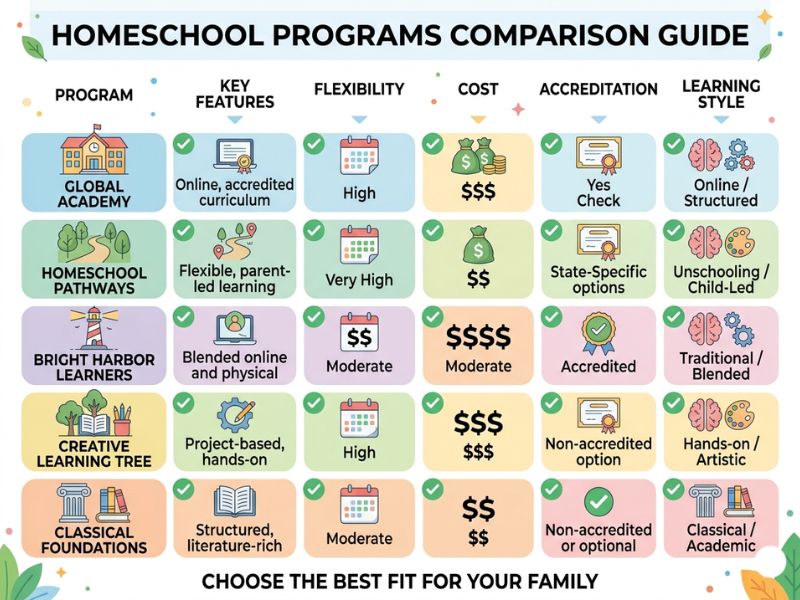
| Program | Accreditation | Grades | Learning Style |
|---|---|---|---|
| K12 | Cognia | K–12 | Teacher-led |
| Connections Academy | Cognia | K–12 | Structured online |
| Laurel Springs | WASC | K–12 | Flexible |
| Keystone | Cognia | K–12 | Self-paced |
| Penn Foster | DEAC (National) | 9–12 | Career-focused |
How to Choose the Right Accredited Program
Choosing the right program can feel overwhelming. I have seen many parents struggle at this step.
Here is a simple checklist:
- Check the accreditation body
- Understand your child’s learning style
- Compare costs
- Look for teacher support
- Confirm diploma recognition
- Review flexibility
Quick Decision Guide
| Your Situation | Best Choice |
|---|---|
| Preparing for college | Choose a regionally accredited homeschool program |
| Need flexibility | Select a self-paced accredited program |
| On a tight budget | Use free public online homeschool programs |
| Want full control | Consider non-accredited homeschooling |
Do You Need an Accredited Program to Homeschool?
In the United States, most states do not require accreditation.
This means:
- You can legally homeschool without an accredited program
- Parents have flexibility in choosing methods
To understand legal requirements in detail, explore homeschooling laws by state.
Do Colleges Accept Accredited Homeschool Programs?
Yes, many colleges accept students from accredited homeschool programs.
Many accredited schools provide professionally prepared homeschool transcripts, which can simplify the admissions process.
Accreditation can make the process easier because:
- Transcripts are structured
- Diplomas are recognized
It is also important to understand that many colleges accept homeschooled students even without accreditation. They often look at:
- Transcripts
- Portfolios
- Standardized test scores
Cost of Accredited Homeschool Programs
The cost varies depending on the program.
- Free: Public online programs
- $300–$2000 per year: Standard programs
- Higher cost: Premium private programs
Always compare value before choosing.
Is an Accredited Homeschool Program Worth It?
For many families, the answer depends on their goals. If you want structure, teacher support, and a smoother college path, it can be worth it. If flexibility and control matter more, other homeschooling options may be a better fit.
Online vs Offline Accredited Homeschool Programs
Most accredited online homeschool programs are delivered through digital platforms, although offline options also exist.
Online programs:
- Structured
- Teacher support
- Easy tracking
Offline programs:
- Flexible
- Parent-led
- Less screen time
You can also explore online homeschool curriculum and offline homeschool curriculum to understand both approaches better.
Pros and Cons of Accredited Homeschool Programs
Pros:
- Recognized education
- Structured learning
- Teacher support
- Easier college transition
Cons:
- Less flexibility
- Higher cost
- More structured schedule
Frequently Asked Questions
Are accredited homeschool programs worth it?
Yes, they help with structure and recognition.
Is accreditation required for homeschooling in the U.S.?
No, it is not required in most states.
Are online homeschool programs accredited?
Some are, but always verify the accrediting body.
Conclusion
From my experience, the real challenge is not homeschooling itself but choosing a path you can trust. Accredited homeschool programs can offer structure and recognition, but the best decision always depends on your child’s needs, your goals, and how confident you feel moving forward with that choice.