 Skip to content
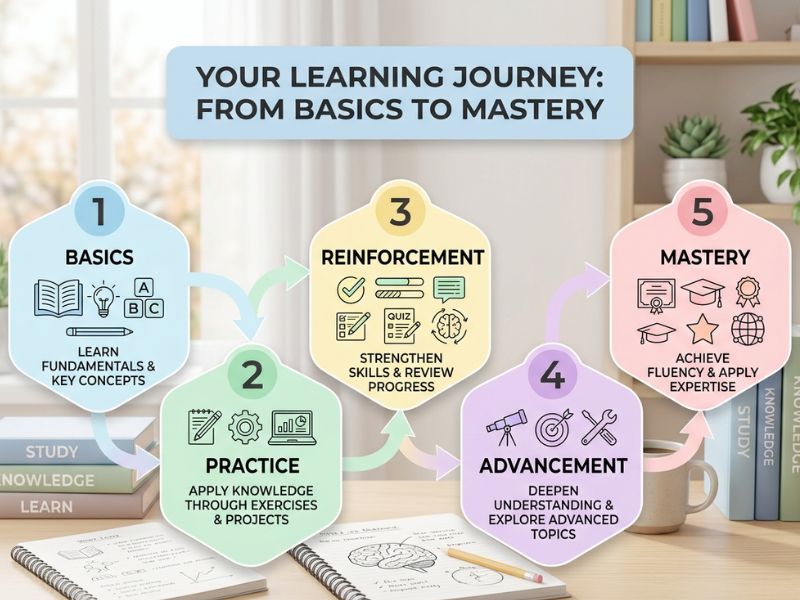
Planning what to teach can feel confusing. Many teachers and homeschool parents sit with books but don’t know where to begin. You may worry about teaching the wrong topics or missing something important. Without a clear plan, learning often feels scattered and stressful, especially without understanding scope and sequence in curriculum.
From experience, this confusion usually comes from a lack of structure, not effort. When lessons are not in order, students struggle to build strong understanding. That is why using a clear scope and sequence helps you teach with confidence and direction.
- Quick Takeaway
- What is Scope and Sequence?
- What is Scope?
- What is Sequence?
- Why is Scope and Sequence Important?
- Why You Need a Scope and Sequence
- When Should You Use Scope and Sequence?
- How to Create a Scope and Sequence
- Simple Learning Flow
- Choosing Your Curriculum Content
- Organizing the Sequence
- Adjusting for Flexibility
- What Makes a Good Scope and Sequence?
- Quick Checklist
- Types of Sequence in Curriculum
- Scope vs Sequence vs Curriculum Map vs Lesson Plan
- Alignment with US Education Standards
- Scope and Sequence Template (Simple Format)
- Examples of Scope and Sequence
- Common Mistakes When Creating a Scope and Sequence
- Frequently Asked Questions (FAQs)
- Conclusion
Quick Takeaway
- Scope = what you teach
- Sequence = the order you teach it
- Together, they create a clear learning plan
- A good structure prevents confusion and learning gaps
What is Scope and Sequence?
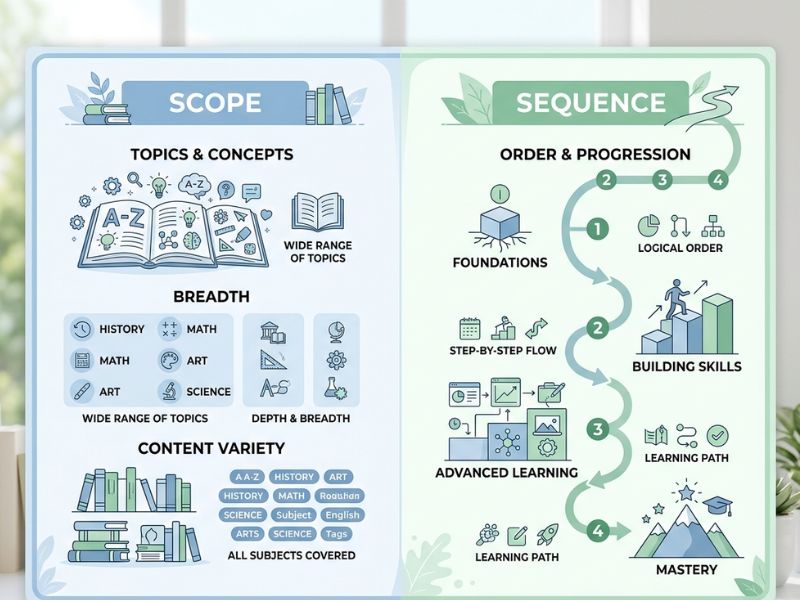
Scope and sequence is a plan for teaching. It answers two simple questions:
- What should be taught? (Scope)
- In what order should it be taught? (Sequence)
This helps students learn step by step without confusion.
What is Scope?
Scope means the topics and skills you plan to teach.
It includes:
- Subjects (Math, Science, Reading)
- Topics (Addition, Plants, Grammar)
- Skills (Problem solving, Writing)
Scope focuses on what to teach, not when.
What is Sequence?
Sequence means the order in which topics are taught.
It makes sure learning goes from:
- Easy → Hard
- Simple → Complex
- Basic → Advanced
Sequence focuses on when and how to teach topics in order.
Why is Scope and Sequence Important?
Scope and sequence helps both teachers and students.
Here’s why it matters:
- It prevents learning gaps
- It builds strong foundations
- It makes lessons easier to follow
- It improves student understanding
- It saves time and reduces confusion
Without it, learning can feel random and unorganized.
Why You Need a Scope and Sequence
If you are a teacher or homeschooling parent, this is very useful.
It helps you:
- Stay organized
- Track progress
- Plan lessons better
- Teach with confidence
It also helps students feel more secure because they know what comes next.
When Should You Use Scope and Sequence?
- When starting a new curriculum
- When homeschooling your child
- When lessons feel unorganized
- When students are struggling with basic skills
How to Create a Scope and Sequence
You can create your own plan by following simple steps.
Step 1: Set Learning Goals
Decide what students should learn by the end.
Example:
- Learn basic addition
- Understand sentence structure
Step 2: List All Topics (Scope)
Write down all topics and skills.
Example:
- Numbers
- Addition
- Subtraction
Step 3: Arrange the Order (Sequence)
Put topics in the right order.
Start with basics, then move forward.
Example:
- Counting
- Addition
- Subtraction
Step 4: Keep It Flexible
Adjust your plan based on student needs.
Not all students learn at the same speed.
Simple Learning Flow
Choosing Your Curriculum Content
Pick content that matches your goals.
You can use:
- Books
- Worksheets
- Online resources
- Real-life activities
Make sure content is simple and clear. If you’re unsure where to begin, using an easy homeschool curriculum can help you stay organized and focus on the most important topics without confusion.
Organizing the Sequence
A good sequence follows logic.
You can use:
- Weekly plans
- Monthly plans
- Grade-level plans
Always build on what students already know.
Adjusting for Flexibility
Learning is not always perfect.
You may need to:
- Repeat topics
- Slow down
- Skip ahead
That’s okay. Flexibility is important.
What Makes a Good Scope and Sequence?
A good scope and sequence is more than a list of topics. It should help students build knowledge in a logical order while allowing enough flexibility to meet different learning needs.
A strong scope and sequence usually:
- Starts with foundational skills before introducing harder concepts.
- Moves from simple ideas to more complex ones.
- Includes regular review to reinforce learning.
- Matches learning goals or grade-level standards.
- Can be adjusted when students need more practice.
When students master one concept before moving to the next, they are more likely to build lasting understanding.
Quick Checklist
- Do I know what to teach?
- Do I know what comes next?
- Are topics in a logical order?
- Can my student understand each step?
Types of Sequence in Curriculum
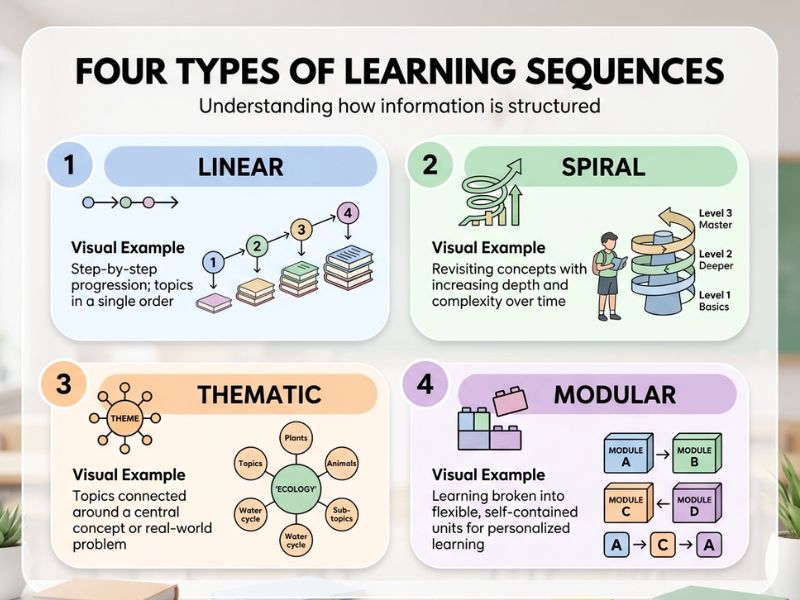
Not all learning follows the same pattern. There are different ways to organize the sequence.
1. Linear Sequence
Topics are taught one after another in a straight line.
Students must understand one topic before moving to the next.
Example:
Addition → Subtraction → Multiplication
2. Spiral Sequence
Topics are repeated over time with increasing difficulty.
Students revisit the same concept at a deeper level.
Example:
Basic fractions → Advanced fractions → Algebra with fractions
3. Thematic Sequence
Topics are grouped around a theme or idea.
This connects learning across different subjects.
Example:
Theme: “Weather”
- Science: Climate
- Reading: Weather stories
- Writing: Describing seasons
4. Modular Sequence
Content is divided into independent units.
Each unit can be taught separately.
Example:
Unit 1: Numbers
Unit 2: Geometry
Unit 3: Measurement
Scope vs Sequence vs Curriculum Map vs Lesson Plan
Understanding related terms can avoid confusion.
| Term | Meaning |
|---|---|
| Scope | What topics and skills are taught |
| Sequence | The order in which topics are taught |
| Curriculum Map | A big-picture plan for the whole year |
| Lesson Plan | Daily or weekly teaching plan |
Alignment with US Education Standards
In the United States, scope and sequence often align with learning standards.
These include:
- Common Core State Standards (for Math and English)
- NGSS (Next Generation Science Standards)
The National Academies’ guide to implementing the Next Generation Science Standards explains that science learning works best when concepts are introduced in a logical progression, allowing students to build understanding over time. This reflects the purpose of a well-planned scope and sequence.
This alignment helps ensure:
- Students learn the right skills at the right time
- Learning matches grade-level expectations
- Progress is consistent across schools
Even in homeschooling, many parents use these standards as a guide.
Scope and Sequence Template (Simple Format)
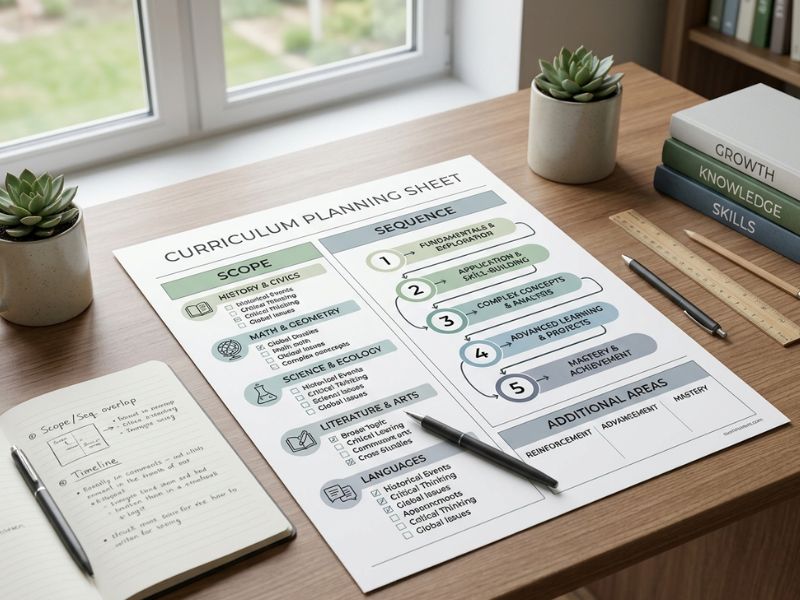
You can use a simple template to create your own plan.
Simple Scope and Sequence Template
Use this basic template to organize what students will learn and the order in which they will learn it. You can customize it for any subject or grade level.
| Subject | ________________________ |
| Grade Level | ________________________ |
| Learning Goal | ________________________ |
| Time Frame | ________________________ |
Scope (Topics to Teach)
- Topic 1 ________________________
- Topic 2 ________________________
- Topic 3 ________________________
- Topic 4 ________________________
Sequence (Teaching Order)
| Time | Topic |
|---|---|
| Week 1 | ________________________ |
| Week 2 | ________________________ |
| Week 3 | ________________________ |
| Week 4 | ________________________ |
Resources
- Textbook or curriculum
- Worksheets or printable activities
- Videos or online learning resources
- Hands-on projects or experiments
Assessment
- Quiz or test
- Project or assignment
- Observation or discussion
- Student portfolio or workbook review
Notes
Adjust the pace when students need more practice, add review sessions before introducing new concepts, and update the plan as learning goals change.
Examples of Scope and Sequence
Example: Elementary Math
Scope:
- Numbers
- Addition
- Subtraction
Sequence:
- Grade 1 → Counting
- Grade 2 → Addition
- Grade 3 → Subtraction
Example: Reading
Scope:
- Letters
- Words
- Sentences
Sequence:
- Learn letters
- Form words
- Read sentences
Common Mistakes When Creating a Scope and Sequence
Even a simple teaching plan can become less effective if topics are not organized carefully.
Some common mistakes include:
- Teaching advanced concepts before students understand the basics.
- Trying to cover too many topics in a short time.
- Following the plan too rigidly without considering student progress.
- Skipping review lessons before introducing new skills.
- Not updating the plan when learning goals change.
Keeping your scope and sequence simple, logical, and flexible helps students learn with greater confidence.
Frequently Asked Questions (FAQs)
What is scope and sequence in simple terms?
Scope is what you teach. Sequence is the order you teach it in.
Why is sequence important in learning?
Sequence helps students learn step by step. It prevents confusion and builds strong understanding.
What is the difference between scope and curriculum?
Scope is part of the curriculum. Curriculum is the full plan, while scope focuses only on topics and skills.
Can I change my scope and sequence?
Yes. It should be flexible. You can adjust it based on student needs and progress.
Is scope and sequence important for homeschooling?
Yes. It helps homeschooling parents stay organized and track learning easily.
Conclusion
From what I’ve seen, teaching becomes easier when there is a clear plan in place. A simple scope and sequence in curriculum removes confusion and builds steady progress. It doesn’t need to be perfect. It just needs to guide learning in the right order so both you and your students stay on track.