 Skip to content
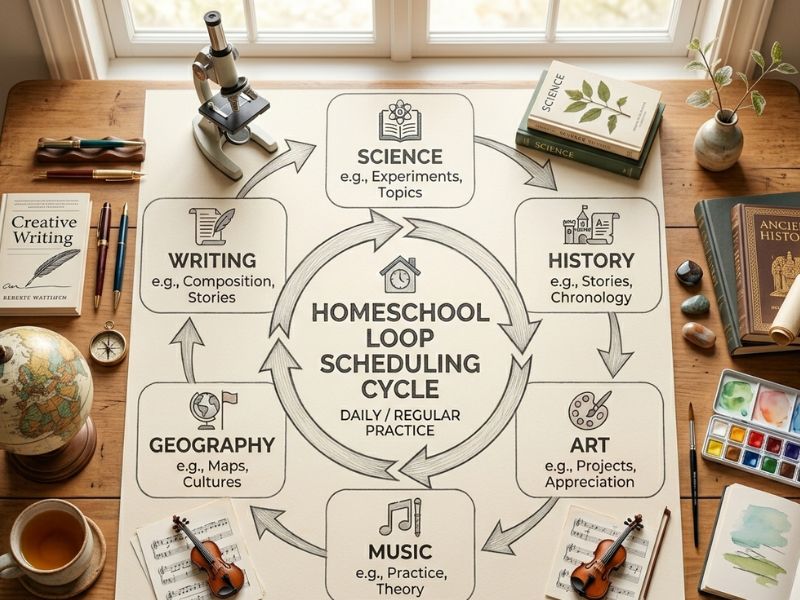
Loop scheduling for homeschool is a flexible way to rotate subjects without assigning them to fixed days. You simply follow a list, stop when your learning time ends, and continue where you left off the next day.
I started using this system when our schedule felt rushed and subjects kept getting skipped. It gave us enough structure to stay consistent without the pressure of completing everything on a specific day.
- What is Loop Scheduling?
- How Loop Scheduling Works
- What a Loop Scheduling Day Looks Like
- Why Loop Scheduling Works for Homeschool Families
- Why Loop Scheduling Works
- Loop Scheduling vs Block Scheduling
- Loop Scheduling vs Traditional Weekly Scheduling
- How to Create a Loop Schedule
- How Often Should Each Subject Appear in Your Loop?
- How to Prioritize Subjects in a Loop Schedule
- Loop Schedule Ideas
- Can You Use More Than One Homeschool Loop?
- Loop Schedule Examples
- How to Loop Schedule Multiple Children
- Common Loop Scheduling Mistakes
- How to Track Your Place in a Loop
- When Loop Scheduling May Not Work
- Daily + Loop Hybrid System
- Simple Loop Schedule Template
- Frequently Asked Questions
- Conclusion
What is Loop Scheduling?

Loop scheduling is a simple way to organize your homeschool subjects. Instead of assigning subjects to specific days, you create a list. You go through that list one by one.
When your day ends, you stop. The next day, you continue from where you left off.
This means:
- No pressure to “finish everything”
- No need to reshuffle missed subjects
- Learning continues naturally
Think of it like a playlist. You don’t restart the list every day. You just continue from the last point.
How Loop Scheduling Works

Loop scheduling works in a simple rotation system. You pick a list of subjects and move through them step by step.
Many families keep skills such as math and reading on a daily schedule and loop subjects such as science, history, art, and electives. However, you can also loop core subjects if that approach better fits your homeschool.
Here is how it looks in real life:
- Start your day with core subjects (like math and reading)
- Move to your loop list (science, history, art, etc.)
- Stop when your time is over
- Continue the next day from the same point
This means even on busy days, your schedule does not break.
Example flow:
- Day 1 → Science, History
- Day 2 → Art, Geography
- Day 3 → Music, Projects
You do not assign these to fixed days. You just follow the loop.
This pick-up-where-you-left-off approach is also explained in guide to the loop scheduling method, which shows how a loop continues after an interrupted homeschool day instead of forcing you to reschedule missed subjects.
What a Loop Scheduling Day Looks Like
A loop schedule becomes easier to understand when you see it in a real homeschool day. The goal is not to finish everything. The goal is to keep moving forward without stress.
| Time | Subject | Type |
|---|---|---|
| 9:00 | Math | Daily Core |
| 9:45 | Reading | Daily Core |
| 10:30 | Science | Loop Subject |
| 11:15 | History | Loop Subject |
| Next Day | Continue with the next loop subject | Flexible |
Why Loop Scheduling Works for Homeschool Families
Loop scheduling solves a common homeschool problem, falling behind.
Key benefits:
- Less stress
You no longer feel like you are failing when something gets skipped - More flexibility
Busy days do not break your routine - Better balance
All subjects get attention over time - Easy to manage
Planning becomes simple and quick - Works for real life
It fits your family’s natural rhythm
This method helps you focus on progress instead of perfection.
Why Loop Scheduling Works
Loop scheduling works because it removes the pressure to complete every subject on a fixed day. Instead of feeling behind, you simply continue from where you stopped.
- It reduces daily decision stress.
- It helps subjects get attention over time.
- It makes interruptions easier to handle.
- It gives structure without making your day feel strict.
Loop Scheduling vs Block Scheduling
Many parents compare different homeschool systems before choosing one.
| Feature | Loop Scheduling | Block Scheduling |
|---|---|---|
| Structure | Flexible rotation | Fixed time blocks |
| Missed work | Continue next day | Must reschedule |
| Stress level | Low | Medium |
| Best for | Flexible families | Structured learners |
If your days feel unpredictable, loop scheduling is usually the better choice.
Loop Scheduling vs Traditional Weekly Scheduling
A traditional homeschool schedule assigns subjects to specific days. For example, science may always happen on Monday. If Monday gets too busy, that lesson may need to be moved or skipped.
A loop schedule works differently. Subjects stay in order, so you simply continue where you stopped.
| Traditional Weekly Schedule | Loop Schedule |
|---|---|
| Subjects are tied to certain days | Subjects follow a rotating order |
| Missed lessons may need rescheduling | You continue with the next subject |
| Works well with predictable routines | Handles changing days more easily |
| Focuses on completing a weekly plan | Focuses on steady progress |
Neither system is better for every family. A traditional schedule can work well when your days are predictable, while a loop gives you more flexibility when plans often change.
How to Create a Loop Schedule
Creating a loop schedule is simple. You do not need complicated tools or planning.
Step 1: Choose your subjects
Pick subjects that do not need daily practice
Example: science, history, art
Step 2: Make a list
Write them in order. This becomes your loop
Step 3: Set daily core subjects
Keep math and reading outside the loop
Step 4: Start your loop
Work through subjects one by one
Step 5: Stop when time ends
Do not force completion
Step 6: Continue next day
Resume from the previous subject
How Often Should Each Subject Appear in Your Loop?
Not every subject needs equal time in your homeschool loop. Some subjects may need to come around more often than others.
For example, if you want science twice as often as art, your loop could look like this:
Science → History → Art → Science → Geography → Music
Science appears twice, so your child reaches it more often without assigning it to a fixed weekday.
Skills that need regular practice, such as math and reading, can stay outside the loop as daily subjects. Adjust the order and frequency based on your child’s needs, curriculum, and learning goals.
How to Prioritize Subjects in a Loop Schedule
A good loop does not have to treat every subject equally. Start by deciding which subjects need daily practice and which can rotate.
A simple system might look like this:
- Daily subjects: Math, reading, and writing
- Higher-frequency loop subjects: Science, history, and literature
- Lower-frequency loop subjects: Art, music, geography, and projects
You can also repeat an important subject inside the loop if it needs more attention.
The goal is not to create a perfectly balanced list. Build the loop around what your child needs to learn and how often each subject should realistically appear.
Loop Schedule Ideas
Here are some ideas you can include in your loop:
- Science
- History
- Geography
- Art
- Music
- STEM projects
- Life skills
- Reading projects
You can also group subjects:
- Creative loop (art + music)
- Academic loop (science + history)
This keeps your homeschool routine fresh and engaging.
Can You Use More Than One Homeschool Loop?
Yes. You do not have to put every subject into one long loop. Creating two or more smaller loops can make your homeschool schedule easier to manage.
For example:
| Type of Loop | Subjects or Activities |
|---|---|
| Academic Loop | Science, History, Geography |
| Creative Loop | Art, Music, Handicrafts |
| Morning Loop | Read-Aloud, Poetry, Memory Work |
| Life Skills Loop | Cooking, Cleaning, Budgeting |
You do not need all of these loops. Start with one or two that solve a real scheduling problem.
For example, you might complete one academic loop activity and one creative loop activity when time allows. Smaller loops also make it easier to control how often different subjects appear.
Loop Schedule Examples
Example for Elementary Student
- Math (daily)
- Reading (daily)
- Loop:
- Science
- History
- Art
- Geography
Day 1 → Science
Day 2 → History
Day 3 → Art
This works well for younger children who need variety.
Example for Middle School Student
- Math (daily)
- Writing (daily)
- Loop:
- Science
- History
- Coding
- Art
Total learning time: around 3–4 hours per day
Helps balance multiple subjects without overload
Example for High School Student
- Core subjects daily
- Loop:
- Advanced science
- Literature study
- Research projects
- Electives
Focus is more on depth and independent learning.
How to Loop Schedule Multiple Children
Loop scheduling can also work when you homeschool children at different grade levels. Keep subjects that require individual practice separate, then create a shared family loop for subjects everyone can study together.
For example:
Individual work:
- Math
- Reading
- Writing
Family loop:
- History
- Science
- Art
- Geography
- Read-alouds
Children can study the same general topic while completing work at their own level. An older child might write a short report, while a younger child draws a picture or gives an oral answer.
This can reduce repeated teaching while keeping the schedule flexible.
Common Loop Scheduling Mistakes

Loop scheduling is simple, but small mistakes can make it ineffective.
- Making the loop too long
A long list means some subjects take too long to repeat - Not tracking progress
If you don’t mark your place, you may forget where to continue - No priority subjects
Some subjects need more attention than others - Turning it into a strict schedule
This removes the flexibility that makes loop scheduling work
How to Track Your Place in a Loop
Tracking a loop does not need to be complicated. You only need to know which subject you completed and where to begin next time.
You can use:
- A simple checklist
- A homeschool planner
- A whiteboard
- A spreadsheet
- A sticky note or bookmark
For example, if you finish history and science is next on your list, mark science as your starting point for the next homeschool day.
The key is to track where you stopped, not which weekday you were supposed to reach. That keeps the system flexible without losing your place.
When Loop Scheduling May Not Work
Loop scheduling works for many families, but not for everyone.
- If you prefer a strict daily timetable
- If your child needs a fixed routine
- If your curriculum requires daily completion
- If flexible planning feels difficult
In these cases, a structured schedule may work better.
Daily + Loop Hybrid System
Many homeschool families use a mix of structure and flexibility.
- Daily subjects (core):
Math, Reading, Writing - Loop subjects:
Science, History, Art, Projects
This system gives you the best of both worlds consistency and flexibility.
Simple Loop Schedule Template
You can use this simple template to build and track your first homeschool loop:
| Order | Subject or Activity | Frequency | Completed |
|---|---|---|---|
| 1 | Science | Twice per loop | ☐ |
| 2 | History | Once per loop | ☐ |
| 3 | Art | Once per loop | ☐ |
| 4 | Science | Twice per loop | ☐ |
| 5 | Geography | Once per loop | ☐ |
| 6 | Music | Once per loop | ☐ |
Start with the first subject and work down the list. When your available loop time ends, stop and mark your place.
On the next homeschool day, begin with the next subject instead of restarting at the top. Once you reach the bottom, return to the first subject and begin the loop again.
You can add, remove, or repeat subjects depending on how often your child needs to study them.
Frequently Asked Questions
What is loop scheduling in homeschool?
It is a flexible method where you rotate subjects instead of assigning them to fixed days.
Is loop scheduling better than a daily schedule?
It works better for families who need flexibility in their routine.
How many subjects should be in a loop?
Start with 4–6 subjects to keep it simple and effective.
What if we do not finish the loop in one week?
You do not need to restart the loop. Simply continue with the next subject on your next homeschool day, even if a new week has started.
Can you use loop scheduling in high school?
Yes, it works well for managing electives and non-core subjects.
Conclusion
Over time, I realized that the right system matters more than a perfect plan. With loop scheduling for homeschool, we stopped worrying about missed work and focused on steady progress. From my experience, a flexible structure creates better results and makes homeschooling feel calm, manageable, and effective.