 Skip to content
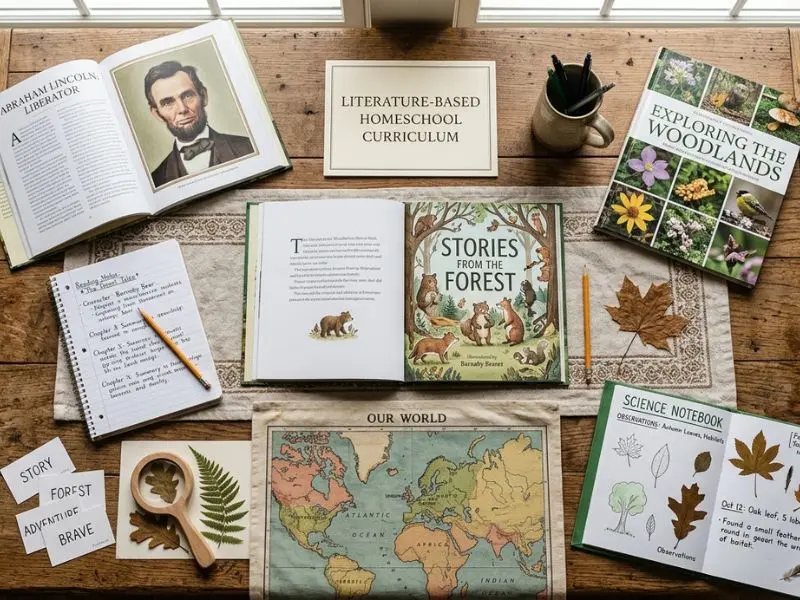
A literature based homeschool curriculum sounds simple until you start comparing options. Some include shelves of books, others require separate subjects, and the reading load can surprise parents. The real challenge is finding a program your child will enjoy without creating an exhausting schedule or an unexpected book bill.
When I assess curriculum choices, I look past attractive reading lists and focus on daily usability. Subject coverage, reading level, parent time, worldview, and total cost matter just as much as the books themselves. This guide uses those practical checks to help you decide what actually fits your family.
- What Is a Literature-Based Homeschool Curriculum?
- How Does a Literature-Based Curriculum Work?
- Literature-Based Curriculum vs. Traditional Curriculum
- Why Choose a Literature-Based Homeschool Curriculum?
- Is a Literature-Based Homeschool Curriculum Right for Your Child?
- What Subjects Can Be Taught Through Literature?
- Best Literature-Based Homeschool Curriculum Options
- Secular Literature-Based Homeschool Curriculum
- Christian Literature-Based Homeschool Curriculum
- Can Literature-Based Curriculum Work for All Grade Levels?
- Does Literature-Based Curriculum Work for Multiple Ages?
- How Much Reading Aloud Is Involved?
- How Much Does a Literature-Based Homeschool Curriculum Cost?
- How to Choose the Best Literature-Based Homeschool Curriculum
- Can You Customize a Literature-Based Curriculum?
- How to Incorporate Literature Into Your Homeschool
- Frequently Asked Questions
- Conclusion
Quick Takeaway
A literature-based homeschool curriculum uses real books as a central part of learning. It can work especially well for children who enjoy stories and discussion. Before choosing one, compare your child’s reading level, subjects covered, parent reading time, worldview, book availability, and total cost.
What Is a Literature-Based Homeschool Curriculum?
A literature-based homeschool curriculum uses high-quality books to teach or support academic subjects. Books become part of the lesson instead of being treated only as extra reading.
For example, a child studying early American history might read a biography, historical fiction, and nonfiction about the same period. The reading could lead to discussion, map work, research, or a writing assignment.
Literature-based homeschooling often includes living books. This term generally refers to engaging, narrative-rich books written by authors who know or care deeply about their subject. These books aim to bring people, events, places, or ideas to life rather than simply presenting short facts to memorize.
Literature can play a major role in subjects such as language arts, history, social studies, geography, and some areas of science. Math, phonics, spelling, and other skill-based subjects may still need direct instruction and practice.
The main idea is simple: books become part of how a child learns the subject, not just something the child reads afterward.
How Does a Literature-Based Curriculum Work?
A literature-based curriculum usually starts with a book or group of books connected to a topic.
A child may read independently, listen while a parent reads aloud, or use both methods. The reading then leads to other learning activities.
A simple lesson might follow this pattern:
Read → Discuss → Write → Explore → Apply
For example, a child could read a story set during the American Revolution. After reading, the child might find important places on a map, discuss what happened, read nonfiction about the real event, and write a short response.

Some programs provide complete reading schedules, lesson plans, discussion questions, writing assignments, activities, and assessments. Others give parents more freedom to choose books and organize lessons themselves.
The amount of structure depends on the curriculum.
In real life, literature-based homeschooling does not mean spending the entire school day reading. A family might read one chapter, discuss it for a few minutes, use a map, and complete a short writing activity. For another example of how this can work in practice, BookShark explains what a literature-based homeschool day can include, such as read-alouds, independent reading, discussion, writing, and connected subject work. The child might then move to a separate math lesson.
Daily routines also change with age. Younger children often depend more on read-alouds. Older students can usually complete more reading, research, and writing independently.
Literature-Based Curriculum vs. Traditional Curriculum
Both approaches can provide a strong education. The main difference is how information is presented and used.
| Literature-Based Curriculum | Traditional Curriculum |
|---|---|
| Uses real books heavily | Relies more on textbooks |
| Often connects several subjects | Subjects are often taught separately |
| Encourages discussion | Often uses direct questions and exercises |
| May include narration and writing | Often includes worksheets and tests |
| Can require more parent reading | May allow more independent textbook work |
| Uses stories and narratives | Often organizes information by topic |

One approach is not automatically better than the other.
Some children enjoy learning through stories and discussion. Others prefer clear explanations, short lessons, and direct practice.
Many homeschool families use both methods. A child might use literature for history and language arts while following a more traditional program for math or phonics.
Why Choose a Literature-Based Homeschool Curriculum?
Books can help children see how people, places, events, and ideas connect.
A textbook might explain a historical event in a few paragraphs. A biography or historical story can give the child more context about the people and choices involved.
Literature can also create opportunities for deeper discussion. Instead of only asking a child to remember a date or definition, a parent might ask:
- Why did this person make that choice?
- How are these two events connected?
- What would you have done differently?
- What point of view does the author present?
- What evidence supports this idea?
These conversations can support reading comprehension, vocabulary, writing, and critical thinking.
Literature-based learning can also be flexible. Families can spend longer on an interesting topic or replace a book that does not work well for their child.
Still, reading many good books does not automatically create a complete education. Parents should make sure important skills and subjects are covered.
Is a Literature-Based Homeschool Curriculum Right for Your Child?
Literature-based homeschooling can be a good fit for children who enjoy stories, books, discussion, and exploring topics in depth.
It may work especially well for a child who enjoys being read to, remembers ideas through stories, asks questions about books, or likes connecting people and events.
However, it will not suit every student in the same way.
A literature-heavy curriculum may need adjustment if your child finds long reading sessions difficult, prefers short and direct lessons, or needs focused practice in specific skills.
Parent availability matters too. Younger children may need significant read-aloud and discussion time. A parent with limited teaching time may prefer a program that allows more independent work.
Before committing to a complete program, pay attention to how your child responds to books. If stories regularly lead to questions and curiosity, a literature-rich approach may be worth exploring. If long reading sessions cause frustration, a lighter literature approach combined with direct instruction may work better.
You do not have to choose one teaching method for every subject. Literature-based history and language arts can work alongside direct math, phonics, spelling, or other skill-based instruction.
The best approach is one that fits your child’s needs and remains practical for your family.
Quick Fit Check
| It May Be a Good Fit If… | You May Need to Adjust It If… |
|---|---|
| Your child enjoys stories and books. | Long reading sessions often cause frustration. |
| Your child likes discussing ideas. | Your child prefers short, direct lessons. |
| You want subjects to connect through common topics. | You prefer subjects to be taught separately. |
| You have time for some parent-led reading. | Parent-led reading time is very limited. |
| You value flexible book choices. | You want highly independent instruction. |
These are general signs, not strict rules. A mixed approach can work well when a child enjoys literature for some subjects but needs more direct instruction in others.
What Subjects Can Be Taught Through Literature?
Literature-based homeschooling works more naturally for some subjects than others.
| Subject | How Literature Can Support Learning |
|---|---|
| Language Arts | Novels, stories, poetry, vocabulary, writing, and discussion |
| History | Historical fiction, biographies, nonfiction, and primary sources |
| Social Studies | Books about people, communities, cultures, and events |
| Geography | Travel writing, maps, biographies, and stories set in different places |
| Science | Narrative nonfiction, nature books, and scientist biographies |
| Art | Artist biographies, picture study, and related projects |
| Math | Stories may support ideas, but direct instruction and practice are usually still needed |
Families do not need to force every subject into a literature-based format. A mixed approach can be more practical.
Literature-Based Language Arts
Language arts is one of the easiest subjects to connect with literature.
A child can learn vocabulary from books and use the same reading for narration, discussion, writing, and literary analysis.
Younger children might retell a story in their own words. Older students can study characters, themes, point of view, figurative language, and an author’s argument.
Reading can also lead naturally into writing. A student might compare two characters, research an idea from a book, write a response, or create an essay about a theme.
Children who need focused help with phonics, spelling, handwriting, or grammar may still benefit from separate instruction.
Literature-Based Science and Social Studies
Books can also support science and social studies.
In social studies, students can use biographies, historical fiction, memoirs, nonfiction, and primary sources to explore a time or place.
A history lesson about westward expansion, for example, could combine a book with maps, nonfiction, historical documents, and writing.
Science can include narrative nonfiction and books about animals, nature, space, inventions, and scientists.
Books should not replace experiments, observation, mathematical work, or direct science instruction when those are needed. Literature works best as one part of a broader learning experience.
Best Literature-Based Homeschool Curriculum Options
There is no single best literature-based homeschool curriculum for every family.
Programs differ in worldview, grade level, structure, subject coverage, book selection, cost, and parent involvement. Start by comparing programs according to what your family actually needs.
| Curriculum | General Approach | Worldview | Useful Starting Point For |
|---|---|---|---|
| Sonlight | Structured and literature-rich | Christian | Families wanting planned, book-centered lessons |
| BookShark | Structured and literature-rich | Secular | Families wanting a planned secular option |
| Build Your Library | Literature-rich and flexible | Secular | Families comfortable sourcing books |
| Oak Meadow | Creative and flexible | Secular | Families interested in a broader creative approach |
| Beyond the Page | Integrated and literature-based | Secular | Families wanting connections across subjects |
| AmblesideOnline | Charlotte Mason-inspired | Christian | Families interested in living books and Charlotte Mason methods |
| Beautiful Feet Books | Literature-based studies | Christian | Families interested in learning through selected literature |
| Blossom & Root | Gentle and literature-rich | Secular | Families seeking literature-rich learning, especially in younger years |
Use this comparison as a starting point. Curriculum offerings can change. Review current samples, book lists, grade levels, subject coverage, and publisher information before making a decision.
Sonlight Curriculum
Sonlight is a Christian homeschool curriculum known for its literature-rich approach.
It uses literature, biographies, historical fiction, and read-aloud books alongside planned lessons and reading schedules.
Families looking for a structured Christian program may want to compare Sonlight with other literature-based options. Because reading is a major part of the program, consider how much parent-led reading and discussion fits your schedule.
BookShark
BookShark uses books as a central part of learning and provides a planned structure for families.
Its programs include scheduled reading and materials across several subjects. It may appeal to families looking for a secular, literature-rich option with organized lesson plans.
Check the current level, subject coverage, and included materials before choosing a program.
Build Your Library
Build Your Library is a secular literature-based homeschool curriculum.
It uses literature alongside subjects such as history and language arts. Families generally need to source many of the books themselves, which gives parents flexibility but also requires planning.
Book availability and the total cost of sourcing materials should be considered before choosing a level.
Oak Meadow
Oak Meadow offers homeschool curriculum across multiple grade levels.
Its approach can include literature, projects, creative activities, and other forms of learning. It may appeal to families who want something broader than a textbook-and-worksheet routine.
Review the specific grade carefully because the learning approach and level of student independence can change as children get older.
Beyond the Page
Beyond the Page uses literature as an important part of integrated learning.
Books can connect with writing, discussion, research, science, and social studies rather than keeping every subject completely separate.
This approach may suit families who like connections between subjects and want literature to lead into broader learning.
AmblesideOnline
AmblesideOnline is a Charlotte Mason-inspired homeschool curriculum that makes extensive use of living books.
Its approach includes literature, history, nature study, poetry, and other subjects.
It may appeal to families interested in a book-rich Charlotte Mason approach. Parents should first understand the method and expected involvement before deciding whether it fits their homeschool.
Beautiful Feet Books
Beautiful Feet Books offers literature-based study guides and book packages.
Its materials often connect history and other topics with selected literature. Families can use books, discussion, and related assignments to explore a subject in greater depth.
Review the worldview, reading level, and books used in the specific course you are considering.
Blossom & Root
Blossom & Root offers secular homeschool materials with an emphasis on literature, nature, creativity, and hands-on learning.
It is often considered by families seeking a gentle, literature-rich approach, especially during the younger years.
Parents should compare the actual level and subject coverage with their child’s needs instead of choosing only by age.
You do not need to compare every literature-based curriculum available. Start by narrowing your choices according to worldview, your child’s age, desired structure, and the amount of parent-led learning you can manage.
Then look closely at sample lessons and book lists from a few suitable programs. This can tell you more than choosing a curriculum simply because it appears on a “best” list.
Secular Literature-Based Homeschool Curriculum
A secular literature based homeschool curriculum uses books as important teaching resources without building instruction around a religious worldview.
Several literature-based programs describe themselves as secular. However, the secular label does not tell you everything about a curriculum.
Parents should still review:
- Grade or age range
- Subjects included
- Required books
- Parent involvement
- Lesson structure
- Writing requirements
- History and science approach
- Total cost
Book lists and sample lessons are especially useful because they show what your child will actually read and do.
Choose based on the complete program rather than one label.
Christian Literature-Based Homeschool Curriculum
Christian literature-based homeschool curricula also use stories, biographies, nonfiction, and other books as important learning resources.
Christian beliefs may be integrated into lesson plans, discussions, history, science, or other subjects.
Sonlight is one example of a literature-based program that identifies its approach as Christian. Other Christian programs may differ in how faith is included.
Review sample lessons and book lists before purchasing. This helps you understand both the academic approach and worldview of the curriculum.
Can Literature-Based Curriculum Work for All Grade Levels?
Literature-based learning can be used from the early years through high school, but the approach should change as students grow.
Early elementary students may spend more time listening to read-alouds, looking at picture books, discussing stories, and giving short oral narrations.
Upper elementary students can begin reading more independently. Books may lead to written responses, research, geography, history, and science activities.
Middle school students can handle longer books and more complex ideas. Writing assignments, discussion, and independent research can increase.
High school students may study novels, plays, essays, biographies, nonfiction, and primary sources. Their work can include literary analysis, research papers, and more advanced discussion.
Age is not the only factor. Reading ability, maturity, interests, and academic needs should also guide book selection.
Does Literature-Based Curriculum Work for Multiple Ages?
Yes, some literature-based learning can work well with siblings of different ages.
A family might read the same history book together. A younger child could draw a picture or give an oral narration. An older student could complete extra reading or write about the same topic.
This can reduce the need to teach every content subject separately.
However, combining children has limits.
Math, reading instruction, advanced writing, and other skill-based subjects often need to match each child’s individual level.
Shared literature works best when parents adjust assignments rather than expecting children of different ages to complete the same work.
How Much Reading Aloud Is Involved?
The amount of reading aloud depends on the curriculum and the child’s age.
Younger students often need parents to do much of the reading. A literature-heavy program may therefore require significant parent involvement.
Older children can usually complete more books independently.
Before choosing a curriculum, check its sample schedule and look at:
- Pages assigned each day
- Read-aloud books
- Independent reading
- Discussion time
- Writing assignments
- Extra activities
This gives you a better picture of the daily workload than looking at a book list alone.
Families teaching several children should pay particular attention to this. A curriculum may look simple on paper but become difficult if it requires hours of parent-led reading and discussion.
Also consider the time required to find and manage books. If a curriculum uses many separate titles, you may need to reserve library books, buy unavailable titles, and organize books around the reading schedule.
A good book list still needs to fit the time you realistically have available.
How Much Does a Literature-Based Homeschool Curriculum Cost?
The total cost depends on more than the price of the curriculum guide.
Families may need to pay for:
- Curriculum or teacher guides
- Required books
- Printing
- Activity supplies
- Separate math or skill-based programs
Some curriculum packages include many required books. Others provide lesson plans and book lists but expect parents to find the books separately.
You may be able to reduce costs by borrowing books from the library, purchasing used copies, reusing books with younger children, and using books you already own.
For example, one program might have a lower-priced guide but require many books to be purchased separately. Another may cost more upfront because more materials are included. The lower initial price is not automatically the lower total cost.
Before comparing programs, make a simple list of the curriculum, required books, separate subjects, printing, and activity materials you expect to need.
Compare the total expected cost, not only the advertised curriculum price.
How to Choose the Best Literature-Based Homeschool Curriculum

Start with your child rather than the curriculum brand.
A popular curriculum is not automatically the right curriculum for your family.
Consider:
- Age and grade level: Does the material match your child?
- Reading ability: Can your child manage the assigned books?
- Worldview: Does the program fit what your family wants?
- Subjects: Is it complete, or will you need separate programs?
- Structure: Do you want daily plans or more flexibility?
- Parent involvement: How much reading and teaching will you do?
- Books: Are they included or purchased separately?
- Budget: What will the program cost after books and supplies?
- Learning preference: Does your child enjoy books and discussion?
- Multiple children: Can any subjects or books be shared?
A simple way to narrow the decision is:
Child fit → worldview → subjects → structure → parent time → book availability → total cost

Before You Choose
- ☐ Check your child’s current reading level.
- ☐ Decide whether you want secular or faith-based materials.
- ☐ Check which subjects the curriculum actually covers.
- ☐ Review a sample weekly or daily lesson.
- ☐ Estimate how much parent-led reading is required.
- ☐ Check whether required books are included.
- ☐ See which books you may be able to borrow from the library.
- ☐ Add books, supplies, printing, and separate subjects to the total cost.
- ☐ Review the curriculum’s scope and sequence.
- ☐ Make sure the routine is realistic for your family.
There is little reason to compare prices if a curriculum’s teaching style does not fit your child. Remove programs that do not meet your basic needs first. Then compare the remaining choices more closely.
Whenever possible, review sample lessons and book lists before buying.
A curriculum should fit your family. Your family should not have to reshape every day just to fit a curriculum.
Can You Customize a Literature-Based Curriculum?
Yes. Literature-based homeschooling can be flexible.
Parents can replace a book that is too easy, too difficult, unavailable, or simply not a good fit.
You can also slow down the reading schedule or spend more time on a topic that interests your child.
Libraries can make customization easier. Instead of purchasing every title, families may be able to borrow some books and spend their curriculum budget elsewhere.
Parents may also add:
- Audiobooks
- Maps
- Documentaries
- Art projects
- Nature study
- Field trips
- Writing assignments
- Primary sources
- Hands-on experiments
Customization should have a purpose. More books and activities do not automatically mean better learning.
Start with what your child needs to learn. Then choose books and activities that support that goal.
How to Incorporate Literature Into Your Homeschool
You do not need to purchase a complete literature-based curriculum to bring more books into your homeschool.
Start with a subject you already teach.
For history, you could add biographies, historical fiction, or nonfiction related to the period your child is studying. For science, you might add nature books, scientist biographies, or narrative nonfiction alongside experiments and direct instruction.
Read-alouds can also introduce younger children to books that are above their independent reading level. Older students can complete more reading on their own and discuss important ideas afterward.
Audiobooks can be useful during car rides, quiet activities, or family reading time.
You can also combine literature-rich learning with curriculum you already use.
For example, keep your current math and language skills programs while adding biographies and historical fiction to history. Or continue using your regular science curriculum while adding nature books and scientist biographies.
This allows your family to try literature-rich learning without replacing everything at once.
Start small. Choose one subject and add one or two meaningful books. The goal is not to read as many books as possible. The goal is to use books that help your child understand the subject more deeply.
Frequently Asked Questions
Will My Child Miss Content Compared With a Textbook?
Not necessarily. A well-planned literature-based curriculum can cover many important topics and skills.
However, parents should check the curriculum’s scope and sequence for possible gaps. Some subjects, especially math and skill-based instruction, may need separate resources.
Do not judge academic coverage only by the number of books included. Look at the skills and topics the curriculum plans to teach across the year.
Are Literature-Based Curriculums Suitable for High School Students?
Yes. High school students can use novels, nonfiction, biographies, essays, plays, and primary sources.
Their reading can lead to literary analysis, research, discussion, and formal writing. Parents should also make sure courses meet their homeschool goals and any graduation requirements that apply to their situation.
Where Can You Find Literature-Based Homeschool Curriculum?
Literature-based curricula are available directly from curriculum publishers and homeschool retailers.
Some programs provide digital guides, while others offer packages containing books and other materials.
Families can also use libraries, used-book sellers, and books they already own to reduce the number of new books they need to purchase.
Conclusion
After comparing literature-based approaches, I would choose for fit rather than the longest book list or most popular name. Check sample lessons, reading demands, subject coverage, and the real cost first. A literature based homeschool curriculum is most useful when its books support your child’s learning without making everyday homeschooling harder to manage.