 Skip to content
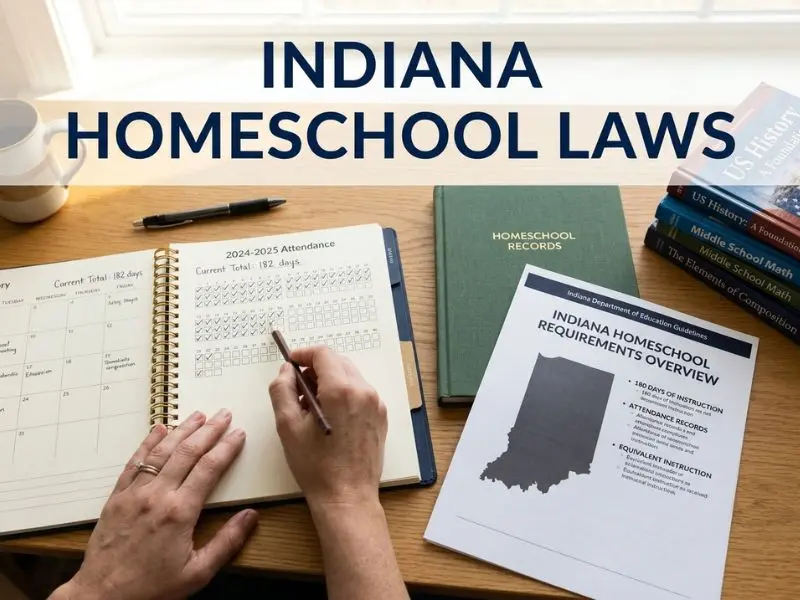
Starting homeschool in Indiana can bring an unexpected worry: what if one missed form or rule causes trouble later? I found that the confusing part is rarely teaching itself. It is knowing where registration, withdrawal, attendance, and the 180-day rule fit together.
After reviewing Indiana’s current homeschool guidance, the path becomes much clearer. Families have broad flexibility, but a few responsibilities still matter. This guide separates legal requirements from optional steps and practical recommendations, so you can understand what applies before making important schooling decisions.
- Indiana Homeschool Laws: Key Takeaways
- Indiana Homeschool Requirements at a Glance
- How Indiana Classifies a Homeschool
- Compulsory Attendance Ages in Indiana
- Indiana Homeschool Instruction Requirements
- What Indiana Requires and Does Not Require
- Indiana Homeschool Attendance Records
- How to Start Homeschooling in Indiana
- Is Homeschool Registration Required in Indiana?
- Indiana Homeschool Curriculum Requirements
- Does Indiana Require Homeschool Testing?
- Do Parents Need Teaching Qualifications?
- Homeschool vs. Virtual School in Indiana
- Special Education and Homeschooling
- Sports and Extracurricular Activities
- Indiana Homeschool High School Planning
- Returning to Public School After Homeschooling
- Indiana Employment Rules for Homeschooled Minors
- Frequently Asked Questions
- Conclusion
Indiana Homeschool Laws: Key Takeaways
- Indiana homeschool registration is generally optional.
- Parents should provide 180 days of instruction during the academic year.
- An accurate daily attendance record is required.
- Instruction must be provided in English and be equivalent to public-school instruction.
- Indiana does not generally require a state-approved curriculum, standardized testing, or parent teaching license.
- Registration and school withdrawal are not the same process.
- Parents withdrawing a high school student should pay special attention to Indiana’s withdrawal requirements.
Indiana Homeschool Requirements at a Glance
The easiest way to understand Indiana homeschool requirements is to separate what is required from what is optional or simply useful.
| Requirement | Status | What Parents Should Know |
|---|---|---|
| 180 instructional days | Required | Provide and track 180 days during the academic year |
| Attendance records | Required | Keep an accurate daily attendance record |
| Instruction in English | Required | Instruction must be given in English |
| Equivalent instruction | Required | Provide genuine instruction equivalent to public-school instruction |
| Homeschool registration | Optional | IDOE registration is not generally required |
| State-approved curriculum | Not required | Parents choose curriculum and materials |
| Standardized testing | Not required | Testing may be used voluntarily |
| Parent teaching license | Not required | Parents do not need teacher certification |
| Detailed academic records | Recommended | Helpful for transfers and future planning |
| High school transcript | Recommended | Important for documenting courses, credits, and grades |
Registration and withdrawal are different. A family may not need to register a homeschool, but a child who is already enrolled in another school should still be properly withdrawn.

How Indiana Classifies a Homeschool
Indiana generally treats a homeschool as a nonpublic, nonaccredited school. This gives parents broad control over how their children are educated.
Parents can choose curriculum, set schedules, select learning materials, and decide how lessons are taught. A homeschool does not have to copy the daily structure of the local public school.
That flexibility still comes with responsibility. Parents need to provide real instruction and follow the attendance and instructional requirements that apply to homeschooling.
Compulsory Attendance Ages in Indiana
Indiana’s compulsory attendance requirements generally begin at age 7. Families may start homeschooling earlier, but kindergarten itself is not generally mandatory.
A homeschooled child should begin receiving instruction no later than the child’s seventh birthday.
Parents of older students need to pay closer attention to withdrawal requirements, especially when a teenager is leaving an accredited high school to homeschool.
Indiana Homeschool Instruction Requirements
Indiana does not tell homeschool parents exactly how every school day should look. Instead, the law focuses on a few basic requirements.
180 Days of Instruction

Indiana homeschool parents should provide 180 days of instruction during the academic year. Parents can review the Indiana homeschool requirements directly through the Indiana Department of Education, which explains instructional days, attendance records, curriculum, testing, and other homeschool rules.
For this purpose, the academic year runs from July 1 through June 30. Parents can decide which days will be instructional days, so the homeschool calendar does not have to match the local public-school calendar.
If a child transfers from a public or accredited school during the year, days already attended there can count toward the 180-day total.
Families can use traditional five-day weeks, flexible schedules, longer breaks, or year-round homeschooling while meeting the applicable requirement.
How Many Hours a Day Are Required?
Indiana does not generally set a specific number of instructional hours per homeschool day.
This gives parents room to adjust lesson length to the child’s age, ability, and learning needs. A younger child may finish focused lessons much faster than a high school student.
The important point is to provide meaningful instruction and keep an accurate record of instructional days.
Equivalent Instruction
Indiana requires homeschool education to be equivalent to instruction offered in public schools.
This does not mean parents must copy the local public school’s curriculum, textbooks, lesson plans, or daily schedule. Indiana does not define equivalency by requiring homeschools to operate exactly like public schools.
Parents should provide genuine and continuing education. Keeping curriculum information, lesson records, and samples of completed work can also help document the education being provided.
English-Language Instruction
Homeschool instruction must be provided in the English language.
This requirement does not prevent a family from teaching foreign languages or including additional language learning in the curriculum. English remains the required language of instruction.
What Indiana Requires and Does Not Require
Many new homeschool parents worry that they may have missed an application, test, or approval process. Indiana’s requirements are less complicated than they may first appear.
What Is Required?
Parents need to pay particular attention to:
- 180 days of instruction;
- accurate attendance records;
- instruction in English;
- equivalent instruction.
These form the core of Indiana’s general homeschool requirements.
What Is Not Generally Required?
Indiana does not generally require homeschool parents to:
- register their homeschool with IDOE;
- obtain a teaching license;
- use state-approved curriculum;
- use state-approved textbooks;
- follow the public-school curriculum;
- give state or other standardized tests.
An optional or recommended step should not be mistaken for a legal requirement.
What Is Smart to Keep?
Attendance records are required, but families may benefit from keeping more than the legal minimum.
Useful records can include:
- curriculum lists;
- grades;
- work samples;
- reading lists;
- course descriptions;
- voluntary test results;
- high school credits;
- transcripts.
These records become more valuable as children get older or if they later enter another school.
Indiana Homeschool Attendance Records
Parents must maintain an accurate daily attendance record.
Indiana does not require one particular state attendance form. Families can use a calendar, spreadsheet, planner, or their own attendance sheet.
A simple record might look like this:
| Date | Instructional Day | Attendance |
|---|---|---|
| August 17 | Day 1 | Present |
| August 18 | Day 2 | Present |
| August 19 | Day 3 | Present |
This table is only an example and is not an official Indiana form.
Attendance records must be available if requested by the Secretary of Education or the public school superintendent where the student lives.
Parents maintain their own homeschool educational records. They do not normally send academic records to IDOE for the agency to store or validate.
How to Start Homeschooling in Indiana
For most families, starting can be broken into a manageable process:
Understand the requirements → Withdraw if necessary → Request existing records → Plan 180 days → Choose curriculum → Set up attendance tracking → Begin instruction.

Understand the Requirements
Before withdrawing a child, become familiar with Indiana’s basic homeschool rules.
Know how attendance works, understand the 180-day requirement, and decide how you will keep records. It is also useful to review the latest Indiana Department of Education guidance before making an enrollment change.
Withdraw From Public School
If your child is currently enrolled in a traditional school, do not simply stop sending the child to school.
Notify the child’s current principal in writing that you are withdrawing the student to homeschool. You do not need to obtain a homeschool number before starting home instruction.
Registration and withdrawal are separate issues. The fact that homeschool registration is optional does not remove the need to properly handle a currently enrolled child’s withdrawal.
Request Your Child’s School Records
Request a copy of your child’s existing school records when making the transition.
Previous grades, test information, course records, and other documents can help you determine where to begin at home. They can also be useful if the child returns to public school later.
Keep copies of withdrawal documents and important school correspondence with your homeschool records.
High School Withdrawal
Withdrawing a high school student requires extra attention.
Indiana uses a Withdrawal to Non-Accredited Non-public School Located in Indiana form for applicable high school withdrawals. This is a withdrawal document, not a homeschool registration form.
Failure to properly complete the required high school withdrawal process can have consequences. A student may be treated as a dropout for those purposes, and reporting to the Indiana Bureau of Motor Vehicles can affect driving privileges.
Parents withdrawing a high school student should check the latest IDOE instructions before completing the process.
Plan the Academic Year
Decide how your family will complete 180 instructional days.
You can follow a traditional school calendar, homeschool year-round, or build a flexible schedule around family needs. Indiana does not generally require a fixed number of homeschool hours each day.
Set up an attendance system at the same time so instructional days are documented from the beginning.
Choose a Curriculum
Indiana does not provide one required homeschool curriculum.
Families may use textbooks, workbooks, online programs, library materials, hands-on activities, or a combination of resources.
Choose materials based on the child’s age, current skills, learning needs, and educational goals.
High school parents should also consider future course credits, transcripts, college admission, career training, and graduation plans.
Set Up a Record-Keeping System
Start with attendance because it is required.
Then decide which additional academic records will help your family. A simple folder, binder, digital system, or homeschool planner may be enough.
For younger students, work samples and curriculum information can be useful. High school students benefit from more detailed course, grade, credit, and transcript records.
Quick Indiana Homeschool Starting Checklist
- ☐ Understand Indiana’s basic homeschool requirements.
- ☐ Properly withdraw your child if currently enrolled in school.
- ☐ Check the additional withdrawal requirements for a high school student.
- ☐ Request a copy of your child’s previous school records.
- ☐ Plan how you will complete 180 instructional days.
- ☐ Choose curriculum and learning materials.
- ☐ Create a daily attendance record.
- ☐ Set up a simple system for important academic records.
- ☐ Review current Indiana Department of Education guidance before making major enrollment decisions.
Is Homeschool Registration Required in Indiana?
No. Indiana does not generally require families to register their homeschool with the Indiana Department of Education.
IDOE provides an optional registration process. Choosing not to use that system does not by itself make a homeschool illegal.
If a family voluntarily registers, current IDOE guidance says registration only needs to be completed once rather than every school year.
Do not confuse this optional registration with withdrawing an enrolled child from school. These are separate processes.
Indiana Homeschool Curriculum Requirements
Indiana gives parents broad control over curriculum and teaching materials.
There is no single state-approved homeschool curriculum that every family must use. Homeschool parents also do not generally have to follow the same curriculum requirements imposed on Indiana public schools.
Parents may build a program using subjects such as math, reading, writing, English language arts, science, social studies, and other areas that fit the child’s educational goals.
These examples should not be treated as a state-mandated homeschool subject list. The legal focus is equivalent instruction rather than copying a public-school curriculum.
Does Indiana Require Homeschool Testing?
Indiana does not generally require homeschool students to take state standardized tests or other standardized tests.
IDOE recommends periodic standardized achievement testing, but that recommendation is not the same as a legal requirement.
Parents may choose voluntary testing to measure progress or identify areas where a child needs more support.
A private program, college, scholarship, or other organization may have its own testing requirements. Those requirements are separate from Indiana’s general homeschool law.
Do Parents Need Teaching Qualifications?
Indiana does not generally require homeschool parents to hold a teaching license or education degree.
Parents can direct their child’s homeschool education without becoming certified teachers.
This freedom makes choosing suitable curriculum and monitoring academic progress especially important. Parents can also use tutors, online courses, co-ops, or other educational resources when extra help is useful.
Homeschool vs. Virtual School in Indiana
Learning from home does not always mean a student is legally homeschooled.
Indiana-accredited virtual schools and virtual charter schools are different from independent homeschools. A child can complete lessons at home while still being enrolled in an accredited or public-school program.
Independent Homeschool
In an independent homeschool, the parent or guardian directs the child’s education and chooses the curriculum.
The family is responsible for following the homeschool requirements that apply.
Virtual School
In a virtual school, the child remains enrolled in the school or program. The school generally controls curriculum and program requirements.
Before enrolling in an online program, parents should determine whether they are purchasing homeschool curriculum or enrolling the child in an accredited virtual school.
Special Education and Homeschooling
Parents of children with disabilities can choose homeschooling, but available services may work differently after leaving public school.
A homeschooled child does not necessarily receive services in exactly the same way as a student enrolled full time in a public school.
Families should review current Indiana guidance and determine what services may remain available before withdrawing a child who currently receives special education support.
This is especially important when therapies, accommodations, evaluations, or other school-based services are part of the child’s current education.
Sports and Extracurricular Activities
Homeschooling does not automatically guarantee access to every public-school sport or extracurricular activity.
Public-school extracurricular participation can depend on local policies. Athletic participation can also depend on current Indiana High School Athletic Association eligibility rules.
Families interested in public-school sports should check the current requirements before the season begins.
Other opportunities may be available through homeschool groups, community leagues, co-ops, clubs, music programs, and recreation programs.
Indiana Homeschool High School Planning
High school homeschooling requires more planning than simply counting instructional days.
Parents should think ahead about courses, credits, grades, transcripts, graduation, college, and career plans.

Homeschool Diplomas
A homeschool diploma is not issued by the local public school or the Indiana Department of Education.
Parents should establish reasonable graduation expectations and maintain records showing what the student completed.
A homeschool diploma and a High School Equivalency credential are different. Families considering the HSE route should review current Indiana eligibility and testing requirements.
Building a Homeschool Transcript
A transcript provides a clear record of the student’s high school education.
It commonly includes courses, credits, grades, and graduation information.
Start the transcript in ninth grade instead of trying to recreate four years of records during senior year. Updating it after each semester or school year makes the process easier.
Course descriptions and supporting records may also help when a college, employer, or school asks for more information.
College Planning
College-bound homeschool students should research admission requirements early.
Requirements can vary between colleges. A school may request a transcript, specific high school courses, test scores, or additional documentation.
Planning early gives families time to adjust high school courses if a student’s preferred college or career path has specific expectations.
21st Century Scholars
Indiana homeschool families should be aware of an important college-funding limitation.
Students enrolled in nonpublic, nonaccredited schools, including homeschools, are not eligible for Indiana’s 21st Century Scholars program.
Families planning for college should consider this early and explore other scholarships, financial aid, and funding opportunities that accept homeschool students.
Returning to Public School After Homeschooling
Choosing homeschooling does not mean a child can never return to public school.
A homeschooled student can enroll in public school again. The receiving school determines appropriate placement and evaluates previous homeschool work or credits according to its policies and applicable rules.
Parents of older students may provide attendance records, curriculum information, grades, test results, course descriptions, and other evidence of completed work.
Detailed records do not guarantee that every homeschool credit will transfer exactly as recorded. They do, however, give the receiving school better information when evaluating placement and credits.
Families who think their child may return to public school should keep stronger academic records from the beginning.
Indiana Employment Rules for Homeschooled Minors
Indiana no longer requires traditional work permits for minor employees.
Homeschooled teenagers who work must still follow applicable Indiana child labor rules. Requirements can vary based on age, type of employment, and work schedule.
Parents should review current Indiana youth employment guidance when their teenager begins working.
Homeschool status does not provide an exemption from applicable child labor laws.
Frequently Asked Questions
Is Homeschooling Legal in Indiana?
Yes. Homeschooling is legal in Indiana and generally operates under the rules for nonpublic, nonaccredited schools.
Do I Have to Register My Homeschool in Indiana?
No. Registration with the Indiana Department of Education is generally optional.
Is Registration the Same as School Withdrawal?
No. Homeschool registration and withdrawing an enrolled child are separate processes. An enrolled child should still be properly withdrawn even though homeschool registration is optional.
How Many Days Do You Have to Homeschool in Indiana?
Indiana homeschool parents should provide 180 instructional days during the academic year.
How Many Hours a Day Do You Have to Homeschool in Indiana?
Indiana does not generally require a specific number of instructional hours each homeschool day.
Does Indiana Require Specific Homeschool Subjects?
Indiana does not generally impose the same curriculum requirements on homeschools that apply to public schools. Parents have broad control over curriculum while still providing equivalent instruction.
Do Indiana Homeschoolers Have to Take Standardized Tests?
No. Standardized testing is not generally required. IDOE recommends periodic achievement testing, but it remains a recommendation rather than a general homeschool testing mandate.
Do You Need a Teaching Degree to Homeschool in Indiana?
No. Parents do not generally need a teaching degree or teaching license to homeschool their children in Indiana.
Do I Need to Keep Attendance Records?
Yes. Indiana requires parents to maintain accurate attendance records.
Do I Send Homeschool Records to IDOE?
No. Parents maintain their own homeschool educational records. IDOE does not normally store or validate these records.
Is Kindergarten Required in Indiana?
Kindergarten is not generally compulsory. Indiana’s compulsory attendance requirement generally begins at age seven.
Is Online School the Same as Homeschooling?
Not always. A child attending an Indiana-accredited virtual school or virtual charter school from home is not automatically considered an independent homeschool student.
Can Indiana Homeschool Students Play Public School Sports?
Participation may be possible, but it is not automatic. Families should check current school policies and applicable IHSAA eligibility requirements.
Can a Homeschool Student Return to Public School?
Yes. A homeschooled child can return to public school. The receiving school determines placement and evaluates previous homeschool work or credits.
Conclusion
Indiana homeschool laws are easier to manage once you separate what is required from what is optional. Focus first on 180 instructional days, attendance records, English instruction, equivalent instruction, and proper withdrawal if your child is already enrolled in school.
Keeping good records can also prevent problems later, especially during high school or a return to public school. Rules and guidance can change, so check the latest Indiana Department of Education information before making an important legal, withdrawal, or enrollment decision.