 Skip to content
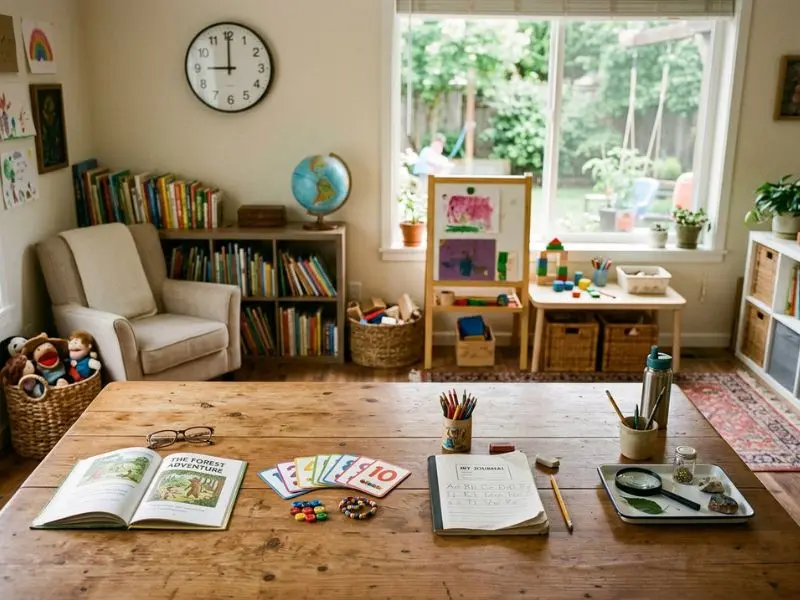
For many families, 1st grade homeschool hours can start around 1–2 hours of focused academics per day. When our lessons finished quickly, I worried we were doing too little. I learned that progress mattered more than stretching lessons just to fill the clock.
The full homeschool day can be longer with reading, projects, play, and breaks. I found it more useful to watch understanding and adjust the workload as needed. Your child’s pace, curriculum, and state homeschool requirements should guide the final amount of time.
- 1st Grade Homeschool Hours at a Glance
- How Many Hours a Day Should a 1st Grader Homeschool?
- What Counts as Homeschool Hours in First Grade?
- Focused Learning Time vs. Total Homeschool Time
- Do Breaks Count as 1st Grade Homeschool Hours?
- Recommended Homeschool Hours for 1st Grade
- Factors That Affect 1st Grade Homeschool Hours
- How Long Should a First Grader Spend on Each Subject?
- Is 1 Hour of Homeschool Enough for First Grade?
- Shorter vs. Longer First Grade Homeschool Days
- Sample 1st Grade Homeschool Hours
- How Many Days a Week Should a First Grader Homeschool?
- How Many Homeschool Hours Per Week for First Grade?
- Why First Grade Homeschool Can Take Less Time Than a Traditional School Day
- How to Tell If Your First Grade Homeschool Day Is Too Long
- What If Your First Grader Finishes Early?
- What If First Grade Homeschool Takes More Than 2 Hours?
- Tips for Managing 1st Grade Homeschool Hours
- Do States Require Specific Homeschool Hours?
- Frequently Asked Questions
- Conclusion
1st Grade Homeschool Hours at a Glance
- Focused academics: About 1–2 hours can be a practical starting point.
- Lesson length: Short, focused blocks often work well for first grade.
- Total homeschool day: It may be longer with reading, projects, enrichment, and breaks.
- Weekly routine: Four or five learning days can both work.
- Most important: Look at understanding and progress, not only time.
- Legal note: State homeschool requirements may differ from general planning ranges.
How Many Hours a Day Should a 1st Grader Homeschool?
For many families, 1–2 hours of focused academic work per day can be a useful starting range. This time can cover reading, phonics, math, writing, and other core lessons.
This is a planning range, not a national requirement.
Some first graders complete their core work sooner. Others need extra practice, shorter lessons, or more breaks. Instead of aiming for an exact number of minutes, look at how the learning is going.
Ask yourself:
- Did my child understand today’s lesson?
- Did we practice the important skills?
- Is my child making steady progress?
- Is the workload manageable?
The total homeschool morning may last 2–3 hours or longer when you include read-alouds, science, art, movement, snacks, and breaks.
The key difference is simple:
Focused academic time is not the same as the total homeschool day.
What Counts as Homeschool Hours in First Grade?
First grade learning does not happen only through worksheets or desk work.
A homeschool day may include:
- Reading and phonics
- Math
- Writing and handwriting
- Read-alouds
- Science activities
- Social studies
- Art and music
- Educational games
- Nature study
- Hands-on projects
This explains why two families can report very different 1st grade homeschool hours even when their children spend a similar amount of time on core academics.
One family may count only formal lessons. Another may count reading, projects, enrichment, and other planned learning activities.
Knowing what is included in the number makes homeschool-hour comparisons more useful.
Focused Learning Time vs. Total Homeschool Time

Focused learning time is the part of the day spent directly working on academic skills. Reading instruction, phonics, math, and writing are common examples.
Total homeschool time can include those lessons plus enrichment, projects, read-alouds, movement, and breaks.
For example:
- Phonics — 20 minutes
- Math — 20 minutes
- Writing — 15 minutes
- Reading — 20 minutes
- Science — 20 minutes
That equals about 95 minutes of focused learning.
Add a snack, movement break, art activity, or longer read-aloud, and the entire homeschool morning may reach 2–3 hours.
Both numbers can be accurate because they measure different parts of the day.
What Do Parents Mean by Homeschool Hours?
| When a Parent Says… | They May Be Counting… |
|---|---|
| “We homeschool for 90 minutes.” | Mainly focused academic lessons |
| “Our school morning takes 2 hours.” | Lessons plus reading and short breaks |
| “We homeschool for 3 hours.” | Lessons, projects, enrichment, and breaks |
This is why comparing homeschool hours without knowing what each family counts can be misleading.
| Type of Time | Examples |
|---|---|
| Core academic time | Reading, phonics, math, writing |
| Enrichment time | Science projects, art, music, nature study |
| Break or non-instruction time | Snacks, free play, rest, transitions |
This distinction matters when another parent says, “We homeschool for three hours.” That does not always mean the child spends three straight hours doing formal lessons.
Do Breaks Count as 1st Grade Homeschool Hours?
Breaks can be part of the total homeschool schedule, but they are different from focused academic instruction.
A two-hour homeschool morning, for example, could contain 90 minutes of learning activities and 30 minutes of snacks, movement, or rest.
For everyday planning, it can help to track two numbers:
Focused academic time: Time spent on lessons and academic practice.
Total homeschool time: The full period that includes planned lessons, enrichment, and breaks.
If your state requires you to document instructional time, follow the rules that apply to your homeschool option. Do not assume every break or activity automatically counts toward a legal requirement.
Recommended Homeschool Hours for 1st Grade
There is no single daily schedule that works for every first grader.
It is more useful to treat homeschool hours as flexible planning ranges.
| Example Day | Focused Academic Time | How It May Be Used |
|---|---|---|
| Lighter academic day | 60–90 minutes | Core lessons or reduced workload |
| Standard planning day | 90–120 minutes | Several focused academic blocks |
| Extended learning day | 2+ hours | Extra practice, projects, or more subjects |
A real curriculum example shows how this can work in practice. Apologia’s first-grade program estimates that most families using its curriculum spend about 1–2 hours per day, while allowing families to adjust the pace to the child and their routine.
These are planning examples, not official first grade homeschool requirements.
If your child understands the planned material in 75 minutes, another hour of worksheets may add little value.
The opposite can also happen. A child may need more time for reading, math, or another difficult skill. There is no reason to rush just to stay under two hours.
The better question is whether the time is helping your child learn and progress.
Factors That Affect 1st Grade Homeschool Hours
First grade homeschool hours can change from one child or family to another.
Age and Development
First graders are young learners. Long periods of sitting may make lessons harder.
Short academic blocks with opportunities to move can make the day easier to manage.
Learning Pace
One child may finish math quickly but need more reading practice. Another may need extra time for math.
Give more time to the areas that need it instead of forcing every subject into the same time block.
Curriculum
Curricula are designed differently.
Some use short workbook lessons. Others include videos, reading, projects, discussions, or hands-on activities. The curriculum you choose can change how long the homeschool day takes.
One-on-One Instruction
Homeschooling can allow a lesson to move at the child’s pace.
A parent can explain a concept, check understanding, provide practice, and move on without following the pace of an entire classroom.
This can make some formal lessons shorter.
Activities Beyond Formal Lessons
Not every useful learning experience looks like schoolwork.
Reading together, measuring ingredients, observing nature, building a model, or completing a science activity can support learning without another workbook page.
Family Schedule
Work, appointments, younger siblings, co-ops, sports, and other responsibilities can affect the homeschool routine.
A schedule is more useful when it works with family life rather than against it.
How Long Should a First Grader Spend on Each Subject?
First grade lessons often work well in short, focused blocks.
Here is one example of how academic time might be divided:
| Subject | Example Time Block |
|---|---|
| Reading and phonics | 15–25 minutes |
| Math | 15–25 minutes |
| Writing or handwriting | 10–15 minutes |
| Read-aloud | 15–20 minutes |
| Science | 15–30 minutes |
| Social studies | 15–30 minutes |
| Art or music | Flexible |
These are sample lesson blocks, not required limits. Adjust them based on your child, curriculum, and the activity.

Reading and Phonics
Reading deserves regular attention during first grade.
A lesson can include phonics, decoding, word practice, or reading simple books. Read-aloud time can be separate and does not need to replace direct reading instruction.
Math and Problem Solving
A short math block may be enough when the lesson is focused.
The goal is to teach and practice the skill rather than keep working until a set amount of time has passed. Hands-on activities can also support early math concepts.
Writing and Handwriting
Writing sessions can stay short, especially when handwriting requires a lot of concentration.
A child might practice letter formation, spelling, or writing a few meaningful sentences instead of completing a long page.
Science and Social Studies
Science and social studies do not always need to happen every day.
You can rotate them through the week and allow extra time for experiments, projects, books, or discussions.
Art, Music, and Projects
Enrichment activities can be flexible.
If your child stays interested in an art project or science activity, there is no need to stop simply because a suggested time block has ended.
Is 1 Hour of Homeschool Enough for First Grade?
One focused hour can be enough for some first grade homeschool days, especially when the planned core work is completed and the child is making progress.
A one-hour day could look like:
- Reading or phonics — 20 minutes
- Math — 20 minutes
- Writing — 10 minutes
- Read-aloud — 10 minutes
Other days may naturally take longer because you add science, social studies, projects, or extra practice.
If your first grader finishes in an hour, do not automatically add worksheets because the day feels too short.
Check understanding first.
Can your child explain the skill? Can they use it with reasonable independence? Are they making progress over time?
If so, the clock alone is not a reason to create more work.
Shorter vs. Longer First Grade Homeschool Days
Both shorter and longer homeschool days can work.
| Shorter Homeschool Day | Longer Homeschool Day |
|---|---|
| Focuses mainly on core subjects | May include more subjects |
| Uses short lesson blocks | May include projects and enrichment |
| May involve 60–90 focused minutes | May involve 2+ focused hours |
| Leaves more open time | Provides more structured learning time |
| Can work when lessons are completed efficiently | Can help when more practice is useful |
A longer homeschool day is not automatically better. A shorter one is not automatically inadequate.
Look at what your child is learning during those hours.
Sample 1st Grade Homeschool Hours
A simple example can make the difference between academic time and total homeschool time easier to see.
Example Two-Hour Homeschool Morning
9:00–9:20 — Reading and phonics
Practice sounds, decoding, or reading.
9:20–9:40 — Math
Complete the main lesson and focused practice.
9:40–9:55 — Break
Have a snack, stretch, or move around.
9:55–10:10 — Writing
Practice handwriting, spelling, or a short sentence.
10:10–10:30 — Read-aloud
Read together and discuss the story.
10:30–11:00 — Rotating subject
Use this time for science, social studies, art, or another planned activity.
This example lasts two hours from start to finish, including a 15-minute break. About 105 minutes are set aside for learning activities.
The purpose is not to create a schedule you must copy. It simply shows how focused lessons and breaks can fit into a normal homeschool morning.

How Many Days a Week Should a First Grader Homeschool?
Some families prefer five shorter homeschool days. Others use four main academic days with another day for projects, field trips, co-op activities, appointments, or catch-up work.
Neither structure is automatically better.
For example, reading, writing, and math may happen more often. Science, social studies, art, and music can rotate through the week.
The best weekly rhythm depends on your curriculum, family routine, child’s needs, and applicable state requirements.
How Many Homeschool Hours Per Week for First Grade?
There is no single weekly homeschool-hour recommendation that applies to every first grader.
For planning purposes, you can estimate weekly focused learning time by multiplying the length of your academic day by the number of homeschool days.
For example:
- 1 hour × 5 days = 5 focused hours
- 1.5 hours × 5 days = 7.5 focused hours
- 2 hours × 5 days = 10 focused hours
- 1.5 hours × 4 days = 6 focused hours
These are planning examples, not national requirements.
Your legal requirements may be different. Check the homeschool rules that apply to your state and homeschool option.
Why First Grade Homeschool Can Take Less Time Than a Traditional School Day
A homeschool day does not need to copy the length or structure of a classroom day.
At home, instruction may be more direct. There may also be less time spent waiting for a group, moving between classrooms, handling whole-class transitions, or managing a large number of students.
This can allow some academic lessons to be completed in less time.
That does not mean one homeschool hour automatically equals several classroom hours. The two settings simply use time differently.
How to Tell If Your First Grade Homeschool Day Is Too Long
A three-hour homeschool morning is not automatically too long. A one-hour day is not automatically too short.
Look at what is happening during that time.
Your routine may need adjustment if:
- A short lesson regularly stretches far beyond its planned time
- Your child struggles to stay engaged through most lessons
- Formal schoolwork takes up much of the day
- The same material is repeated after your child already understands it
- Difficult subjects are always left until your child is tired
You might shorten lessons, add movement breaks, change the subject order, rotate non-core subjects, or check whether the curriculum level fits your child.
The goal is not to make homeschool as short as possible. It is to use the time well.
What If Your First Grader Finishes Early?

Finishing early does not automatically mean you need to assign more schoolwork.
First, check understanding.
Can your child explain the idea? Can they use the skill without heavy help? Are they making reasonable progress through the curriculum?
If yes, the remaining time can be used for:
- Independent reading
- Drawing
- Building
- Outdoor play
- Hobbies
- Educational games
- Family activities
There is little benefit in creating busywork simply to reach an arbitrary number of homeschool hours.
What If First Grade Homeschool Takes More Than 2 Hours?
Taking more than two hours is not automatically a problem.
Read-alouds, projects, enrichment, breaks, and extra practice can extend the day. Some curricula also take longer than others.
Look more closely when focused academic lessons regularly take much longer than expected.
Check the Workload
You may be trying to complete too many subjects or activities every day.
Core work can stay consistent while some subjects rotate through the week.
Check the Curriculum Level
Work that is consistently too difficult can turn short lessons into long sessions.
Make sure the material matches your child’s current skills rather than only the grade printed on the curriculum.
Check Lesson Length
A long lesson can sometimes be divided into two shorter sessions.
A break between them may help your child return with better focus.
Tips for Managing 1st Grade Homeschool Hours
A good routine should support learning rather than control every minute.
Start With Reading, Writing, and Math
Reading, writing, and math provide a simple foundation for the academic part of many first grade homeschool days.
Complete high-priority work when your child is ready to focus. Add other subjects based on your curriculum and weekly plan.
Rotate Other Subjects
Science, social studies, art, music, and projects do not always need to happen every day.
Rotating them can keep the daily workload manageable while still providing variety.
Use Breaks When Needed
A movement or snack break can help separate demanding lessons.
Breaks do not need to follow an exact timer. Watch how your child responds to the workload.
Avoid Adding Busywork
Finishing a lesson quickly is not automatically a problem.
If your child understands the material, extra worksheets added only to fill time may not improve learning.
Do States Require Specific Homeschool Hours?
Homeschool requirements vary by state.
There is no single daily homeschool-hour rule that applies to every homeschool family in the United States.
Depending on the state and homeschool option used, requirements may involve instructional time or days, required subjects, records, assessments, notices, or other forms of compliance.
This means a general recommendation such as 1–2 focused hours should be treated as a planning guideline. It is not proof that you have met your state’s legal requirements.
Always verify the current homeschool rules that apply to your state and the homeschool option you use.
Frequently Asked Questions
How Many Hours Should a 1st-Grade Homeschool Day Be?
Many families can use about 1–2 hours of focused academic work as a practical starting point. The full homeschool day may be longer when reading, projects, enrichment, and breaks are included.
Is 90 Minutes of Homeschool Enough for First Grade?
It can be. If your child completes the planned core lessons, understands the material, and is making steady progress, 90 focused minutes may work well on some days.
Does Reading Count as Homeschool Time in First Grade?
Reading instruction, independent reading, and read-alouds can all be meaningful parts of a first grade homeschool day. For legal recordkeeping, follow the requirements that apply to your state’s homeschool option.
Do I Need to Teach Every Subject Every Day?
No. Core subjects may happen more often, while science, social studies, art, music, and other subjects can rotate throughout the week.
Should I Homeschool First Grade Five Days a Week?
Not necessarily. Some families use five shorter days. Others prefer four main academic days and one flexible day. Your curriculum, family routine, and state requirements should guide the decision.
What Time Should First Grade Homeschool Start?
There is no universal starting time. Choose a consistent part of the day when your child is alert and your family can focus.
Is Two Hours of Homeschool Enough for a First Grader?
Two focused hours can provide enough time for many first graders to complete core lessons. Progress and understanding matter more than reaching an exact number of minutes.
Why Does Homeschool Take Less Time Than Regular School?
Homeschool can involve direct instruction with fewer whole-class transitions, waiting periods, and group-management tasks. This can make some academic lessons shorter without assuming that a certain number of homeschool hours equals a full classroom day.
Conclusion
After working through different routines, I learned that a longer first grade day does not automatically produce better learning. I now look at understanding, progress, and workload before adding more time. Use 1–2 focused hours as a flexible starting point, adjust for your child, and always follow the homeschool requirements that apply in your state.