 Skip to content
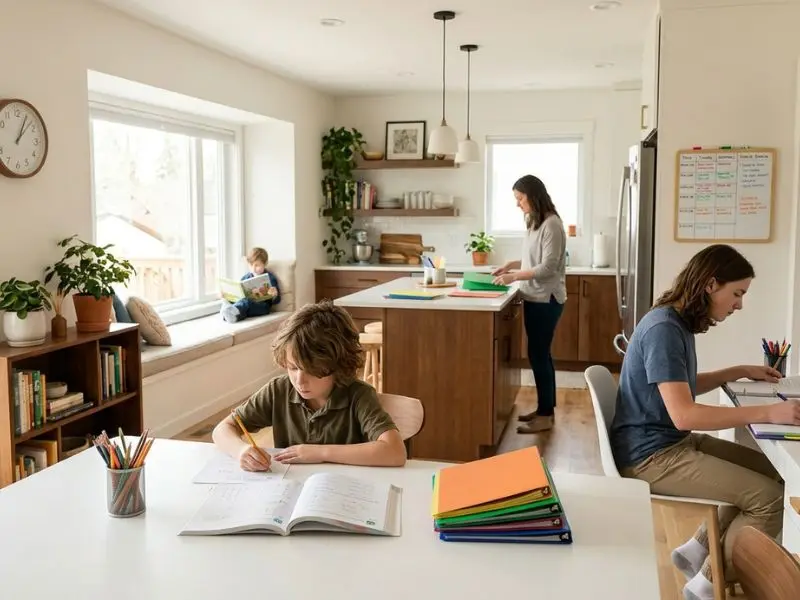
A homeschool schedule by grade should change as your child grows. Younger students usually need shorter lessons, more breaks, and direct help. Older students can handle longer blocks and more independent work.
I learned that one fixed schedule rarely fits every grade. The most practical approach is to start with a grade-level routine, then adjust the subjects, timing, and workload to match your child’s pace and your family’s day.
- Homeschool Schedule by Grade at a Glance
- Understanding Homeschool Schedule Fundamentals
- Early Elementary Homeschool Schedule: Grades K–2
- Upper Elementary Homeschool Schedule: Grades 3–5
- Middle School Homeschool Schedule: Grades 6–8
- High School Homeschool Schedule: Grades 9–12
- How Many Hours a Day Should You Homeschool?
- What Counts as Homeschool Time?
- Managing Homeschool Schedules for Multiple Grades
- Customizing the Schedule for Your Child
- Troubleshooting Common Homeschool Schedule Problems
- Frequently Asked Questions About Homeschool Schedules by Grade
- Conclusion
Homeschool Schedule by Grade at a Glance
The biggest change from kindergarten through high school is not simply the number of hours. Lessons often become longer, subjects become more demanding, and students gradually take more responsibility for their work.
| Grade | Main Focus | Schedule Style | Independence |
|---|---|---|---|
| Kindergarten | Early literacy, math, play | Very short blocks | Parent-led |
| 1st Grade | Phonics, reading, math | Short blocks | High parent support |
| 2nd Grade | Reading, writing, math | Short to moderate blocks | High parent support |
| 3rd Grade | Core academic skills | Moderate blocks | Beginning independence |
| 4th Grade | Core subjects and projects | Moderate blocks | Growing |
| 5th Grade | Core subjects and study skills | Moderate blocks | Growing |
| 6th Grade | Broader coursework | Longer blocks | Moderate |
| 7th Grade | Subject-based learning | Longer blocks | Moderate to high |
| 8th Grade | High school preparation | Longer blocks | Increasing |
| 9th Grade | Credit-based courses | Course blocks | High |
| 10th Grade | Core courses and electives | Course blocks | High |
| 11th Grade | Advanced coursework and planning | Flexible course blocks | High |
| 12th Grade | Graduation and future goals | Flexible blocks | Mostly independent |
These are general planning patterns, not fixed rules. Two children in the same grade may need different schedules.

Key Takeaways
- A homeschool schedule should change as your child grows.
- Younger students usually need shorter lessons, more breaks, and more parent help.
- Older students can gradually manage longer lessons and more independent work.
- Math and language arts often need regular attention, while some other subjects can rotate.
- A shorter homeschool day does not automatically mean less learning.
- Grade-level schedules are starting points, not fixed rules.
- Always separate sample schedules from your state’s legal homeschool requirements.
Understanding Homeschool Schedule Fundamentals
A useful homeschool routine provides structure without making every minute rigid. Your child should know what needs to be done, but there should still be room to slow down, take a break, or adjust the day.
Before setting exact times, consider your child’s age, workload, difficult subjects, energy levels, outside commitments, and ability to work independently.
Age-Appropriate Lesson Length
Younger children often do better with short lessons followed by movement, play, or hands-on activities. Sitting through a long lesson may make it harder for them to focus.
As children grow, they can usually handle longer periods of reading, writing, problem-solving, and independent study.
Do not stretch a lesson simply to fill a time block. If your child understands the material and completes the work well, moving on may make more sense.
Core Subject Prioritization
Math and language arts often need regular attention because later skills build on them. Language arts may include reading, writing, spelling, grammar, and vocabulary.
Science and social studies do not always need to appear every day. Some families alternate them or teach them several days each week.
Art, music, health, physical education, and other electives can also rotate through the week. Your curriculum’s scope and sequence can help you decide how often each subject needs attention.
Balancing Flexibility and Structure
Structure helps children know what comes next. Flexibility gives you room when a lesson takes longer, your child needs a break, or family plans change.
You do not have to start every subject at an exact minute. Some families use clock times. Others use blocks or simply follow the same subject order each day.
Add fixed commitments first. These may include co-op classes, sports, appointments, therapy, music lessons, or outside classes. Build the more flexible parts of your homeschool day around them.
Some children prefer several short lessons. Others focus better when they can stay with one subject for longer. Watch how your child responds instead of choosing a schedule only because it matches a grade level.
Important: The schedules below are examples, not legal requirements. Homeschool laws differ by state. Check the current rules that apply to your family, including any requirements for subjects, instructional time, attendance, records, or assessments.
Early Elementary Homeschool Schedule: Grades K–2
Early elementary usually works best with short lessons and frequent changes in activity. Reading aloud, conversation, movement, crafts, outdoor time, and play can all have a place in the day.
At this stage, parents usually provide most of the direction.

Kindergarten Homeschool Schedule
Kindergarten does not need to look like a full traditional school day. Early reading skills, basic math, stories, fine motor activities, play, and exploration can form the core of the routine.
The times below are examples. You can use the same order without following exact clock times.
| Start Time | Activity |
|---|---|
| 9:00 | Morning routine and read-aloud |
| 9:20 | Early math |
| 9:40 | Break and movement |
| 10:00 | Phonics and reading |
| 10:25 | Snack |
| 10:40 | Art, science, nature, or hands-on activity |
| 11:10 | Outdoor time or free play |
Keep formal lessons manageable. If focus disappears, changing activities may work better than forcing the lesson to continue.
1st Grade Homeschool Schedule
First grade often puts more attention on phonics, reading, writing, and early math. Children still benefit from movement and hands-on activities.
| Start Time | Activity |
|---|---|
| 8:30 | Morning routine and reading |
| 9:00 | Math |
| 9:30 | Break |
| 9:45 | Phonics and language arts |
| 10:20 | Snack and movement |
| 10:40 | Science or social studies |
| 11:10 | Writing, art, or read-aloud |
Some lessons will take longer than others. Give more time to skills your child is still developing instead of making every subject the same length.
2nd Grade Homeschool Schedule
Second graders may be ready for slightly longer lessons, but regular breaks still matter. Reading fluency, writing, and math remain important parts of the day.
| Start Time | Activity |
|---|---|
| 8:30 | Independent or shared reading |
| 9:00 | Math |
| 9:35 | Break |
| 9:50 | Language arts |
| 10:30 | Snack |
| 10:45 | Science |
| 11:15 | Social studies |
| 11:45 | Art, project, or outdoor activity |
If the day becomes crowded, science and social studies can be placed on different days rather than forcing both into every routine.
Upper Elementary Homeschool Schedule: Grades 3–5
Grades 3–5 are a transition between heavily parent-led learning and greater independence. Students still need guidance, but they can gradually begin managing small parts of the day themselves.
3rd Grade Homeschool Schedule
Third graders may be able to complete short reading, practice, or review assignments without constant parent help.
| Start Time | Activity |
|---|---|
| 8:30 | Reading |
| 9:00 | Math |
| 9:40 | Break |
| 10:00 | Language arts and writing |
| 10:45 | Science |
| 11:20 | Lunch or longer break |
| 12:00 | Social studies |
| 12:35 | Independent reading or project |
If math or writing requires the most concentration, place it during the part of the day when your child usually focuses best.
4th Grade Homeschool Schedule
Fourth grade may bring longer reading assignments, more detailed writing, and more complex math. Students can also begin tracking some of their own work.
| Start Time | Activity |
|---|---|
| 8:30 | Math |
| 9:15 | Language arts |
| 10:00 | Break |
| 10:20 | Reading |
| 10:50 | Science |
| 11:30 | Lunch |
| 12:15 | Social studies |
| 12:50 | Independent work or elective |
A simple daily checklist can help a fourth grader see what is finished and what still needs attention.
5th Grade Homeschool Schedule
By fifth grade, many students can handle part of their schoolwork independently while still receiving regular parent guidance.
| Start Time | Activity |
|---|---|
| 8:30 | Math |
| 9:20 | Language arts |
| 10:10 | Break |
| 10:30 | Science |
| 11:15 | Reading and writing |
| 12:00 | Lunch |
| 12:45 | Social studies |
| 1:30 | Elective or independent work |
The goal is not to remove parent support. It is to teach the child how to manage appropriate tasks without needing instructions at every step.
Building Independence and Study Skills

Upper elementary is a useful time to introduce basic study habits.
Children can begin to:
- check a daily assignment list;
- gather materials before a lesson;
- complete short tasks independently;
- mark finished assignments;
- ask for help when needed;
- return to unfinished work.
Increase responsibility gradually. One fifth grader may work independently for long periods, while another still needs frequent guidance.
Middle School Homeschool Schedule: Grades 6–8
Middle school often brings longer subject blocks, more reading and writing, and greater responsibility. Students may also begin using planners, textbooks, online courses, or separate subject teachers.
Parents can gradually move from directing every lesson toward checking progress and helping with difficult work.
6th Grade Homeschool Schedule
Sixth grade often acts as a bridge between elementary routines and more independent middle school work.
| Start Time | Activity |
|---|---|
| 8:30 | Math |
| 9:20 | Language arts |
| 10:10 | Break |
| 10:30 | Science |
| 11:20 | Social studies |
| 12:10 | Lunch |
| 1:00 | Independent reading |
| 1:40 | Elective, project, or physical activity |
A sixth grader can begin checking an assignment list while the parent remains available for instruction and questions.
7th Grade Homeschool Schedule
Seventh-grade work may include longer reading assignments, writing projects, research, and more independent practice.
| Start Time | Activity |
|---|---|
| 8:30 | Math |
| 9:20 | English |
| 10:10 | Break |
| 10:30 | Science |
| 11:20 | History or social studies |
| 12:10 | Lunch |
| 1:00 | Independent study |
| 1:45 | Elective or physical education |
If one subject regularly turns the day into a struggle, check the workload, difficulty, and curriculum placement before simply adding more hours.
8th Grade Homeschool Schedule
Eighth grade can help students prepare for the increased responsibility of high school.
| Start Time | Activity |
|---|---|
| 8:30 | Math |
| 9:25 | English |
| 10:20 | Break |
| 10:40 | Science |
| 11:35 | History |
| 12:25 | Lunch |
| 1:10 | Independent coursework |
| 2:00 | Elective, project, or PE |
Students can begin estimating how long assignments will take and planning around deadlines.
Developmental Considerations for Middle Schoolers
Middle school students often want more control over their day. Giving them reasonable choices can help build responsibility.
For example, you might decide which assignments must be completed while allowing the student to choose whether science or history comes first.
A planner or checklist can help track assignments, projects, co-op work, and outside activities.
High School Homeschool Schedule: Grades 9–12
High school scheduling becomes more course-focused. Credits, graduation plans, transcripts, future education, and career goals may affect how the day is organized.
Students may also balance homeschool with sports, jobs, co-op classes, dual enrollment, volunteering, or other commitments.
9th Grade Homeschool Schedule
Ninth grade is a good time to build consistent habits for managing high school courses and deadlines.
| Start Time | Activity |
|---|---|
| 8:00 | Math |
| 9:00 | English |
| 10:00 | Break |
| 10:20 | Science |
| 11:20 | History |
| 12:20 | Lunch |
| 1:00 | Elective or foreign language |
| 2:00 | Independent study or assignments |
Students can begin taking greater responsibility for checking assignments and meeting deadlines without depending on a parent for every reminder.
10th Grade Homeschool Schedule
Tenth graders may be ready for longer independent work periods and greater control over subject order.
| Start Time | Activity |
|---|---|
| 8:00 | Math |
| 9:00 | English |
| 10:00 | Science |
| 11:00 | Break |
| 11:20 | History |
| 12:20 | Lunch |
| 1:00 | Foreign language or elective |
| 2:00 | Independent coursework |
Some students prefer finishing difficult academic subjects first and saving flexible work for later in the day.
11th Grade Homeschool Schedule
Junior year may include heavier coursework, college planning, test preparation, dual enrollment, work, or career exploration.
| Start Time | Activity |
|---|---|
| 8:00 | Math |
| 9:00 | English |
| 10:00 | Science |
| 11:00 | Break |
| 11:20 | History or social studies |
| 12:20 | Lunch |
| 1:00 | Elective or dual-enrollment work |
| 2:15 | Independent study, project, or test preparation |
An 11th-grade schedule should reflect the student’s goals rather than simply copying another family’s routine.
12th Grade Homeschool Schedule
Senior schedules can vary widely. Some students are finishing standard high school courses. Others may spend more time on college classes, career training, work, or major projects.
| Start Time | Activity |
|---|---|
| 8:00 | Core academic course |
| 9:00 | Core academic course |
| 10:00 | Break |
| 10:20 | Remaining required course |
| 11:20 | Elective |
| 12:20 | Lunch |
| 1:00 | Dual enrollment, career study, or project |
| 2:30 | Independent work |
Before reducing senior-year coursework, check the student’s remaining graduation goals and any requirements that apply.
Credit Requirements and College Preparation
High school planning should consider your state’s homeschool rules and the student’s graduation goals.
Keep clear records of completed courses, grades, credits, and information needed for transcripts or future applications.
Students planning to attend college should also review the admission requirements of schools they may apply to. Requirements can differ from one college to another.
Advanced Placement and Dual Enrollment Considerations
Some homeschooled high school students take Advanced Placement courses or college classes.
Outside courses may have fixed class times, assignment deadlines, and exams. Put those commitments on the schedule first. Then arrange flexible homeschool coursework around them.
How Many Hours a Day Should You Homeschool?
There is no universal number of daily homeschool hours that fits every student or satisfies every state’s requirements.
Younger children may finish focused lessons much sooner than teenagers completing several high school courses. Curriculum difficulty, learning pace, projects, breaks, and independent work also affect the length of the day.
A homeschool day being shorter than a traditional school day does not automatically mean the child is doing too little. Grade-by-grade homeschool hour guidelines also show how structured learning time generally increases as students move from kindergarten through high school. Use these ranges as planning references, not fixed rules or legal requirements.
Homeschool Hour Requirements
Homeschool requirements vary across the United States. Depending on the state, rules may address instructional time, attendance, required subjects, records, assessments, or other areas.
A sample schedule found online does not prove that a family has met its legal requirements.
Check the current homeschool rules for your state before deciding how to track days, hours, attendance, or other required information.
How to Shorten a Homeschool Day That Feels Too Long
If school regularly stretches much longer than expected, identify the reason before cutting important work.
You may be able to make the day more efficient by:
- removing unnecessary repetition;
- rotating subjects that do not need daily lessons;
- preparing materials before school starts;
- scheduling difficult work when focus is strongest;
- adding suitable independent work;
- using focused learning blocks;
- taking breaks before attention disappears.
If one subject is taking far longer than expected every day, also check whether the curriculum level or workload is a good fit.
What Counts as Homeschool Time?
Learning does not happen only while a child sits at a desk.
Reading, science experiments, projects, field trips, nature study, music, physical education, research, and other planned educational activities can all support learning.
This is why formal lesson time and the total learning day may look different.
However, whether a specific activity legally counts toward required instructional time, days, or attendance depends on your state’s rules. Keep practical scheduling advice separate from legal requirements.
Managing Homeschool Schedules for Multiple Grades
Teaching several children does not mean running several completely separate school days.
A useful approach is to combine what makes sense, rotate lessons that require direct parent help, and give other children suitable independent work.

Loop Scheduling for Multiple Grades
A loop schedule places subjects or activities in an order instead of assigning every one to a fixed weekday.
For example:
- Science
- History
- Art
- Geography
Each time you reach the loop, continue with the next subject. If Tuesday becomes busy and you miss the loop, continue where you stopped the next time.
This can work well for subjects that do not need daily instruction.
Combined Learning Opportunities
Children in different grades can sometimes learn together during read-alouds, science experiments, history discussions, art, music, physical education, field trips, or nature study.
The topic can be shared while assignments remain appropriate for each child’s level.
A younger child might draw what was learned during a science activity, while an older student writes a short report about the same topic.
Using Independent Work
Independent work can give a parent time to teach another child.
One student might read, practice math facts, complete handwriting, work through an appropriate lesson, or finish a project while you teach a sibling.
Choose work the child can realistically complete without constant help. Independent work should make the family schedule easier, not create another source of frustration.
Customizing the Schedule for Your Child
Grade level provides a useful starting point, but two children in the same grade may need very different routines.
Consider the child’s pace, concentration, difficult subjects, strengths, curriculum, outside activities, and ability to work independently.
Using Visual Supports
Some children benefit from seeing what comes next.
A written schedule, checklist, calendar, map, diagram, timeline, or visual planner can make the day easier to follow.
These tools can also help older students take more responsibility for managing their work.
Using Discussion and Read-Alouds
Some lessons work well through conversation, reading aloud, audiobooks, oral review, or verbal explanations.
These approaches can be especially useful when a child understands a topic better after talking through it.
They can be mixed with reading, writing, independent work, and hands-on learning.
Adding Hands-On Learning and Movement
Experiments, manipulatives, building activities, outdoor learning, and movement can break up long periods of sitting.
This can be especially helpful for younger children, but hands-on work can remain useful through middle and high school.
Choose the approach that fits the subject instead of trying to make every lesson look the same.
Troubleshooting Common Homeschool Schedule Problems
A schedule that worked earlier in the year may stop working later. Curriculum changes, harder subjects, activities, family needs, or growing independence can all affect the routine.
Before rebuilding the whole schedule, identify the main problem.
| Problem | Possible Cause | Adjustment |
|---|---|---|
| Lessons always run late | Too much work or repetition | Review the workload |
| Child loses focus | Learning blocks are too long | Shorten lessons or add breaks |
| One subject causes daily battles | Timing, difficulty, or placement | Move it or review the level |
| Parent feels overwhelmed | Too much direct teaching | Add suitable independent work |
| Subjects keep getting skipped | Schedule is overcrowded | Rotate some subjects |
| Student misses deadlines | Weak organization habits | Use a planner or checklist |
Dealing With Resistance and Motivation
Frequent resistance does not always mean a child is unwilling to learn.
The work may be too difficult, repetitive, long, or scheduled when the child has little energy.
Look for patterns. If math causes problems every afternoon, for example, try moving it to the morning before changing the entire routine.
Accommodating Family Life Changes
Illness, travel, a new baby, work changes, appointments, and other events can interrupt a normal homeschool routine.
During busy periods, focus on essential work first. Return to the fuller schedule when family life becomes more stable.
A flexible plan is often easier to maintain than trying to catch up on every missed minute.
Balancing Structure With Spontaneous Learning
Structure creates consistency, but not every useful learning opportunity will appear in the planner.
A museum visit, nature walk, interesting question, science experiment, or family project may sometimes replace a planned activity.
Leave enough room in the week to follow worthwhile learning opportunities without losing the basic routine.
Managing Technology and Screen Time
Online curricula and digital resources can be useful, especially for older students. Still, every subject does not need to happen on a screen.
Mix digital lessons with books, handwriting, experiments, discussion, physical activity, outdoor learning, and projects when appropriate.
Frequently Asked Questions About Homeschool Schedules by Grade
What Is a Good Homeschool Schedule by Grade?
A good schedule matches the child’s grade, curriculum, pace, family routine, and level of independence. Use grade-level examples as starting points rather than fixed rules.
How Many Hours Should a Child Homeschool Each Day?
There is no universal number for every child. Younger students often use shorter formal learning blocks, while older students usually spend more time on coursework and independent study.
Does Homeschooling Need to Start at the Same Time Every Day?
No. A regular starting time can create consistency, but families can choose a routine that fits their work, activities, energy levels, and other responsibilities.
Do Homeschoolers Need to Study Every Subject Every Day?
No. Core subjects may receive more frequent attention, while science, history, art, music, and other subjects can be rotated through the week.
Does Homeschooling Have to Be Five Days a Week?
Not always. Some families use four-day or five-day schedules, while others organize their week differently. The schedule still needs to fit the curriculum and any legal requirements that apply.
Do Homeschoolers Have to Follow a Traditional School Calendar?
Not necessarily. Some families follow a traditional school year, while others homeschool year-round or take breaks at different times. Check applicable state requirements before setting your calendar.
How Long Should Homeschool Lessons Be?
Lesson length depends on the child’s age, subject, curriculum, pace, and ability to focus. Younger children often do better with shorter blocks, while older students can usually handle longer periods of focused work.
When Should a Homeschooled Child Start Working Independently?
Independence usually develops gradually. Upper elementary students may begin with short independent tasks, while middle and high school students can take increasing responsibility for assignments and deadlines.
Can I Homeschool Children in Different Grades at the Same Time?
Yes. Some activities can be combined, while skill-based subjects such as math may need separate instruction. Independent work and loop scheduling can also help manage multiple grades.
What Should I Do if Our Homeschool Schedule Is Not Working?
Identify the main problem first. Try changing lesson length, subject order, breaks, workload, independence, or curriculum placement before replacing the entire schedule.
Conclusion
After working through different homeschool routines, I have learned to judge a schedule by progress rather than how full the clock looks. Use these homeschool schedules by grade as a framework, then watch your child’s focus, workload, and independence. Small adjustments often create a more sustainable day than constantly rebuilding the entire routine.