 Skip to content
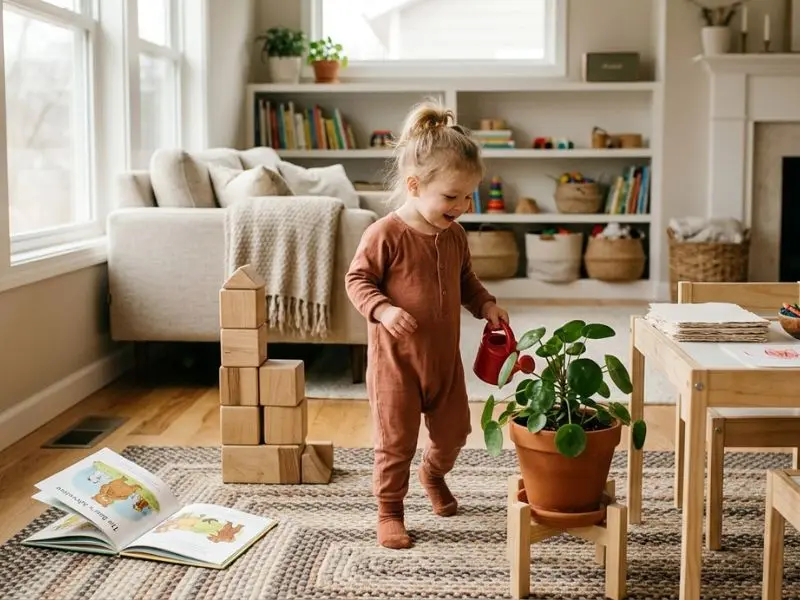
I used to think a toddler learning plan needed carefully planned lessons to be useful. That idea quickly creates pressure: What should I teach? Am I doing enough? Do I need an expensive program? Those questions can make a simple day with a toddler feel more complicated than it needs to be.
A toddler homeschool curriculum works better when it gives the parent direction without controlling the child’s day. Books, conversation, movement, play, and everyday tasks can provide meaningful learning. The aim is not to race toward academics, but to create age-appropriate opportunities that fit your toddler and your family.
Quick Takeaway: A toddler homeschool curriculum should focus on play, conversation, books, movement, sensory experiences, practical life skills, and simple early learning. Keep activities short and flexible. You do not need a full paid curriculum or a school-style schedule to create meaningful learning at home.
- What Is a Toddler Homeschool Curriculum?
- Can You Start Homeschooling a 2-Year-Old?
- What Should I Be Teaching My Toddler?
- Toddler Homeschool Curriculum by Age
- What to Look for in a Toddler Homeschool Program
- Should I Buy a Toddler Homeschool Curriculum?
- Best Toddler Homeschool Curriculum Options
- How to Make Lesson Plans for Homeschooling a Toddler
- A Sample Day for Homeschooling a Toddler
- Weekly Rhythm Example for Toddler Homeschool
- Supplies Needed for Homeschooling Toddlers
- Practical Tips for Homeschooling Toddlers at Home
- Frequently Asked Questions
- Conclusion
What Is a Toddler Homeschool Curriculum?
A toddler homeschool curriculum is a simple learning plan for young children at home. It may include reading, movement, sensory activities, art, conversation, outdoor play, practical life tasks, and early learning concepts.
Unlike an elementary curriculum, it does not need several formal subjects or long lessons. Toddlers learn throughout the day.
Sorting socks can build matching skills. Helping prepare food can introduce new words and simple counting. A walk outside can become a lesson about animals, weather, colors, and sounds.
The curriculum gives the parent a plan while the toddler still gets the freedom to play, explore, and move.
Can You Start Homeschooling a 2-Year-Old?
Yes. You can begin simple home-based learning activities at age two. However, this is very different from formal homeschooling for a school-age child.
A two-year-old needs time to move, explore, talk, play, rest, and connect with family. You can offer short learning activities without expecting your toddler to sit at a desk or complete a fixed lesson.
At this age, think of homeschooling as guided learning through everyday life.
You also do not need to worry about completing every planned activity. Your toddler may enjoy something for ten minutes one day and lose interest after two minutes the next. Follow interest instead of forcing the schedule.
What Should I Be Teaching My Toddler?
Toddler learning should support the whole child rather than focus only on letters and numbers.
Language, social-emotional development, thinking skills, movement, independence, creativity, and play can all be supported through simple everyday experiences.
You do not need to turn these areas into separate school subjects. They often overlap naturally during play.

Language and Communication
Talk with your toddler throughout the day. Name objects, describe actions, ask simple questions, sing songs, and read together.
For example, while preparing lunch you might say, “This apple is red. Can you find another red thing?”
Simple conversations introduce new words and help toddlers learn how language works.
Picture books are especially useful. Let your toddler point to familiar objects, turn pages, repeat words, and talk about the pictures.
Movement and Coordination
Toddlers need frequent movement.
Running, climbing, dancing, throwing a ball, walking outside, and carrying safe objects can support gross motor development.
Fine motor activities use smaller hand movements. Try stacking blocks, drawing with crayons, building with large pieces, turning book pages, or placing objects into containers.
Movement should be part of the learning plan, not something that only happens after the lesson is finished.
Problem-Solving and Practical Life Skills
Simple problems can create useful learning opportunities.
Puzzles, shape sorters, stacking toys, matching games, and building blocks encourage children to experiment and find solutions.
Daily tasks can also build independence. Your toddler may help put toys away, carry clothes to the laundry basket, wipe a small spill, place napkins on the table, or choose between two outfits.
The goal is not perfection. Let your child try.
Focus and Attention
Toddlers usually have short attention spans. A curriculum should work with that reality instead of fighting it.
Use short activities and watch your child’s interest.
If your toddler becomes restless or frustrated, move to something else. You can return to the activity later.
Books, simple puzzles, drawing, building, and listening games can provide natural chances to practice attention over time.
Social-Emotional Skills
Learning how to understand feelings and interact with other people is an important part of toddler development.
Name emotions during everyday situations. You might say, “You look frustrated because the tower fell.”
Pretend play can help children explore emotions and relationships. Dolls, toy animals, kitchens, and dress-up items give toddlers opportunities to copy situations they see in daily life.
Playing with siblings, relatives, or other children can also provide chances to practice sharing, waiting, and communicating.
Toddlers are also beginning to practice self-regulation with adult support. Predictable routines, simple choices, calm transitions, and help naming feelings can support this process over time.
Early Literacy
Early literacy begins before a child can read.
Read aloud regularly. Let your toddler choose books, turn pages, look at pictures, and hear favorite stories more than once.
Use nursery rhymes, songs, fingerplays, and simple sound games.
Letters can be introduced naturally when your child shows interest. There is no need to rush alphabet memorization.
Early Math Skills
Early math can be part of normal play.
Count toys while cleaning up. Sort objects by color or size. Compare which cup is bigger. Build towers and talk about which one is taller.
At this age, simple number words, matching, sorting, patterns, shapes, and size comparisons are enough.
You do not need formal math worksheets.
Sensory Exploration
Toddlers learn by touching, moving, pouring, squeezing, listening, and observing.
Water play, playdough, paint, sand, safe kitchen materials, leaves, and textured objects can support sensory exploration.
A simple activity might involve transferring water between cups or comparing objects that feel smooth, rough, soft, or hard.
Always choose materials that are safe for your child’s age. Avoid small items that could become choking hazards, and closely supervise activities involving water, food, art materials, or sensory objects.
Play and Imagination
Play is not time away from learning. It is one of the main ways toddlers explore ideas, practice language, solve problems, use their imagination, and understand everyday life.
Leave plenty of room for child-led play.
Blocks, dolls, toy animals, cardboard boxes, pretend kitchens, outdoor materials, and other simple objects can create meaningful learning opportunities without much preparation.
Toddler Homeschool Curriculum by Age
Toddler development changes quickly, so one learning plan may not work equally well for every age.
Choose activities based on your child’s current skills, interests, energy, and attention span rather than only the word “toddler.”
| Learning Area | Age 2 Focus | Age 3 Focus |
|---|---|---|
| Language | Naming objects, simple phrases, songs | Conversations, questions, simple storytelling |
| Early Math | Sorting, matching, counting during play | Counting, shapes, size, simple patterns |
| Early Literacy | Picture books, rhymes, sounds | Stories, rhymes, growing interest in letters |
| Fine Motor | Stacking, crayons, simple puzzles | Drawing, puzzles, simple art activities |
| Movement | Running, climbing, ball play | Movement games, dancing, outdoor challenges |
| Practical Life | Putting toys away, simple helping tasks | Dressing help, sorting, simple household tasks |
| Play | Simple pretend and exploratory play | Longer pretend and imaginative play |
Note: These are general learning focuses, not skills every child must master at a certain age. Development varies, so adjust activities to your toddler’s interests and abilities.

Curriculum for a 2-Year-Old
For a 2-year-old, keep learning highly hands-on.
Focus on talking, picture books, songs, movement, pretend play, stacking, sorting, simple puzzles, sensory exploration, and everyday independence.
Introduce colors, numbers, shapes, and letters naturally through play. They do not need to control the day.
Curriculum for a 3-Year-Old
A 3-year-old may be ready for slightly longer conversations and activities.
You can build on stories, counting during play, drawing, puzzles, pretend play, simple art, outdoor exploration, music, matching activities, and practical tasks.
Some children will show more interest in letters or numbers at this age. Others may prefer movement, building, or imaginative play. Both can provide meaningful learning.
Keep in mind: Development varies from child to child. Learning ideas and milestone examples are guides, not tests your toddler must pass. If you have concerns about your child’s development or a loss of previously learned skills, talk with your child’s healthcare provider.
What to Look for in a Toddler Homeschool Program
A good curriculum should fit your toddler rather than force your toddler to fit the curriculum.
Look for a program that offers:
- Short and flexible activities
- Hands-on learning
- Reading and conversation
- Movement and outdoor play
- Art and sensory experiences
- Simple parent instructions
- Age-appropriate materials
- Time for free play
- Activities that can be skipped or repeated
- Reasonable preparation for the parent
Parent preparation matters more than many families expect.
A beautiful curriculum may not work if you need an hour every evening to prepare the next day’s activities. A simpler plan that you can use consistently may be a better fit.
Also think about flexibility. Toddlers have naps, difficult mornings, appointments, siblings, and changing energy levels. A program should be easy to pause or adjust.
Screen use is another factor. Some families want a screen-free toddler homeschool curriculum. Others may use limited digital content for songs or parent guidance.
Choose what works for your home.
Should I Buy a Toddler Homeschool Curriculum?
You do not have to buy a complete curriculum to teach a toddler at home.
Books, toys, outdoor spaces, household items, art supplies, songs, and ordinary routines already provide many learning opportunities.
You can build a simple DIY toddler curriculum around things you already do each day. For another practical example, Toddler Approved’s approach shows how learning can stay simple through reading, play, creative activities, and hands-on experiences.
A paid curriculum can still be useful if you want activities planned for you. It may reduce preparation time, provide a clear sequence, introduce new ideas, and make your daily rhythm easier to maintain.
Its main value at this age is often giving the parent structure, not making the toddler complete more academic work.
Ask yourself:
Would a curriculum make learning at home easier for our family?
If yes, a structured program may be helpful.
If you already feel comfortable choosing books, activities, and simple learning goals, a DIY approach may be enough.
A Simple DIY Toddler Curriculum Formula
You can build a simple toddler homeschool curriculum around five types of learning. You do not need to use all five every day. Treat them as a flexible menu and repeat the activities your toddler enjoys.
- Read: Picture books, rhymes, songs, and simple conversations.
- Move: Outdoor play, climbing, dancing, walking, or ball games.
- Create: Crayons, washable paint, playdough, stickers, or simple crafts.
- Explore: Sorting, puzzles, nature, water play, or sensory activities.
- Help: Cooking, cleaning up, dressing, carrying safe items, or other simple family tasks.
A simple plan like this can give you enough structure to guide the week without creating a long lesson schedule or buying a large curriculum package.

Printables
Printables can provide quick activities for matching, coloring, shapes, counting, or vocabulary.
Use them as one small part of toddler learning rather than the main curriculum.
Toddlers benefit from touching, moving, talking, building, pretending, and exploring real objects. A printable cannot replace those experiences.
Curriculum Programs and Resources
Toddler programs vary widely.
Some provide daily lesson plans. Others offer themed activities, book suggestions, crafts, songs, printable resources, or digital lessons.
Before choosing one, check:
- Recommended age
- Teaching approach
- Parent preparation
- Lesson length
- Required materials
- Screen use
- Cost
- Flexibility
Do not choose only because a program says “preschool” or “early learning.” Check whether its actual activities match your toddler’s age and abilities.
Best Toddler Homeschool Curriculum Options
There is no single best toddler homeschool curriculum for every child.
Your best option depends on age, interests, budget, learning style, parent preparation, and how much structure you want.
Important: “Toddler” covers a wide developmental range, and not every program below is designed for every toddler. Some programs begin around age 2 or 2½, while others are intended for age 3 or later. Always check the publisher’s current age guidance before choosing a program.
Busy Toddler: Playing Preschool
Playing Preschool uses hands-on early learning activities built around themes, books, conversations, simple math, literacy, and play.
It may appeal to families who want a planned approach without making every activity feel like formal school.
Check the current recommended age before using it with a younger toddler.
Timberdoodle Tiny Tots
Timberdoodle offers collections of learning materials and activities for young children.
It may work well for parents who prefer physical resources and hands-on materials instead of creating everything from scratch.
Review individual products carefully to make sure they match your child’s developmental stage.
Blossom and Root: Early Years
Blossom and Root’s Early Years materials emphasize stories, nature, art, music, and hands-on experiences.
This may appeal to families looking for gentle learning instead of a worksheet-heavy program.
Parents should still adjust activities based on the child’s age and interest.
The Good and the Beautiful
The Good and the Beautiful offers early learning materials that introduce beginning academic concepts.
Individual programs have their own age recommendations and skill expectations, so review the current program details before choosing it for a toddler.
Time4Learning Pre-K
Time4Learning provides an online Pre-K program with digital learning activities.
It may suit families looking for an online option. However, screen learning should not replace physical play, books, movement, conversation, and real-world exploration during the toddler years.
Always check the current recommended age and program features before enrolling.
How to Make Lesson Plans for Homeschooling a Toddler
Toddler lesson planning can stay simple.
You do not need six school subjects each day.
Choose a few learning experiences that fit naturally into your routine.
For example:
Read: one or two picture books
Talk: introduce useful words during daily activities
Create: draw, paint, or use playdough
Move: dance, climb, walk, or play with a ball
Explore: try a puzzle, sorting activity, or sensory experience
Help: include your toddler in one simple household task
You do not need to complete everything.
If your child becomes deeply interested in building a block tower, let the activity continue. You do not need to stop simply because another activity was written on the plan.
Low-prep activities often work best for busy families. Use books you already own, household objects, simple art materials, and outdoor spaces whenever possible.
The plan should reduce your workload, not create another job.
A Sample Day for Homeschooling a Toddler
A toddler homeschool day does not need to copy a school timetable.
Meals, naps, free play, chores, outdoor time, and family routines can form the basic structure. Short learning activities can fit naturally between them.
A Homeschool Schedule for Toddlers With Time Blocks
If your family likes time blocks, here is one flexible example.
| Time | Activity |
|---|---|
| 8:00 | Breakfast and conversation |
| 9:00 | Story and songs |
| 9:30 | Free play |
| 10:00 | Outdoor movement |
| 11:00 | Simple hands-on activity |
| 12:00 | Lunch |
| 1:00 | Nap or quiet time |
| 3:00 | Art or sensory play |
| 4:00 | Free play or outdoor time |
| Evening | Family time and books |
Adjust the times around meals, naps, appointments, outings, siblings, and your toddler’s natural energy.
Treat this as an example, not a rule.
A Flexible Toddler Homeschool Schedule
Some families prefer not to use the clock at all.
Instead, use a simple rhythm:
Breakfast → books → play → outdoor time → lunch → rest → creative activity → free play → family time
This gives the parent structure without making the toddler follow a rigid timetable.
If something does not happen that day, move on. You are not behind.

Weekly Rhythm Example for Toddler Homeschool
A weekly rhythm can make planning easier because you do not need to invent new activities every morning.
Monday: Art-Based
Try painting, crayons, playdough, stickers, or a simple craft.
Focus on exploring materials rather than producing a perfect finished project.
Tuesday: Outdoor and Nature
Take a walk, observe birds, collect leaves, notice the weather, or play with water and dirt.
Talk about what your toddler sees, hears, and touches.
Wednesday: Pretend and Imagination
Use toy animals, dolls, blocks, costumes, cardboard boxes, or a play kitchen.
Let your toddler lead the story when possible.
Thursday: Movement and Music
Dance, sing, march, climb, play with a ball, or create a simple movement course.
Songs with actions can combine language and movement.
Friday: Social Activity
Spend time with relatives, meet another family, visit a child-friendly community space, or enjoy cooperative play at home with siblings.
Social learning does not need to look like a classroom.
Supplies Needed for Homeschooling Toddlers
You do not need a large homeschool room or expensive equipment.
A simple collection may include:
- Picture books
- Large crayons
- Washable paint
- Paper
- Playdough
- Blocks
- Simple puzzles
- Balls
- Toy animals or dolls
- Large sorting objects
- Age-appropriate craft materials
- Containers for pouring and transferring
Many household items can become learning materials.
Cardboard boxes, measuring cups, wooden spoons, laundry baskets, plastic containers, and other safe everyday items can support play and exploration.
Start small.
Buying more materials does not automatically create better learning. Choose resources your toddler will actually use and that you can easily manage.
Practical Tips for Homeschooling Toddlers at Home
A successful toddler curriculum should make family life easier, not turn every day into a battle.
Start With a Daily Rhythm, Not a Fixed Schedule
Toddlers can be unpredictable.
Use familiar parts of the day as anchors. You might read after breakfast, go outside before lunch, and offer art after nap time.
If the routine changes, learning has not failed.
Anchor Learning in Real-Life Tasks
Some of the easiest toddler lessons are already part of your day.
Count strawberries while preparing a snack. Sort clothes by color. Talk about bubbles while washing dishes. Compare large and small spoons. Name vegetables at the grocery store.
These activities can support learning without adding extra preparation.
Respect Short Attention Spans With Movement Transitions
Do not expect a toddler to remain seated for long periods.
If you finish a book or puzzle, move around before offering another quiet activity.
Sing an action song, walk outside, jump, dance, or carry something to another room.
Movement is part of toddler learning, not an interruption.
Keep the Plan Easy to Change
Some days your toddler will enjoy every activity. Other days nothing you planned will hold their attention.
That does not mean the curriculum failed.
Shorten the activity, simplify it, offer a choice, or save it for another day.
A useful curriculum should work around real family life.
Frequently Asked Questions
What Is the Best Curriculum for a Toddler?
The best toddler homeschool curriculum is one that matches your child’s age, interests, development, and attention span. Look for short, hands-on activities with books, movement, conversation, creative play, outdoor time, and flexibility rather than a program built mainly around worksheets.
Do I Really Need a Full Curriculum, or Can I Mix and Match Resources?
You can mix and match resources.
Many families combine library books, toys, outdoor activities, printables, art, household tasks, and selected curriculum materials.
A full program is mainly useful when you want more planning and structure.
My Toddler Just Wants to Play. How Can I Bring in Structure Without Pushing Too Hard?
Build learning into play.
Count blocks, name colors while drawing, talk about animals during pretend play, sing while moving, or sort household objects together.
You can create a simple daily rhythm while still allowing your toddler to choose, explore, and change activities.
Do Toddlers Really Need Homeschool Schedules?
Not necessarily.
A predictable rhythm can help parents organize meals, naps, books, outdoor time, and activities, but toddlers do not need a strict classroom schedule.
A flexible routine is often easier to maintain.
What If My Toddler Refuses a Planned Activity?
Do not force every activity.
Try shortening it, changing the materials, joining the play yourself, or offering another option. You can also put the activity away and try it another day.
The curriculum is a guide. Your toddler’s interest and energy will change from day to day.
How Do I Know If We Are Doing Enough?
Do not measure toddler learning only by completed lessons.
If your child regularly has opportunities to talk, read, move, play, explore, create, help with simple tasks, spend time outdoors, and connect with family, learning is already happening in many areas.
Conclusion
My biggest lesson from looking closely at toddler learning is that more curriculum does not automatically mean more learning. A useful toddler homeschool curriculum leaves room for curiosity, movement, repetition, and ordinary family life. Choose activities with purpose, adjust when needed, and measure progress by development rather than the number of lessons completed.