 Skip to content

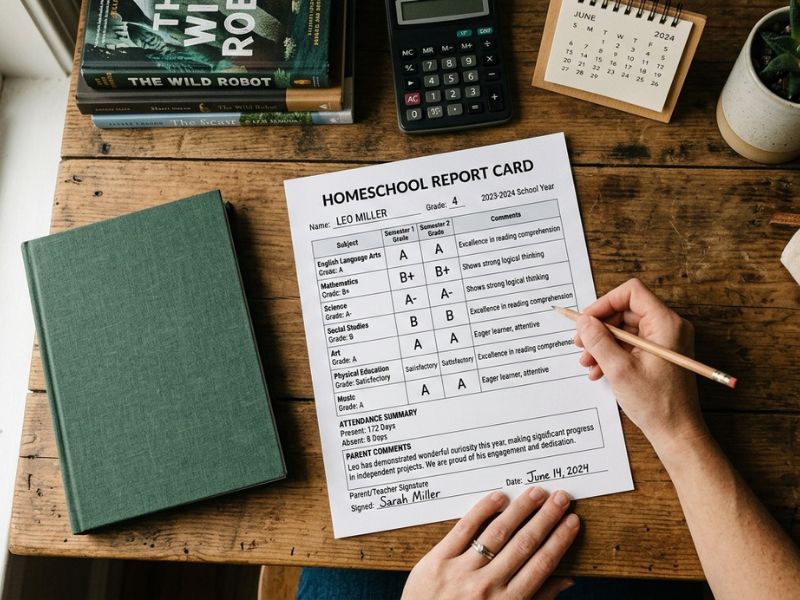
Making a homeschool report card can raise unexpected questions. Which grades belong on it? Should you include attendance, comments, or credits? When I work through homeschool record-keeping, I find that starting with a clear example removes much of that guesswork.
This sample homeschool report card shows what a practical record can look like. You’ll see examples for different grade levels, grading methods, comments, GPA, and record keeping. Use what fits your situation, keep your method consistent, and check any requirements that apply to your homeschool.
- Completed Homeschool Report Card Example
- What Is a Homeschool Report Card?
- What Should a Homeschool Report Card Include?
- How to Make a Homeschool Report Card
- Kindergarten Homeschool Report Card Example
- Elementary Homeschool Report Card Example
- Middle School Homeschool Report Card Example
- High School Homeschool Report Card Example
- Sample Homeschool Grading Scales
- How to Calculate a Homeschool GPA
- Sample Comments for a Homeschool Report Card
- Keep Good Homeschool Records
- Homeschool Report Card vs. Progress Report vs. Transcript
- Common Homeschool Report Card Mistakes
- Frequently Asked Questions
- Conclusion
Completed Homeschool Report Card Example
Here is a completed example for a fifth-grade homeschool student.
| Student Information | Details |
|---|---|
| Student Name | Emma Carter |
| Grade Level | 5th Grade |
| School Year | 2026–2027 |
| Homeschool Name | Carter Family Homeschool |
| Grading Period | Full Year |
| Date Issued | May 28, 2027 |
| Subject | Q1 | Q2 | Q3 | Q4 | Final Grade |
|---|---|---|---|---|---|
| Mathematics | A | A- | A | A | A |
| Language Arts | B+ | A- | A | A | A- |
| Science | A | A | A- | A | A |
| Social Studies | B+ | A | A | A- | A- |
| Art | A | A | A | A | A |
| Physical Education | A | A | A | A | A |
Days Attended: 176
Parent Comment: Emma made steady progress in reading and math. She became more independent with written assignments and showed strong interest in science.
Parent Signature: __________________
This is only an example. Your report card can be shorter or more detailed. The goal is to create a clear record that you can understand and use later.
What Is a Homeschool Report Card?
A homeschool report card is a record of a student’s academic performance during a set period. A parent may complete one at the end of a quarter, semester, or school year.
It can show what your child studied, the grades earned, and areas where progress was made. It can also help you keep yearly homeschool records organized. Report cards can also help organize subjects studied and grades earned, especially when you want a clear record of progress. HSLDA’s guidance on homeschool report cards also explains several reasons families may choose to keep them and recommends checking state record-keeping requirements.
A report card does not need to look exactly like one from a public or private school. You can use a paper form, spreadsheet, document, or printable homeschool report card template.
What Should a Homeschool Report Card Include?
Start with the information that helps someone understand who the report card belongs to, what was studied, and how progress was measured.
A homeschool report card may include:
- Student’s full name
- Grade level
- School year
- Homeschool name
- Grading period
- Date issued
- Subjects or courses
- Grades
- Final grades
- Grading scale
- Attendance
- Parent comments
- Parent or teacher signature
- Credits for applicable high school courses
You may not need every field for every child. A kindergarten report card, for example, can look very different from one for a high school student.
How to Make a Homeschool Report Card
Once you know what information you want to record, you can build the report card in a few steps.

Choose a Grading Period
Decide how often you want to complete a report card.
Common options include:
- Quarterly
- Each semester
- End of the school year
There is no single reporting schedule that works for every homeschool. Some families like quarterly reports because they provide regular progress checks. Others prefer semester or annual reports.
Follow any reporting or record-keeping requirements that apply to your homeschool.
Add Student Information
Include the student’s full name, grade level, school year, and grading period.
You can also add your homeschool name and the date the report card was issued.
Keeping these details consistent makes older records easier to identify later.
List Subjects or Courses
Write down the subjects your child studied during the grading period.
For an elementary student, this might include:
- Math
- Reading
- Writing
- Science
- Social Studies
- Art
- Physical Education
High school course names should be more specific when possible. For example, Algebra I is clearer than Math, while Biology provides more information than Science.
Choose a Grading Method
Decide how you will show progress before entering grades.
You might use:
- Letter grades
- Percentage grades
- Skill-based ratings
- Written progress descriptions
- Pass/Fail
The method can change as your child gets older. What works well for kindergarten may not be the best choice for high school.
Calculate the Grades
Use your grading method and the student’s completed work to determine each grade.
Grades may come from:
- Daily assignments
- Tests
- Quizzes
- Projects
- Essays
- Lab work
- Portfolios
- Other completed work
Use a consistent method so you can explain how you reached the final grade.
Keep enough supporting work to back up important grades. You do not need to save every worksheet. Tests, projects, essays, grade records, and other major work samples can provide useful evidence of progress.
Add Attendance and Comments
Add attendance information if you track it or need it for your records.
You can also write a short comment about the student’s progress. Focus on something useful, such as a strength, improvement, work habit, or skill that needs more practice.
Review and Save the Report Card
Check the student’s information, dates, subjects, and grades before you finish.
Save a copy with your homeschool records. You can use a paper folder, digital folder, or both.
Kindergarten Homeschool Report Card Example
Kindergarten students are still developing basic skills. A traditional A–F grading system may not always give you the clearest picture of their progress.
A simple kindergarten report card can focus on skills.
| Skill | Progress |
|---|---|
| Recognizes letters | Excellent |
| Knows common letter sounds | Good |
| Counts to 100 | Excellent |
| Writes first name | Excellent |
| Follows directions | Good |
| Participates in read-alouds | Excellent |
Possible ratings include:
- Excellent
- Good
- Satisfactory
- Needs Practice
You can also add a short note explaining progress. This lets you record what the child can do without turning every kindergarten activity into a percentage.
Elementary Homeschool Report Card Example
Elementary students may be ready for subject grades, but comments can still provide useful context.
Here is one example:
| Subject | Grade | Parent Note |
|---|---|---|
| Reading | A- | Reading fluency improved |
| Writing | B+ | Needs more spelling practice |
| Math | A | Strong understanding of concepts |
| Science | A | Enjoys hands-on activities |
| Social Studies | B+ | Making steady progress |
You can also track handwriting, reading fluency, work habits, or independent learning when those areas are useful to you.
Keep the report card easy to scan. You should be able to look at it later and quickly understand how your child was doing at that point in the school year.
Middle School Homeschool Report Card Example
Middle school is often a useful time to make grade records more structured. Students may have separate courses, more tests and projects, and clearer final grades.

A middle school report card might look like this:
| Subject | Semester 1 | Semester 2 | Final Grade |
|---|---|---|---|
| Pre-Algebra | B+ | A- | A- |
| English | A | A | A |
| Life Science | B+ | A | A- |
| U.S. History | A- | A | A |
| Art | A | A | A |
Keep enough supporting records to show where the grades came from. This can also help your child get used to more structured academic records before high school.
High School Homeschool Report Card Example
High school report cards deserve extra care because course names, grades, and credits may later help you prepare a transcript.
Here is a simple example:
| Course | Semester 1 | Semester 2 | Final Grade | Credit |
|---|---|---|---|---|
| Algebra I | A- | A | A | 1.0 |
| English I | B+ | A- | A- | 1.0 |
| Biology | A | A- | A | 1.0 |
| World History | B+ | A | A- | 1.0 |
| Spanish I | A | A | A | 1.0 |
The credit values above are examples. Credit policies and graduation requirements can vary. Check the requirements that apply to your student before assigning high school credits.
Use specific course titles whenever possible. Algebra I, Biology, and World History tell you much more about completed coursework than Math, Science, and Social Studies.
Keep course descriptions, final grades, credit information, and other important high school records together. This can save time when you prepare a transcript later.
Sample Homeschool Grading Scales
There is no single grading method that fits every homeschool student. Choose one that works for your child’s age and the way you evaluate learning.
Whatever method you choose, use it consistently and explain it clearly in your records.
Which Report Card Style Should I Use?
| Student or Need | Report Card Style to Consider | What It Shows |
|---|---|---|
| Kindergarten | Skill-based | Developing academic and learning skills |
| Elementary | Skills + grades or comments | Academic progress with useful context |
| Middle School | Letter or percentage grades | More structured subject performance |
| High School | Course grades + credits | Formal course progress and academic records |
| Progress-Focused Learning | Narrative | Strengths, growth, and areas that need more practice |

Letter and Percentage Grades
A simple letter-grade scale might look like this:
| Percentage | Letter Grade |
|---|---|
| 90–100% | A |
| 80–89% | B |
| 70–79% | C |
| 60–69% | D |
| Below 60% | F |
This is only an example. It is not a required national homeschool grading scale.
If you use another scale, record it clearly so you can understand what each grade means later.
Skill-Based Grading
Skill-based grading can work well for younger students.
For example:
- E = Excellent
- G = Good
- S = Satisfactory
- N = Needs Practice
Instead of giving a child 82% in handwriting, you might simply record that the skill is Satisfactory or Needs Practice.
Narrative-Based Report Cards
A narrative report uses written descriptions to explain progress instead of relying only on grades.
For example:
Reading: “Reads grade-level stories with growing confidence. Reading fluency has improved, but unfamiliar words still need practice.”
This approach can work well for younger students or subjects where one letter grade does not show the full picture.
Pass/Fail Grading
Some families use Pass/Fail for certain courses or learning situations.
If you use this method, decide what a student must complete or demonstrate to earn a passing grade. Apply the same rule consistently.
For a high school course, also consider how Pass/Fail will later appear on the student’s transcript.
Weighted Grades
Some families choose to give additional grade points for certain advanced high school courses.
If you use weighted grades, define your weighting method before calculating GPA. Keep the method consistent and document it with your high school records.
How to Calculate a Homeschool GPA
GPA becomes more relevant when you are keeping high school records.
For a credit-weighted GPA, first convert each eligible final grade into grade points based on the scale you use. Then multiply the grade points by the credit value of the course.
For example, if an A equals 4.0 points and a 1-credit course receives an A:
4.0 × 1 credit = 4.0 grade points
Add the grade points from all included courses. Then divide that total by the number of credits included in the calculation.
If you use weighted grades, apply your chosen weighting method consistently and keep a record of how the GPA was calculated.
Sample Comments for a Homeschool Report Card
Report card comments do not need to be long. A useful comment tells you something the grade alone cannot show.
Comments for Strong Progress
“Shows a strong understanding of math concepts and completes assignments carefully.”
“Reads independently and discusses stories with growing confidence.”
Comments for Improvement
“Reading fluency has improved steadily throughout the semester.”
“Has made good progress with multiplication facts and needs less help than earlier in the year.”
Comments for Independent Learning
“Works independently and completes most assignments on time.”
“Shows good focus during independent reading and written work.”
Comments for Areas That Need More Practice
“Would benefit from additional practice with spelling and written sentences.”
“Understands the main math concepts but needs more practice with multi-step problems.”
Comments About Effort
“Shows consistent effort and responds well to feedback.”
“Approaches new lessons with a positive attitude and keeps working when tasks are challenging.”
Specific comments are more useful than simply writing “Good job.” Focus on what improved, what the student does well, or what should come next.
Keep Good Homeschool Records
A report card is only one part of homeschool record keeping.
Depending on your child’s grade level and your situation, you may also keep:
- Attendance records
- Gradebooks
- Work samples
- Test results
- Course descriptions
- Reading lists
- Progress reports
- High school transcripts
You do not need to save every piece of schoolwork just because your child completed it. Keep the records that help document subjects, grades, progress, and important coursework.
Organize records by student and school year. A simple paper folder or clearly named digital folder can make older records much easier to find.
Homeschool record requirements vary by state. Check the current requirements that apply to your homeschool rather than assuming every state follows the same rules.
Homeschool Report Card vs. Progress Report vs. Transcript

These records are related, but they serve different purposes.
| Record | Main Purpose | What It May Include |
|---|---|---|
| Report Card | Shows performance for a grading period | Subjects, grades, attendance, comments |
| Progress Report | Shows how learning is developing during a period | Skills, progress, strengths, areas needing work |
| Transcript | Summarizes high school academic history | Courses, final grades, credits, GPA |
A report card is a snapshot of performance during a grading period. A progress report focuses more on how the student is developing. A transcript gives a broader record of high school coursework.
Keeping accurate high school report cards can make it easier to organize course names, final grades, credits, and other information when you later prepare a transcript.
Common Homeschool Report Card Mistakes
A homeschool report card should be easy to understand. Small mistakes can make old records confusing later.
Common mistakes include:
- Leaving out the school year or grade level
- Using vague high school course names
- Changing grading methods without explaining the change
- Using grades without a clear grading scale
- Saving no supporting grade records
- Mixing report card and transcript information
- Losing older report cards
- Assuming record requirements are the same in every state
Before saving the report card, read it as if you were looking at it several years from now. Make sure the subjects, grades, dates, and grading method would still make sense.
Before You Save Your Report Card
Check that:
- The student’s name and grade level are correct.
- The school year and grading period are included.
- Subjects or course names are clear.
- Grades match your records.
- Your grading scale is explained.
- High school credits are correct, if included.
- Comments are clear and specific.
- You have saved a copy for your records.
Frequently Asked Questions
Do Homeschoolers Need a Report Card?
Homeschool record-keeping requirements vary by state. A traditional report card may not be required in every situation, but other records or evaluations may be.
Check your state’s current homeschool requirements to find out what records you need to keep.
How Often Should I Make a Homeschool Report Card?
Some families create report cards every quarter. Others use semester or end-of-year reports.
Choose a schedule that helps you track progress and follows any reporting requirements that apply to your homeschool.
Can Parents Make Their Own Homeschool Report Cards?
Parents can create their own report-card format for their homeschool records. A simple document, spreadsheet, or printable template can work.
Include clear student information, subjects, grades, and the grading method you used.
Does a Homeschool Report Card Need Attendance?
Attendance can be useful on a report card, but whether you need to track or report it depends on the requirements that apply to your homeschool.
If you already maintain an attendance record, adding the total to the report card can provide a useful yearly summary.
Should a Homeschool Report Card Be Weighted?
A report card does not always need weighted grades. Some high school families use weighting for certain advanced courses, while others use an unweighted system.
Conclusion
From reviewing homeschool record needs, I’ve learned that useful report cards are clear, consistent, and easy to understand later. Use this sample homeschool report card as a starting point, keep evidence behind important grades, and adjust your records as your child advances. For high school, pay extra attention to course names, credits, and GPA.