 Skip to content
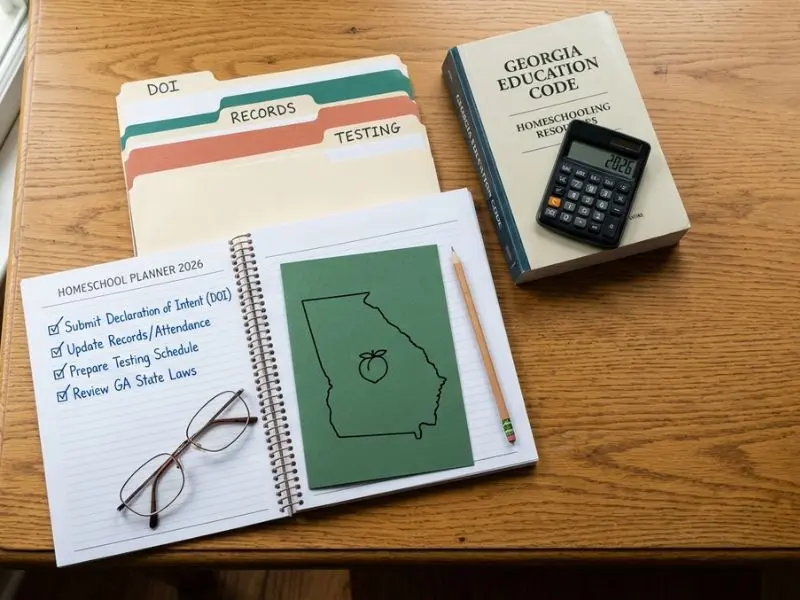
Georgia homeschool laws require parents to file a Declaration of Intent, teach five required subjects, provide 180 days of instruction, complete required testing, and keep progress records. You do not need a teaching certificate, and Georgia gives families flexibility when choosing a curriculum.
Legal rules can still feel overwhelming when you are worried about missing a deadline or filing the wrong paperwork. While researching Georgia’s current homeschool requirements, I found that most confusion comes from knowing what to submit and what to keep. This guide makes those steps easier to understand.
- Georgia Homeschool Requirements at a Glance
- Understanding Georgia's Homeschool Law
- Mandatory School Age in Georgia
- Qualifications to Homeschool in Georgia
- How to Start Homeschooling in Georgia
- Georgia Homeschool Declaration of Intent
- Do You Need Permission to Homeschool in Georgia?
- Georgia Homeschool Subject and Curriculum Requirements
- Georgia Homeschool Attendance Requirements
- Georgia Homeschool Record-Keeping Requirements
- Georgia Homeschool Reporting Requirements
- What Homeschool Records Do You Submit in Georgia?
- Georgia Homeschool Testing Requirements
- Annual Georgia Homeschool Compliance Checklist
- Special Homeschool Situations in Georgia
- Sports and Extracurricular Activities for Georgia Homeschoolers
- Can Georgia Homeschoolers Take the SAT, ACT and Other Exams at Public Schools?
- Georgia Promise Scholarship for Homeschool Families
- Georgia Homeschool Graduation and Diploma Requirements
- Common Misconceptions About Georgia Homeschool Laws
- Georgia Homeschool Laws FAQ
- Conclusion
Georgia Homeschool Requirements at a Glance

Georgia calls an independent homeschool a home study program. Parents have plenty of freedom over how they teach, but the state sets several basic requirements.
| Requirement | Georgia Homeschool Rule |
|---|---|
| Homeschooling legal? | Yes |
| Official term | Home study program |
| Compulsory attendance age | Generally ages 6–16 |
| Declaration of Intent | Required |
| First filing deadline | Within 30 days of starting |
| Annual filing deadline | By September 1 |
| Parent qualification | High school diploma or GED |
| Required subjects | Reading, language arts, math, social studies, and science |
| Instruction days | 180 days per year |
| Instruction time | At least 4.5 hours per school day |
| Standardized testing | At least every 3 years, beginning at the end of 3rd grade |
| Annual progress report | Required |
| Teaching certificate | Not required |
These rules apply to an independent Georgia home study program. A child enrolled in a public virtual school may learn from home, but that does not automatically make the student an independent homeschooler.
Understanding Georgia’s Homeschool Law
Homeschooling is legal in Georgia. Parents or guardians can establish a home study program as long as they follow the state’s requirements.
Georgia does not require families to recreate public school at home. You have flexibility when choosing curriculum, books, teaching methods, and your daily schedule.
That freedom still comes with responsibilities. Families need to follow Georgia’s rules for notification, instruction, required subjects, testing, and progress reports.
Mandatory School Age in Georgia
Georgia’s compulsory attendance law generally applies to children between the ages of 6 and 16.
A child within this age range must receive an education through a legal option. This can include public school, private school, or a home study program.
Parents of younger children should check whether their child has reached compulsory attendance age before assuming every homeschool filing requirement applies.
What Happens When a Homeschool Student Turns 16?
Turning 16 does not always mean you should stop filing homeschool paperwork.
If your student continues a home study program through high school, continue filing the annual Declaration of Intent until the student completes the program. This helps maintain a clear record that the student is continuing home study rather than leaving school before graduation.
Qualifications to Homeschool in Georgia
You do not need to be a certified teacher to homeschool your child in Georgia.
The parent or guardian operating the home study program must have at least a high school diploma or GED.
Parents can also arrange for a tutor to provide instruction. The tutor must meet the educational qualification required under Georgia law.
For most families, this means you do not need a teaching degree or previous classroom experience to begin homeschooling.
How to Start Homeschooling in Georgia
Starting a home study program is easier when you handle each step in the right order.
If your child currently attends school, deal with the transition first. Then complete Georgia’s homeschool paperwork and begin organizing your child’s education.
Withdraw Your Child From School
If your child currently attends a public or private school, complete the school’s withdrawal process before moving fully into homeschooling.
Keep a copy of any withdrawal confirmation or related communication for your records.
Withdrawal and homeschool notification are different steps. Withdrawal ends your child’s enrollment at the current school. Filing the required homeschool paperwork establishes the home study program.
File Your Declaration of Intent
Georgia homeschool families must submit a Declaration of Intent to the Georgia Department of Education.
For a new home study program, the declaration must generally be submitted within 30 days after the program is established.
After the first filing, continuing families submit a new declaration each year by September 1.
Save a copy after filing so you have a record of completing this requirement.
Choose Your Homeschool Curriculum
Once the legal setup is handled, choose materials that cover Georgia’s required academic subjects.
You can use textbooks, workbooks, online lessons, library books, hands-on activities, or a mix of different resources.
You do not need to copy a public school classroom. The goal is to provide consistent instruction while meeting Georgia’s home study requirements.
Your First 30 Days of Homeschooling in Georgia
Starting homeschool can feel easier when you handle the important steps in order. Use this quick checklist during your first few weeks.
- Complete withdrawal if your child is currently enrolled in a public or private school.
- Establish your home study program and decide when your homeschool year will begin.
- File your Declaration of Intent within the required timeframe.
- Save your DOI confirmation and keep a printed or digital copy with your records.
- Choose learning materials that cover Georgia’s five required academic subjects.
- Start tracking your instructional days so you can meet Georgia’s yearly requirements.
Georgia Homeschool Declaration of Intent
The Declaration of Intent, often called the DOI, is one of the most important parts of establishing and maintaining a Georgia home study program.
It tells the state that your child is being educated through a home study program.

When to File the Declaration of Intent
For a new home study program, submit the Declaration of Intent within 30 days of establishing the program.
After that, submit a new declaration each year by September 1.
If you start homeschooling during the school year, pay attention to the initial 30-day deadline. You do not need to wait until the following September to file.
Students who continue homeschooling through high school may also need the annual DOI after turning 16 until the home study program is completed.
What Information Is Required?
The Declaration of Intent must contain the information required by Georgia law and the current Georgia Department of Education form.
This includes information identifying the student, the location of the home study program, and the 12-month period you are using as the school year.
Always check the current form before submitting it because filing procedures can change.
How to File the Declaration of Intent
Parents can file the Declaration of Intent through the Georgia Department of Education’s online system.
Enter the required information carefully. Once the form is submitted, keep the confirmation number and save a printed or digital copy of the declaration.
What Happens After You File the Declaration?
After filing, keep your confirmation number and DOI with your homeschool records.
You do not need to wait for Georgia to approve your curriculum before continuing your home study program.
A copy of the DOI can also be useful when you need to show that your child is enrolled in a home study program.
2026 DOI Filing Note
In July 2026, the Georgia Department of Education reported an issue that may cause its online DOI system to show a school year of 2028 on some submissions.
GaDOE says families affected by this issue do not need to submit another DOI only because of the displayed school year.
Do You Need Permission to Homeschool in Georgia?
No. You do not need Georgia to approve your homeschool curriculum before you can teach your child at home.
Filing a Declaration of Intent is a notification requirement. It is not a request for curriculum approval.
You still need to meet Georgia’s legal home study requirements, but you have flexibility over the curriculum and teaching approach you use.
Georgia Homeschool Subject and Curriculum Requirements
Georgia requires home study programs to cover certain academic areas, but it does not require every family to use the same curriculum.
This gives parents room to choose materials that fit their child’s learning needs.
Required Homeschool Subjects
A Georgia home study program must provide a basic academic educational program that includes:
- Reading
- Language arts
- Mathematics
- Social studies
- Science
Families can teach additional subjects as well.
Art, music, technology, foreign languages, health, and practical life skills are common additions. These subjects can enrich your homeschool program, but they do not replace Georgia’s required academic areas.
Does Georgia Require a Specific Homeschool Curriculum?
No specific homeschool curriculum is required.
You can buy an all-in-one curriculum, choose separate programs for each subject, or build your own combination of educational resources.
Printed books and online programs can also be used together.
The important point is to make sure your child receives consistent instruction in the required subjects.
Georgia Homeschool Attendance Requirements
Two numbers matter when planning your Georgia homeschool year:
180 instructional days and at least 4.5 hours of instruction per school day.
Parents still have flexibility when arranging those days throughout the year.
180 Days of Instruction
A Georgia home study program generally provides instruction for the equivalent of 180 school days during each 12-month school year.
Your homeschool calendar does not have to match the local public school calendar.
You can organize your year around your family’s needs while still meeting the required number of instructional days.
4.5 Hours of Instruction Per Day
Georgia requires at least four and one-half hours of instruction per school day unless the child is physically unable to comply.
Homeschool instruction does not always have to mean sitting at a desk.
Depending on the lesson, reading, experiments, projects, and planned educational activities may be part of your child’s learning time.
The goal is to provide meaningful instruction while meeting Georgia’s requirement.
Georgia Homeschool Record-Keeping Requirements
Good records make it easier to show what your child has completed and can save time if your child changes schools or applies to college later.
Not every record you keep needs to be submitted to the state.
Important Homeschool Records
Keep copies of documents directly connected with your home study program, including:
- Declaration of Intent and confirmation
- Annual progress reports
- Standardized test results
Store these documents somewhere you can easily find them.
Useful Additional Records
Some records may not be routinely submitted to Georgia but are still useful to keep.
These can include:
- Attendance calendar
- Grades
- Curriculum information
- Student work samples
- Course descriptions
- High school credits
- Homeschool transcript
These records become especially valuable during high school or when a child returns to a traditional school.
Georgia Homeschool Reporting Requirements

Georgia requires parents to prepare an annual progress report for each homeschooled student.
The report should describe the student’s academic progress in the required subject areas.
Parents should keep these reports for at least three years.
The report does not need to become a complicated public school report card. It should give you a clear written record of what your child learned and how the student progressed during the year.
What Homeschool Records Do You Submit in Georgia?
Keeping a homeschool document and submitting it to Georgia are not the same thing.
This distinction can prevent a lot of unnecessary paperwork.
| Record | Keep a Copy? | Routinely Submit to GaDOE? |
|---|---|---|
| Declaration of Intent | Yes | Yes |
| Annual progress report | Yes | No |
| Standardized test results | Yes | No |
| Student work samples | Recommended | No |
| High school transcript | Recommended | No |
The Declaration of Intent is the main document routinely submitted through the state home study process.
Keep the other important records organized even when they are not routinely sent to GaDOE. You may need them later for school enrollment, high school planning, college applications, or proof of academic progress.
Georgia Homeschool Testing Requirements
Georgia homeschool students must complete standardized testing at certain points in their education.
The requirement begins at the end of third grade and continues at least once every three years.
When Is Standardized Testing Required?
The first required standardized achievement test is taken at the end of third grade.
After that, testing must occur at least every three years.
For many students, this creates a pattern around the end of grades 3, 6, 9, and 12.
The actual legal requirement is based on the three-year interval beginning at the end of third grade. It is not simply a fixed list of four grade levels.
Simple Georgia Homeschool Testing Timeline
Think of the testing rule as a repeating three-year cycle rather than a fixed list of grade levels.
First required test
Next testing point
Test again
At least every 3 years
Remember: Georgia law is based on testing at least every three years beginning at the end of third grade. Grades 3, 6, 9, and 12 are a common pattern, not a separate fixed-grade rule.
What Type of Test Is Required?
The student should take an appropriate nationally standardized achievement test that meets Georgia’s requirements.
Before buying a test, check that it qualifies for this purpose.
Georgia law also says the testing program should be administered in consultation with a person trained in administering and interpreting norm-referenced tests.
Check the test provider’s administration rules before testing so you know how the assessment should be handled.
Do You Submit Standardized Test Results?
Parents generally keep the results with their homeschool records rather than routinely sending them to the Georgia Department of Education.
Taking the required test and submitting the results to the state are two different things.
Store the results safely in case you need them later.
Quick Check: Avoid These Easy Mistakes
Withdrawing your child from the current school and filing a Declaration of Intent are separate steps.
A new home study program has its own initial Declaration of Intent deadline.
Annual progress reports and standardized test results are generally kept by the parent rather than routinely sent to GaDOE.
Record when your child completes standardized testing so you can plan for the next required three-year interval.
Annual Georgia Homeschool Compliance Checklist
You do not need to think about every homeschool law every day.
A simple yearly checklist can help you stay organized.
- File your Declaration of Intent on time.
- Plan at least 180 instructional days.
- Provide at least 4.5 hours of instruction per school day.
- Teach the five required academic areas.
- Prepare an annual progress report for each student.
- Keep progress reports for at least three years.
- Complete standardized testing when your child’s testing year arrives.
- Keep your DOI, testing records, and other important homeschool documents.
Reviewing these items during the year can help you catch a missing record or deadline early.
Special Homeschool Situations in Georgia
Not every family begins homeschooling at the start of a traditional school year.
School problems, moving, special educational needs, or changes at home may affect when and how you start.
Starting Homeschool Mid-Year
You can start a Georgia home study program during the school year.
If your child is already enrolled in school, complete the withdrawal process and establish your home study program carefully.
Then submit the Declaration of Intent within the applicable deadline.
You do not need to wait until the next school year simply because classes have already started.
Moving to Georgia While Homeschooling
Homeschool laws are different from state to state.
If you were homeschooling legally somewhere else and move to Georgia, do not assume your previous state’s paperwork automatically satisfies Georgia requirements.
Review Georgia’s home study rules and complete the steps that apply after establishing your program in the state.
Returning to Public School
Starting homeschooling does not mean your child can never return to public school.
If you later decide to return, the receiving school may ask for academic records when making placement or credit decisions.
Progress reports, test results, grades, course descriptions, and high school transcripts can make the transition easier.
Contact the receiving school or district before enrollment to learn what documentation it needs.
Homeschooling a Child With Special Needs
Parents can homeschool children with special educational needs in Georgia.
The normal home study requirements still need to be followed.
Access to some public services or educational programs may involve separate rules. Families seeking these services should check current state and local guidance rather than assuming the same services available through public school automatically continue after homeschooling begins.
Sports and Extracurricular Activities for Georgia Homeschoolers
Homeschooling does not automatically prevent a child from participating in public school sports or certain extracurricular activities.
Georgia provides a pathway for eligible home study students through a law commonly known as the Dexter Mosely Act.
How the Dexter Mosely Act Works
Eligible home study students may participate in certain extracurricular and interscholastic activities through public schools.
Participation is not automatic. Families must meet applicable residency, academic, notice, and other eligibility requirements.
Advance planning matters. If your child wants to participate, contact the local school system well before the activity or sports season begins so you can meet current deadlines.
Can Georgia Homeschoolers Take the SAT, ACT and Other Exams at Public Schools?
Georgia home study students can access certain exams offered through their local public school systems.
Under current Georgia rules, systems offering exams such as the PSAT/NMSQT, SAT, PreACT, ACT, or ASVAB must also make them available to eligible home study students living within the system’s attendance area.
This can be especially useful for students homeschooling through high school.
Contact your local school system before the testing date. Registration procedures, deadlines, available exams, and possible administration costs can change.
Georgia Promise Scholarship for Homeschool Families
The Georgia Promise Scholarship may provide educational funding to some eligible students, but it is not automatic funding for every homeschool family.
Eligibility depends on the current rules of the program and the student’s situation.
Do not choose curriculum or make enrollment decisions based on an expected scholarship until you confirm that your child qualifies.
Because eligibility, award amounts, and approved expenses can change, check the official Georgia Promise Scholarship website before applying or making homeschool spending decisions.
Georgia Homeschool Graduation and Diploma Requirements
High school brings different questions than the early homeschool years.
Parents need to think about courses, credits, transcripts, graduation, college admission, and future plans.
Independent Georgia home study students do not simply follow every graduation rule used by public high schools.
Homeschool Diploma
In a Georgia home study program, parents set their student’s graduation requirements and issue the homeschool diploma after those requirements are completed.
Georgia does not issue a separate state homeschool diploma.
Keep records showing what your student completed. These documents can be useful for college, employment, military service, or future education.
Homeschool Transcript
Start maintaining a transcript when your student begins earning high school credits.
A homeschool transcript commonly includes:
- Student information
- Course names
- Credits
- Grades
- GPA
- Graduation date
- Parent or homeschool administrator information
Keeping the transcript updated each year is much easier than trying to rebuild several years of high school work before graduation.
Dual Enrollment and College
Georgia homeschool students may have opportunities to take college courses while completing high school.
Admission and eligibility requirements can vary by institution and program.
If your child plans to attend college, review those requirements early. This gives you time to choose suitable courses, maintain a strong transcript, and complete required testing.
Common Misconceptions About Georgia Homeschool Laws
Older information and advice from other states can make Georgia’s requirements look more complicated than they are.
Understanding a few common misconceptions can prevent unnecessary worry.
Do I Need Approval From My Local School District?
No. Filing the Declaration of Intent is a notification requirement. It should not be confused with asking your local school district to approve your curriculum.
Do I Submit Monthly Attendance Reports?
No. Georgia homeschool families no longer submit the old monthly attendance reports to local school districts.
You should still organize your homeschool year so you can meet the required instructional days.
Do I Send Every Standardized Test Score to Georgia?
No. Georgia requires standardized testing at the required intervals, but parents generally keep the results rather than routinely submitting them to GaDOE.
Do Georgia Homeschoolers Take Georgia Milestones?
Independent home study students follow Georgia’s homeschool standardized testing requirements rather than automatically being treated as public school students for Georgia Milestones testing.
Is Online School the Same as Homeschooling?
Not always.
A child enrolled in a public virtual school may complete lessons at home but still be legally enrolled as a public school student.
An independent Georgia home study program operates under Georgia’s homeschool requirements instead.
Georgia Homeschool Laws FAQ
Do I Need a Teaching Degree to Homeschool in Georgia?
No. You do not need a teaching degree or teaching certificate. However, the parent, guardian, or tutor providing instruction must meet Georgia’s educational qualification requirement.
How Often Do Georgia Homeschoolers Take Standardized Tests?
Students must take an appropriate nationally standardized achievement test at least every three years, beginning at the end of third grade.
Do I Need to Submit Monthly Attendance Reports?
No. Georgia homeschool families no longer submit the old monthly attendance reports to local school districts.
Can Georgia Homeschoolers Play Public School Sports?
Eligible home study students may participate in certain public school extracurricular and interscholastic activities when they meet the applicable requirements.
Does Georgia Pay Parents to Homeschool?
Georgia does not automatically pay parents who choose independent homeschooling. Some students may qualify for educational funding programs if they meet current eligibility requirements.
Do Georgia Homeschoolers Take Georgia Milestones?
Independent home study students generally follow Georgia’s homeschool standardized testing requirement rather than automatically participating in Georgia Milestones as public school students do.
Can I Unschool My Child in Georgia?
Georgia gives parents flexibility over teaching methods, but an unschooling approach still needs to meet the state’s home study requirements for required subjects, instructional time, testing, progress reports, and other legal responsibilities.
Conclusion
Keeping a Georgia homeschool legally on track is simpler when the key requirements become part of your yearly routine. From my research, the most important habits are filing your Declaration of Intent on time, meeting instruction rules, completing required testing, and maintaining clear records. These steps can prevent much of the confusion parents face.