 Skip to content
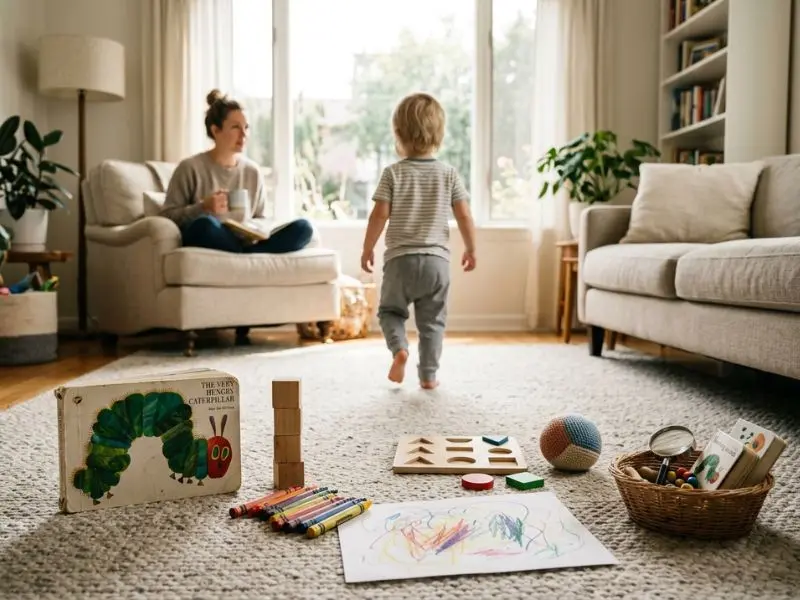
Homeschool for toddlers should be simple and play-based. I found that short activities, books, movement, and everyday tasks worked better than trying to follow formal lessons. Toddlers do not need a full school day to learn.
The biggest mistake I made was planning too much. Once I followed my toddler’s interests and attention instead of the clock, learning felt more natural. A flexible routine with plenty of play is often the best place to start.
- Toddler Homeschool: Key Takeaways
- How Do I Homeschool My Toddler?
- Why Toddler Homeschool Is Different
- Do Toddlers Need Formal Homeschool Lessons?
- What Should I Be Teaching My Toddler?
- Homeschool for Toddlers by Age
- Choosing a Toddler Homeschool Curriculum
- Toddler Homeschool Activities
- Toddler Work Bins and Activity Trays
- Toddler Homeschool Schedule
- What About Socialization for Homeschooled Toddlers?
- How Long Should Toddler Homeschool Take?
- What About Screens During Toddler Homeschool?
- Simple Homeschool Organization
- Must-Have Toddler Homeschool Supplies
- How Do I Know If My Toddler Is Learning?
- Common Toddler Homeschool Mistakes
- Frequently Asked Questions
- Conclusion
Toddler Homeschool: Key Takeaways
- Toddler homeschool should focus on play, movement, books, conversation, and everyday experiences.
- You do not need a formal curriculum or several hours of lessons each day.
- Keep planned activities short and follow your toddler’s interest and attention.
- Use normal routines such as sorting laundry, counting toys, reading, and outdoor walks as learning opportunities.
- Choose activities based on development rather than pressure to get academically ahead.
- A flexible daily rhythm usually works better than a strict school-style schedule.
How Do I Homeschool My Toddler?
Start small. You do not need to plan every hour of your toddler’s day.
Choose a few simple activities that fit naturally into your routine. Read a picture book, sing songs, sort toys, build with blocks, or take a walk outside.
Toddler learning works best when it is active. Your child can learn colors while sorting toys, hear new words while helping in the kitchen, or practice counting while putting blocks into a basket.
A simple approach is:
- Follow your toddler’s interests.
- Keep planned activities short.
- Read together every day.
- Include plenty of movement and play.
- Repeat favorite activities.
- Use everyday tasks as learning opportunities.
- Stop when your child loses interest.
You do not need to fill the whole day with planned learning. Toddlers also need free play, meals, movement, rest, and time with family.
Consistency matters more than creating a perfect school day.
Why Toddler Homeschool Is Different
Homeschooling a toddler is very different from teaching a school-age child at home.
Toddlers are still building language, movement, social, emotional, and thinking skills. They often learn by touching, moving, watching, listening, copying, experimenting, and repeating.
Pouring water between cups may look like simple play, but it can help with coordination and control. Building a block tower can support fine motor skills and problem-solving.
This is why a toddler does not need to sit at a desk for long lessons.
Play and everyday experiences can create valuable learning opportunities. More worksheets or longer lessons do not automatically mean more learning.
Do Toddlers Need Formal Homeschool Lessons?
Toddlers do not need a traditional school-style day at home to learn.
A toddler can learn through conversations, picture books, songs, pretend play, outdoor exploration, household routines, and hands-on activities.
Instead of asking, “How much school did we finish today?” ask:
- Did we talk and read together?
- Did my toddler move and explore?
- Did we practice a new skill?
- Did my child have time for free play?
- Did we enjoy learning together?
Formal preschool or toddler programs can give some families useful structure. However, you can also create meaningful learning experiences at home without turning your day into a classroom.
What Should I Be Teaching My Toddler?
You do not need a long list of academic subjects.
Focus on broad skills that support your toddler’s development. Language, movement, early math, social skills, creativity, and practical life can all grow through normal daily activities.

Language and Early Literacy
Talk with your toddler throughout the day. Name objects, describe what you are doing, ask simple questions, and give your child time to respond.
Picture books are especially useful. Let your toddler point at pictures, turn pages, name familiar objects, and hear favorite stories again.
Songs and rhymes can also introduce new words and sounds.
Early literacy activities can include:
- listening to stories
- looking at pictures
- learning new words
- singing songs
- hearing rhymes
- scribbling
- talking about everyday experiences
You do not need to push your toddler to read independently.
Early Math Skills
Toddler math should be simple and hands-on.
Count stairs while walking. Sort toys by type or color. Compare big and small objects. Match similar objects or count blocks as you put them away.
Simple early math experiences include:
- counting real objects
- sorting
- matching
- stacking
- noticing basic shapes
- recognizing simple patterns
- comparing sizes
- exploring ideas such as more, less, full, and empty
You can introduce these ideas naturally without turning them into worksheets.
Fine and Gross Motor Skills
Fine motor skills involve smaller movements, especially movements of the hands and fingers.
Activities can include:
- stacking blocks
- scribbling with large crayons
- turning book pages
- completing simple puzzles
- using play dough
- placing large objects into containers
Gross motor skills involve larger body movements.
Running, dancing, climbing, kicking a ball, walking outdoors, and jumping can all give toddlers chances to move and practice physical skills.
A toddler who wants to move instead of sitting through an activity is not necessarily refusing to learn. Movement can be part of learning.
Social and Self-Regulation Skills
Learning at this age also involves emotions and relationships.
Toddlers are beginning to practice communicating needs, following simple routines, waiting, making choices, and interacting with other people.
You can support these skills by naming feelings, modeling calm behavior, keeping routines predictable, and offering simple choices.
Do not expect perfect self-control. These skills develop gradually.
Creativity and Imagination
Give your toddler chances to create without expecting a perfect final result.
Drawing, painting, music, pretend cooking, dress-up, blocks, and simple role-play can encourage imagination.
Try not to correct every creative choice. A purple tree or unusual block house does not need to be fixed. The process matters more than making something look “right.”
Homeschool for Toddlers by Age
Toddler development can change quickly. An activity that interests a child close to age three may not work for a younger toddler.
Age ranges can help you choose activities, but they should not become strict academic standards.
Children develop at different rates, so use these age ranges as general guidance rather than a checklist your toddler must complete. Focus on your child’s current abilities, interests, and comfort instead of comparing progress with other children.
| Age | Main Focus | Simple Learning Ideas |
|---|---|---|
| 12–18 months | Language, movement, exploration | Picture books, songs, stacking, safe sensory play |
| 18–24 months | Matching, sorting, communication, pretend play | Simple puzzles, scribbling, action songs, household tasks |
| 2–3 years | Early concepts, creativity, independence | Counting during play, colors, shapes, art, pretend play |
Use this table as a quick guide, not a developmental checklist. Children develop at different rates, and activities should match your toddler’s abilities and interests.

12–18 Months
At this stage, focus on interaction, movement, simple language, and safe exploration.
You might:
- name familiar objects
- read short picture books
- sing simple songs
- stack large blocks
- put objects into containers
- explore safe textures
- spend time outdoors
- encourage safe movement
Keep activities simple and closely supervised.
18–24 Months
As language and physical skills grow, you can introduce more matching, sorting, pretend play, and simple art.
Activities might include:
- matching familiar objects
- sorting large items
- scribbling
- simple puzzles
- pretend cooking
- identifying body parts
- singing action songs
- counting a few real objects
- helping with simple household tasks
Repetition is useful. You do not need a new activity every day.
2–3 Years
Older toddlers may enjoy slightly more structured activities while still learning mainly through play.
You can explore:
- colors
- basic shapes
- counting during play
- picture books
- simple puzzles
- pretend play
- drawing and painting
- songs and rhymes
- sorting and matching
- practical life skills
Some children may also become interested in letters or numbers. Follow that interest without turning it into pressure or a test.
Choosing a Toddler Homeschool Curriculum
A toddler homeschool curriculum can give parents ideas and structure. However, buying a curriculum is not the only way to support learning at home.
You generally have three simple options.
No Formal Curriculum
Build learning around books, play, outdoor time, conversation, and everyday routines.
This works well for parents who want a flexible and low-cost approach.
Flexible Learning Plan
Choose a few skills or themes and plan several simple activities each week.
For example, a week about animals might include animal books, songs, counting toy animals, outdoor observation, and animal-themed art.
Structured Curriculum
Follow a prepared program that provides themes, activities, or lesson plans.
This can be useful if you prefer more direction and do not want to create activities yourself.
The best choice is one you can use consistently without making learning stressful for your toddler or your family.
You also do not need to spend heavily. Many useful toddler learning experiences need only books, basic art supplies, household objects, outdoor time, and toys you already own.
What to Look for in a Toddler Homeschool Program
If you choose a toddler homeschool program, look beyond colorful worksheets and long activity lists.
A useful program should fit your child’s developmental level and leave plenty of room for play.
Look for:
- short activities
- hands-on learning
- movement
- books and language
- simple preparation
- flexibility
- creative play
- practical life activities
- realistic expectations
Avoid choosing a program only because it promises to help your toddler get academically ahead.
Choose something that fits the child you have, not an ideal schedule you may struggle to maintain.
Toddler Homeschool Activities
You do not need expensive materials or complicated preparation to create useful toddler homeschool activities.
Many learning opportunities can come from things already around your home.
Instead of planning activities only because they look educational, think about what your toddler can explore or practice through each one.
Sensory Play
Sensory activities allow toddlers to explore through touch, sight, sound, and movement.
Simple ideas include supervised water play, play dough, safe texture exploration, or transferring large, age-appropriate objects between containers.
Avoid small loose items that could become choking hazards. Keep activities suitable for your child’s age and supervise closely when needed.
If your toddler does not like a sensory activity, do not force it. Try something different or return to it another day.
Books and Read-Alouds
Reading is one of the easiest learning activities to include every day.
Let your toddler choose books. Talk about the pictures. Ask simple questions such as, “Where is the dog?” or “What color is the car?”
It is fine to read the same book again and again. Repetition can help toddlers become familiar with words, pictures, and stories.
Reading does not need to become a lesson. Sitting together and enjoying a book has value on its own.
Art and Creative Activities
Toddler art should focus on exploration rather than producing perfect crafts.
Try:
- large crayons
- washable paint
- plain paper
- age-appropriate stickers
- play dough
- simple collage activities using safe materials
Allow your toddler to make choices and experiment.
If the activity lasts only a few minutes, that is okay.
Math and Sorting Activities
You can build early math into normal play.
Sort large toy animals into groups. Match pairs of safe objects. Count blocks while building. Compare two toys and ask which is bigger.
You can also sort socks while doing laundry or count pieces of fruit at snack time.
Simple household moments can introduce math without creating a separate lesson.
Outdoor and Movement Activities
Outdoor time offers many learning opportunities.
Take a nature walk and talk about what you see. Notice colors, sounds, weather, plants, and animals.
Outdoor play also creates simple science opportunities. Talk about leaves, insects, water, shadows, rocks, and changing seasons. Let your toddler observe, touch safe objects, ask questions, and notice differences.
At this age, science can be as simple as being curious about how the world works.
Outdoor time also gives toddlers chances to walk, run, balance, climb, and move.
Real-Life Learning Activities

Daily tasks can become useful learning activities.
Your toddler might:
- put toys into a basket
- match socks
- carry safe items to the table
- wipe a small spill
- help water plants
- choose clothes
- put books back on a shelf
These activities can support language, coordination, independence, and practical skills.
You do not need to create a special activity when real life already provides a good learning opportunity.
Toddler Work Bins and Activity Trays
Work bins or activity trays can make toddler homeschool easier to organize.
You do not need dozens of them. Prepare a few simple activities and rotate them when your toddler loses interest.
Activity bins can be especially useful when you are homeschooling older children too. One practical approach is to keep a separate toddler activity box with simple materials that are easy to bring out during lesson time. My Homeschool shares a similar strategy in its guide to homeschooling with toddlers and babies, along with ideas for managing learning across different ages
One tray might contain an age-appropriate puzzle. Another could have blocks. A third could contain large crayons and paper.
Rotate the bins instead of offering everything at once. This can keep familiar activities interesting without requiring you to prepare something new every day.
Keep materials visible and easy to reach when they are safe for independent use. Put anything requiring close supervision away until an adult is available.
The goal is to make activities easier to start, not to create a miniature classroom.
Toddler Homeschool Schedule
A toddler homeschool schedule should leave plenty of room for normal family life.
Here is one simple example:
| Part of Day | Activity |
|---|---|
| Morning | Breakfast and free play |
| After breakfast | Picture book and songs |
| Mid-morning | Short hands-on activity |
| Late morning | Outdoor or movement time |
| Noon | Lunch |
| Early afternoon | Nap or quiet time |
| Afternoon | Art, sensory, or practical activity |
| Later afternoon | Free play |
| Evening | Family time and books |
This is only an example. Your toddler’s sleep, meals, energy, interests, and family routine should shape your actual day.

Start With a Daily Rhythm, Not a Fixed Schedule
A daily rhythm gives your toddler some predictability without forcing every activity to happen at an exact time.
For example:
Breakfast → play → reading → outside → lunch → nap → activity → free play
If your toddler becomes deeply involved in building blocks, you do not need to stop because the schedule says it is time for art.
If the morning falls apart, you also do not need to “catch up” later.
Flexibility is one of the biggest advantages of learning at home.
What About Socialization for Homeschooled Toddlers?
Learning at home does not mean a toddler needs to stay home all day.
Toddlers can interact with other people through siblings, relatives, playgrounds, library storytimes, playgroups, neighborhood activities, and parent-child classes.
Keep social experiences simple and age-appropriate. Toddlers are still learning how to communicate, share space, express feelings, and play around other children.
You do not need to fill the calendar with activities just to create social opportunities. Regular interaction with other people can happen naturally as part of family and community life.
How Long Should Toddler Homeschool Take?
Toddler homeschool does not need to take several hours of formal instruction each day.
Keep planned activities short and watch your child’s response. Some toddlers may participate for only a few minutes. Others may stay involved longer when an activity matches their interests.
Learning also continues outside planned activities.
Reading before a nap, counting fruit at lunch, talking during a walk, building blocks, helping with laundry, and pretend play can all provide learning opportunities.
Instead of tracking “school hours,” focus on creating a balanced day with interaction, play, movement, books, rest, and exploration.
What If My Toddler Will Not Do the Activity?
You do not need to force your toddler to finish an activity.
If your child walks away, becomes frustrated, throws the materials, or clearly loses interest, stop and try something else.
You can simplify the activity, offer a choice, add movement, or return to it another day. Sometimes free play is the better choice.
A five-minute activity that ends happily can be more useful than a longer activity that becomes a struggle.
What About Screens During Toddler Homeschool?
Screens do not need to be the center of toddler homeschool.
Young children benefit from real-world interaction, conversation, movement, books, play, and hands-on exploration.
If you use digital media, choose age-appropriate, high-quality content and stay involved when possible.
Avoid letting screen activities replace active play, reading, sleep, family interaction, or outdoor exploration.
For toddlers, technology works best as a limited tool rather than the main way they learn.
Simple Homeschool Organization
Toddler homeschool does not require a dedicated classroom.
A bookshelf, small storage area, or a few baskets may be enough.
Keep frequently used materials easy to access when they are safe for independent use. Rotate some toys and activities rather than displaying everything at once.
You can keep a small basket for current books and another for art supplies that require adult help.
Simple organization can save preparation time and make it easier to start an activity and clean up afterward.
Do not compare your home with elaborate homeschool rooms online. A useful learning space can be simple.
Must-Have Toddler Homeschool Supplies
You can homeschool a toddler with basic materials.
Useful supplies may include:
- picture books
- large crayons
- washable paint
- plain paper
- blocks
- age-appropriate puzzles
- balls
- play dough
- simple musical instruments
- sorting containers
- child-safe art supplies
- household objects suitable for supervised activities
You do not need to buy everything at once.
Start with what you already have. Add a material when it serves a clear purpose rather than buying supplies simply because they are labeled “educational.”
How Do I Know If My Toddler Is Learning?
You do not need grades, tests, or report cards to notice learning at this age.
Pay attention to everyday changes.
Your toddler may begin using new words, solving a familiar puzzle more easily, following simple directions, copying actions, showing more independence, asking questions, or using toys in new ways.
Development does not always happen at the same pace across every area. Avoid turning another child’s progress into your toddler’s academic deadline.
Developmental milestone checklists can help you notice how your child is progressing, but they are not the same as a developmental screening or diagnosis. A homeschool activity list should not be treated as a test your toddler must pass.
If you have concerns about your child’s development, use trusted developmental guidance and discuss those concerns with an appropriate healthcare professional rather than relying on homeschool comparisons alone.
Common Toddler Homeschool Mistakes
Most toddler homeschool problems come from trying to make learning too formal.
Planning Too Much
A full day of scheduled activities can quickly become stressful.
Plan less than you think you need. Leave room for meals, naps, free play, outdoor time, and unexpected changes.
Expecting a Toddler to Sit Still
Toddlers often learn while moving.
If your child struggles to sit through an activity, try taking the learning outside, using larger materials, or turning the activity into something active.
Buying Too Many Materials
You do not need a large collection of educational toys or supplies.
Start with books, blocks, crayons, paper, simple puzzles, and household items. Add new materials only when they serve a clear purpose.
Comparing Your Toddler With Other Children
Another toddler may talk more, count higher, or show interest in letters earlier.
That does not mean your child is failing.
Use your own child’s progress, interests, and needs to guide your homeschool choices.
Turning Every Moment Into a Lesson
Not every game, snack, or walk needs a learning goal.
Toddlers also need time to play simply because play is enjoyable.
Frequently Asked Questions
Is 2 Years Old Too Early to Start Homeschooling?
It is not too early to create learning opportunities at home. However, a two-year-old does not need a traditional school day. Focus on play, reading, conversation, movement, exploration, and simple routines rather than pushing formal academics.
Does a Toddler Need a Homeschool Curriculum?
A formal toddler homeschool curriculum is not necessary for every family. Some parents like the structure, while others prefer books, play, activities, and everyday experiences. Choose an approach that fits your child, budget, available time, and family routine.
How Many Hours a Day Should I Homeschool My Toddler?
You do not need to recreate a full school day. Planned activities can be short, while learning happens throughout normal routines. Reading, outdoor play, conversation, practical tasks, and free play can all be part of your toddler’s learning day.
What Should a 2-Year-Old Learn at Home?
Focus on broad development rather than a strict academic checklist. Language, movement, social skills, books, simple counting, matching, sorting, pretend play, art, and everyday independence are useful areas to explore.
Can Toddlers Learn Through Play?
Yes. Play gives toddlers chances to explore, communicate, move, solve problems, practice skills, and use their imagination. You can support learning by providing safe materials, talking with your child, and joining the play when appropriate.
Do I Need Worksheets to Homeschool a Toddler?
No. Worksheets are not required for toddler homeschool. Hands-on activities, books, conversation, movement, art, practical tasks, and play can provide natural ways for toddlers to explore early skills.
What If My Toddler Does Not Want to Learn?
Do not assume your toddler is refusing to learn just because a planned activity fails. Your child may be tired, hungry, interested in something else, or simply finished. Stop, simplify the activity, offer another choice, or try again later.
Conclusion
After working through different routines and activities, I have learned that toddler homeschool does not improve by making the day busier. I focus on development, curiosity, play, and everyday progress instead. Keep learning simple, watch how your child responds, and use trusted developmental guidance when you need answers beyond everyday homeschool decisions.