 Skip to content
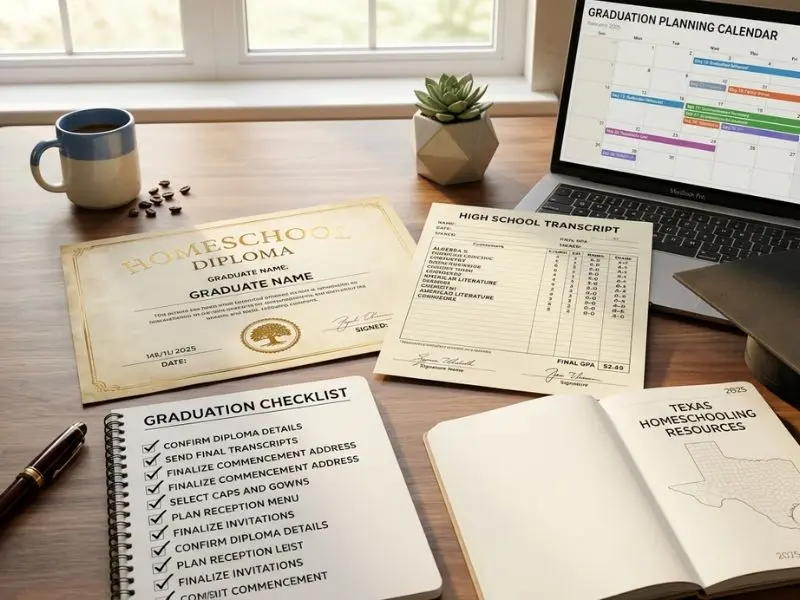
Watching your homeschooled child reach graduation should feel rewarding, yet many parents suddenly worry about diplomas, transcripts, and whether everything has been done correctly. If you’re wondering how to get a homeschool diploma in Texas, you’re likely looking for clear answers instead of conflicting advice.
As I reviewed Texas homeschool guidance and compared it with questions real families ask, one pattern stood out: uncertainty grows when legal facts and personal opinions get mixed together. This guide simplifies the process, explains what truly matters, and helps you graduate your student with confidence.
- Quick Answer
- Homeschooling in Texas: What You Need to Know
- Homeschooling in Texas: Just Like a Private School
- How Does My High School Student Graduate From Homeschooling?
- How to Get a Homeschool Diploma in Texas: Step by Step
- Creating Homeschool Transcripts and Diplomas in Texas
- Making a Diploma
- Get Support
- Common Mistakes Parents Should Avoid
- Graduation Ceremonies
- Planning for the Future After Homeschooling in Texas
- Beyond Graduation
- Graduation Recognition
- What If the Student Returns to Public School?
- Keeping and Replacing Graduation Records
- What Should You Do Next?
- Final Checklist Before You Issue a Homeschool Diploma
- Texas Homeschool Diploma at a Glance
- Frequently Asked Questions
- Conclusion
Quick Answer
In Texas, parents issue homeschool diplomas because they direct and administer their homeschool program. The State of Texas does not issue homeschool diplomas, and the Texas Education Agency does not approve or regulate independent homeschool graduation. After a student completes the family’s graduation requirements, the parent may prepare a transcript, issue the diploma, and maintain the student’s permanent academic records.
Key Takeaways
- Parents issue homeschool diplomas in Texas.
- Texas does not award homeschool diplomas to homeschool students.
- Parents determine homeschool graduation requirements.
- A transcript is just as important as the diploma.
- Organized record keeping throughout high school makes graduation much easier.
- Colleges, employers, and career training programs often request a transcript along with the diploma.
Who Should Read This Guide?
This guide is especially helpful if you are:
- Homeschooling a high school student in Texas.
- Preparing for your child’s graduation.
- Planning ahead for ninth or tenth grade.
- Moving to Texas from another state.
- Applying to college, trade school, or military service.
- Creating your first homeschool transcript or diploma.
Whether your student plans to attend college, enter the workforce, start a business, or learn a skilled trade, understanding the graduation process now will make every future step easier.
Homeschooling in Texas: What You Need to Know

Before creating a homeschool diploma, it’s important to understand how Texas law views homeschooling. Many parents mistakenly believe they must follow the same graduation rules as public schools. In reality, Texas gives homeschool families significant flexibility in planning high school education.
Parents have the authority to teach their children at home, establish graduation requirements, maintain academic records, and issue a homeschool diploma after those requirements have been completed. Understanding these legal foundations helps you make informed decisions throughout your student’s high school years.
Parental Control Over Graduation Requirements
One of the greatest advantages of homeschooling in Texas is that parents oversee the entire graduation process. There is no state agency that decides whether a homeschooled student has earned a diploma.
As the homeschool administrator, you may:
- Decide which courses your student completes.
- Establish graduation requirements.
- Track academic progress.
- Maintain permanent records.
- Prepare the transcript.
- Issue the homeschool diploma.
Although Texas gives parents this flexibility, it is still wise to create a graduation plan before high school begins. Planning ahead makes record keeping, transcript preparation, and college applications much easier.
No State-Mandated Graduation Requirements
Many families wonder how many credits a homeschool student must earn before graduating.
Unlike Texas public schools, independent homeschool students are not required to complete a state-approved graduation plan or a fixed number of credits. Parents decide what their student must accomplish before graduation.
Many homeschool families voluntarily use public school graduation plans as a guide because they provide a familiar structure for colleges and employers. However, these plans are recommendations rather than legal requirements for independent homeschool students.
A balanced high school program commonly includes:
- English
- Mathematics
- Science
- Social Studies
- Physical Education
- Fine Arts
- Foreign Language
- Electives
Your graduation plan should match your student’s future goals, whether they involve college, career training, military service, entrepreneurship, or entering the workforce.
Equivalency to Public School Graduation
Many parents ask whether a homeschool diploma has the same value as a public school diploma.
Texas recognizes the successful completion of a homeschool education for admission to covered Texas public institutions of higher education under state law. Colleges, employers, trade schools, and other organizations often review the student’s complete academic record rather than the diploma alone.
This is why preparing a detailed transcript is just as important as creating the diploma itself. Together, these documents provide clear evidence that your student successfully completed high school.
The Leeper Case
The legal foundation for homeschooling in Texas comes from the landmark Leeper v. Arlington Independent School District decision.
Before this ruling, many homeschool families faced uncertainty about whether homeschooling was legally protected. The Texas Supreme Court confirmed that a bona fide homeschool may operate under the private-school exemption when it meets the state’s basic requirements.
This decision continues to protect the rights of Texas parents to direct their children’s education, establish graduation standards, and issue homeschool diplomas without applying for state approval.
What Subjects Are Required for Texas Homeschoolers?
Texas does not require independent homeschool students to complete a state-approved graduation credit plan. However, a homeschool program should provide genuine instruction using a written, digital, video, or another visual curriculum.
The curriculum should include:
- Reading
- Spelling
- Grammar
- Mathematics
- Good citizenship
These are the basic educational subjects associated with operating a homeschool in Texas. Parents are free to teach many additional subjects and design a high school program that supports their student’s future goals.
What If You Recently Moved to Texas?
Families relocating from another state can usually continue homeschooling after learning Texas homeschool requirements.
If your student has already completed high school courses elsewhere, keep copies of previous transcripts, report cards, curriculum records, and course descriptions. These records will help you prepare one complete homeschool transcript when your student graduates.
Homeschooling in Texas: Just Like a Private School
One of the most important facts every homeschool parent should understand is that Texas allows bona fide homeschools to operate under the private-school exemption. This explains why parents have the authority to direct instruction, determine graduation requirements, and issue a homeschool diploma.
Many families mistakenly believe they need approval from the Texas Education Agency before graduating a homeschool student. That is not how independent homeschooling works in Texas.
Instead, parents oversee the student’s education from beginning to end. They plan coursework, maintain records, evaluate progress, prepare graduation documents, and determine when the student has successfully completed the homeschool program.
What Does This Mean for You?
As the homeschool administrator, you are responsible for organizing your student’s high school education.
This includes:
- Planning coursework.
- Keeping attendance and academic records.
- Tracking completed credits.
- Preparing the homeschool transcript.
- Creating and signing the diploma.
- Saving permanent graduation records.
Good organization throughout high school helps prevent problems during college admissions, employment applications, scholarship opportunities, and future record requests.
Homeschool Graduation
A homeschool student graduates when the parent determines that the family’s graduation requirements have been successfully completed.
After confirming that all coursework and graduation goals have been met, parents can:
- Finalize the transcript.
- Prepare the diploma.
- Record the graduation date.
- Sign the graduation documents.
- Hold a graduation ceremony if desired.
- Store permanent copies of all records.
There is no general requirement to notify the Texas Education Agency or apply to the state before issuing an independently homeschooled student’s diploma.
Other Options
While most Texas homeschool families issue their own diploma, some choose a different educational path.
Students enrolled in an umbrella school or private homeschool program may receive a diploma from that organization instead of one issued directly by their parents.
Some students also earn dual-credit college courses while completing high school. These credits can strengthen both the transcript and future college applications.
A GED or Certificate of High School Equivalency is another educational pathway, but it is not required simply because a student was homeschooled. Most independent homeschool graduates complete high school by meeting their family’s graduation requirements and receiving a parent-issued diploma.
How Does My High School Student Graduate From Homeschooling?
One of the most common questions Texas homeschool parents ask is, How does my child officially graduate? The answer is simpler than many families expect. In Texas, parents decide when their student has successfully completed the homeschool program. There is no state graduation application, no state-issued diploma, and no final approval from the Texas Education Agency.
Instead, graduation is based on the requirements you establish for your homeschool. Once your student completes those requirements, you may officially graduate them and prepare their homeschool diploma and transcript.
The process becomes much easier when you begin planning during the first year of high school instead of waiting until senior year.
Personal Graduation
Most homeschool families in Texas choose a parent-issued graduation. In this situation, the parent serves as both the teacher and the homeschool administrator throughout high school.
When your student completes the graduation requirements you established, you may officially recognize them as a homeschool graduate.
A typical parent-issued graduation includes:
- Reviewing completed coursework.
- Confirming graduation requirements have been met.
- Finalizing the homeschool transcript.
- Preparing the homeschool diploma.
- Signing and dating the diploma.
- Saving permanent graduation records.
- Celebrating with a graduation ceremony if desired.
There is no general requirement to notify the Texas Education Agency or apply to the state before issuing an independently homeschooled student’s diploma.
Parents also do not need to register the diploma with the state. Instead, they should maintain accurate records showing that the student completed the homeschool program according to the family’s graduation plan.
Umbrella School Diploma
Some Texas homeschool families choose to enroll their student in an umbrella school, private school, or distance-learning program.
In these situations, the outside school may:
- Establish graduation requirements.
- Maintain the student’s transcript.
- Award the diploma.
- Keep permanent academic records.
Before enrolling, parents should understand:
- Who prepares the transcript.
- Who issues the diploma.
- Which graduation requirements apply.
- Whether the program is accredited.
- How graduation records can be requested in the future.
An umbrella school is completely optional. Independent homeschool families may still issue their own homeschool diploma without joining one.
GED or High School Equivalency
Many parents wonder whether their homeschooled student must earn a GED before receiving a diploma.
The answer is no.
A homeschool graduate who successfully completes the family’s homeschool program does not need a GED simply because they were educated at home.
A GED, officially known in Texas as a Certificate of High School Equivalency, is primarily designed for individuals who did not complete a traditional or homeschool high school program.
Some students may choose this option for personal or career reasons, but it is not the standard graduation pathway for Texas homeschool families.
Before choosing a GED or another high school equivalency option, compare the admission or employment requirements of the student’s intended college, career program, or military branch.
A Warning About Diploma Mills
As graduation approaches, some families receive advertisements promising to make a homeschool diploma “official” or “state approved” for a fee.
Be cautious of these offers.
A decorative diploma alone does not prove that a student completed high school. Colleges and employers usually look for complete academic records that include coursework, grades, and a transcript.
Before paying for any graduation service, ask:
- Does the organization require real coursework?
- Who prepares the transcript?
- Who awards the diploma?
- Can records be requested years later?
- Does the organization clearly explain its accreditation, if any?
Independent Texas homeschools do not need to purchase state approval in order to issue a parent-prepared diploma.
How to Get a Homeschool Diploma in Texas: Step by Step

If you’re wondering exactly what to do next, follow this simple process. These steps help ensure your student’s graduation records are complete, organized, and ready for future college or career opportunities.
Step 1: Confirm Your Homeschool Meets Texas Requirements
Before graduation, make sure your homeschool program provides genuine instruction using a written, digital, video, or another visual curriculum.
The curriculum should include the required foundational subjects while also supporting your student’s individual educational goals.
Keeping organized records throughout high school will make every later step much easier.
Step 2: Set Graduation Requirements
Parents decide what their student must accomplish before graduation.
Your graduation plan may include:
- Required academic courses.
- Elective subjects.
- Career and technical education.
- Community service.
- Dual-credit classes.
- Independent projects.
- Internships or work experience.
Although Texas does not require homeschool families to follow the public school graduation plan, college-bound students should review the admission requirements of the colleges they may attend.
Suggested Texas Homeschool High School Credits
Texas does not require independent homeschool students to complete a fixed number of graduation credits. However, many families use a college-preparatory plan as a practical guide.
| Subject | Suggested Credits |
|---|---|
| English | 4 |
| Mathematics | 3–4 |
| Science | 3–4 |
| Social Studies | 3–4 |
| Foreign Language | 2 |
| Fine Arts | 1 |
| Physical Education | 1 |
| Electives | Based on the student’s goals |
This example is not a legal graduation requirement. It is simply a planning guide that many homeschool families use when preparing students for college or career pathways.
When Should You Start Planning for Graduation?
Many parents wait until senior year before thinking about transcripts and diplomas. A better approach is to begin planning as soon as high school starts.
Starting in ninth grade allows you to:
- Track completed courses.
- Record grades consistently.
- Award credits accurately.
- Save important academic records.
- Explore dual-credit opportunities.
- Prepare for college, career, or military goals.
Early planning reduces stress and helps prevent missing information during graduation.
Texas Homeschool Graduation Timeline
Use this simple timeline to organize graduation planning throughout high school.
| High School Year | Parent’s Main Focus |
|---|---|
| 9th Grade | Create the transcript, choose a credit system, and begin recording courses and grades. |
| 10th Grade | Continue tracking credits, activities, awards, volunteer work, and academic progress. |
| 11th Grade | Research colleges, scholarships, trade programs, military requirements, or career options. |
| 12th Grade | Complete graduation requirements, finalize the transcript, prepare the diploma, and save permanent records. |
Important: This timeline is a planning guide, not a Texas legal requirement. Adjust it to match your student’s goals.
Step 3: Track Courses, Grades, and Credits
As your student completes each course, update their academic records.
Record:
- Course title.
- School year.
- Final grade.
- Credit earned.
- Curriculum used, if desired.
Also keep supporting documents such as:
- Course descriptions.
- Reading lists.
- Writing assignments.
- Standardized test scores.
- Volunteer activities.
- Certificates.
- Awards.
- Dual-credit transcripts.
Updating these records every semester is much easier than recreating four years of information during the senior year.
Step 4: Confirm Graduation Requirements Have Been Completed
Before selecting a graduation date, carefully review your student’s complete academic record.
Confirm that:
- All required courses are finished.
- Credits have been accurately recorded.
- Final grades are complete.
- Outside transcripts have been received.
- Dual-credit work has been included.
- Family graduation requirements have been fully met.
Correct any missing information before preparing the final graduation documents.
Step 5: Finalize the Homeschool Transcript
Once graduation requirements are complete, prepare the student’s final transcript.
A professional transcript should include:
- Student’s full legal name.
- Homeschool name.
- Graduation date.
- Courses completed.
- Credits earned.
- Final grades.
- GPA, if used.
- Parent or homeschool administrator’s signature.
The transcript often becomes the most important graduation document because colleges, employers, and career programs usually review it before reviewing the diploma.
Step 6: Create and Sign the Diploma
Prepare a diploma that clearly states the student has successfully completed the homeschool high school program.
Most diplomas include:
- Homeschool name.
- Student’s full legal name.
- Graduation statement.
- Graduation date.
- Parent or administrator’s printed name.
- Parent or administrator’s signature.
A decorative border, embossed seal, or professional paper may improve appearance, but these features are optional.
Step 7: Save Permanent Graduation Records
After graduation, organize and securely store all important documents.
Keep both printed and digital copies of:
- Homeschool diploma.
- Final transcript.
- Course descriptions.
- Dual-credit transcripts.
- Standardized test scores.
- Awards and certificates.
- Important academic records.
Because Texas does not maintain homeschool graduation records, families should preserve these documents for future college admissions, employment opportunities, licensing applications, or other situations where proof of graduation may be requested.
Remember that every student’s educational journey is different. Texas gives homeschool families significant flexibility, so your graduation plan should reflect your student’s future goals rather than following a one-size-fits-all approach.
Creating Homeschool Transcripts and Diplomas in Texas
After your student completes the graduation requirements you established, the next step is preparing the official graduation documents. These records often become more important than parents expect because colleges, employers, scholarship providers, trade schools, and military recruiters commonly ask to review them.
The two most important graduation documents are the homeschool transcript and the homeschool diploma. Although they work together, each serves a different purpose. Understanding how they differ helps you prepare complete and professional graduation records.
Making Transcripts
A homeschool transcript is the student’s complete academic record. It summarizes the courses completed, grades earned, credits awarded, and graduation information.
Unlike the diploma, which simply confirms graduation, the transcript explains how that graduation was earned.
Many colleges and employers review the transcript before looking at the diploma because it provides a detailed picture of the student’s academic achievements.
The easiest way to prepare a transcript is to update it every semester rather than trying to recreate four years of records during the senior year.
What Is a Homeschool Transcript?
A homeschool transcript is an official academic record prepared by the homeschool administrator, usually the parent.
It documents the student’s educational progress throughout high school and serves as proof of completed coursework.
Texas does not issue homeschool transcripts. Parents prepare and maintain them as part of the student’s permanent homeschool records.
What Should Be Included in a Homeschool Transcript?
A complete homeschool transcript should clearly summarize the student’s high school education.
Most transcripts include:
- Student’s full legal name
- Homeschool name
- Address and contact information
- Graduation date
- High school courses completed
- Credits earned
- Final grades
- Cumulative GPA, if calculated
- Total credits earned
- Parent or homeschool administrator’s signature
- Transcript completion date
If your student earned honors, awards, certifications, internships, or career credentials, you may also include them in a separate accomplishments section.
Does a Homeschool Transcript Have to Be Notarized?
No. Texas does not generally require homeschool transcripts to be notarized.
The transcript becomes an official homeschool record when it is prepared, signed, and dated by the homeschool administrator.
However, a college, employer, scholarship organization, or licensing agency may have its own documentation requirements. Always follow the instructions provided by the institution requesting the transcript.
Official vs. Unofficial Homeschool Transcripts
Parents often hear the terms official and unofficial transcript.
An unofficial transcript is commonly used for planning, reviewing completed courses, or sharing preliminary academic information.
An official homeschool transcript should be:
- Complete
- Accurate
- Signed
- Dated
- Updated with the student’s graduation date
Some colleges accept uploaded transcripts, while others request printed copies or documents submitted according to their own procedures. These are institutional requirements rather than statewide Texas homeschool rules.
What Is the Best Way to Keep Records for a High School Transcript?
Good transcripts begin with good record keeping.
Instead of collecting information at the end of high school, save important records throughout every school year.
Keep copies of:
- Course descriptions
- Curriculum information
- Reading lists
- Report cards
- Writing assignments
- Science lab work
- Standardized test scores
- Volunteer activities
- Community service
- Awards
- Attendance records
- Dual-credit transcripts
Keeping both digital and printed copies helps protect important records and makes transcript preparation much easier.
How Do Homeschool Credits Work?
Texas does not provide one required formula for calculating homeschool credits. Parents may choose a reasonable method and use it consistently throughout high school.
A common approach is:
- One full-year course equals one credit.
- One semester course equals one-half credit.
- Shorter electives may earn one-quarter credit.
Parents may award credit based on completed curriculum, instructional time, demonstrated mastery, or a combination of these methods.
For parent-designed courses, keep a short course description explaining the topics studied, major assignments, and evaluation methods. Colleges may request this information during admissions.
How Do You Calculate a Homeschool GPA?
Many homeschool families include a cumulative GPA on the transcript because it provides colleges and scholarship organizations with an easy way to evaluate academic performance.
A basic 4.0 grading scale is commonly used.
| Grade | Grade Points |
|---|---|
| A | 4 |
| B | 3 |
| C | 2 |
| D | 1 |
| F | 0 |
To calculate the GPA:
- Multiply the grade points by the credit earned for each course.
- Add all grade points together.
- Divide the total by the total number of attempted credits.
If you use weighted grades for honors or dual-credit courses, clearly explain your grading scale on the transcript and use it consistently.
Additional Information You May Include
Some students complete valuable experiences outside traditional classroom learning.
Depending on your student’s accomplishments, you may also include:
- Leadership positions
- Internships
- Apprenticeships
- Career and technical education
- Independent research projects
- Fine arts achievements
- Athletic participation
- Employment experience
- Industry certifications
These accomplishments help colleges and employers better understand the student’s abilities beyond academic coursework.
What About College Credit or Dual Credit Courses?
Many Texas homeschool students earn college credit while completing high school through dual-credit or dual-enrollment programs.
These courses should appear on the homeschool transcript because they demonstrate advanced academic achievement.
When recording dual-credit work, include:
- Course title
- College name
- Credit earned
- Final grade
Students should also request an official transcript directly from the college whenever one is required during admissions.
Including both the homeschool transcript and the college transcript provides a complete academic record.
Making a Diploma
Once the transcript has been completed, you can prepare the homeschool diploma.
The diploma is a formal certificate stating that the student has successfully completed the homeschool high school program. Unlike the transcript, it does not list individual courses, grades, or credits.
Many families design their own diploma using a computer template, purchase a professionally printed diploma, or create one through a homeschool organization.
The appearance may differ from family to family, but the information included should remain clear and professional.
What Information Should a Texas Homeschool Diploma Include?
Before printing the final diploma, make sure it contains the essential graduation information.
A professional homeschool diploma typically includes:
- Homeschool name
- Student’s full legal name
- Statement confirming successful completion of high school
- Graduation date
- Parent or homeschool administrator’s signature
- Printed administrator name
- School seal or embossed seal (optional)
Always double-check names, dates, and spelling before printing the final copy.
Does Your Homeschool Need a School Name or Accreditation?
Texas does not require homeschool families to register an official homeschool name.
However, using the same homeschool name consistently on the transcript, diploma, course descriptions, and graduation records creates a more organized appearance.
For example, families often choose simple names such as:
- Carter Homeschool
- Smith Family Academy
- Oak Valley Homeschool
Using a homeschool name does not make the homeschool accredited or state approved.
Independent Texas homeschools do not need state accreditation to issue a parent-prepared diploma. Accreditation may only become relevant when a student enrolls in an outside private school or distance-learning program.
Before paying for any accredited program, verify exactly what services it provides and whether the student’s intended college or organization recognizes its accreditation.
Homeschool Diploma vs. Transcript
Although they are often mentioned together, the diploma and transcript have different purposes.
| Homeschool Diploma | Homeschool Transcript |
|---|---|
| Confirms graduation | Documents academic history |
| One-page certificate | Detailed academic record |
| Includes graduation date | Lists courses, grades, and credits |
| Signed by homeschool administrator | Signed by homeschool administrator |
| Presented during graduation | Requested during admissions and hiring |
Most colleges and employers rely more heavily on the transcript because it provides detailed evidence of the student’s education. The diploma simply confirms that graduation has taken place.
Get Support
Preparing graduation records does not have to be overwhelming.
Many homeschool organizations provide transcript templates, diploma examples, graduation planning guides, and record-keeping resources that can simplify the process.
Experienced homeschool parents, local support groups, and statewide homeschool organizations can also offer valuable guidance as graduation approaches.
Asking questions early often prevents problems later.
Common Mistakes Parents Should Avoid
Creating a homeschool diploma is straightforward, but small mistakes can cause unnecessary stress during college admissions or employment applications.
Avoid these common errors:
- Waiting until senior year to organize records.
- Forgetting to track credits consistently.
- Leaving courses off the transcript.
- Using different graduation dates on official documents.
- Misspelling the student’s legal name.
- Forgetting to sign the diploma or transcript.
- Losing important graduation records.
- Assuming the diploma is more important than the transcript.
- Failing to save digital backup copies.
Staying organized throughout high school makes graduation much smoother and ensures your student has professional records ready whenever they are needed.
Graduation Ceremonies
Graduation is a meaningful milestone for every student. After years of dedication and hard work, many homeschool families choose to celebrate this achievement with a special ceremony.
Unlike public schools, homeschool families have complete flexibility. You can organize a simple family gathering, join a homeschool graduation event, or participate in a larger community celebration.
The ceremony itself does not affect the validity of the diploma. It is simply an opportunity to recognize your student’s accomplishments and celebrate the beginning of the next stage of life.
THSC Graduation
Many Texas homeschool families participate in graduation ceremonies organized by the Texas Home School Coalition (THSC) or other homeschool organizations.
These events often include:
- Graduation caps and gowns
- Formal diploma presentations
- Guest speakers
- Professional photographs
- Graduate recognition
- Family celebrations
Participating in a homeschool graduation ceremony allows students to celebrate with other homeschool graduates while creating lasting memories.
Hosting Your Own Graduation Ceremony
Many families prefer to organize a personal graduation ceremony that reflects their own traditions and values.
A private ceremony can be held at:
- Home
- Church
- Community center
- Local park
- Homeschool co-op
- Event venue
Parents often invite family members, friends, mentors, grandparents, and others who supported the student’s educational journey.
Whether your celebration is formal or simple, recognizing your student’s achievement can make graduation even more meaningful.
Planning for the Future After Homeschooling in Texas

Graduating from homeschool is an exciting achievement, but it is also the beginning of new opportunities. Every student follows a different path after high school, so planning ahead helps make the transition smoother.
Whether your child plans to attend college, start a career, learn a skilled trade, join the military, or launch a business, thoughtful preparation during high school can make a significant difference.
Explore Different Paths
Texas homeschool graduates have many opportunities after graduation.
Some continue their education through:
- Community colleges
- Four-year universities
- Technical colleges
- Trade schools
- Online degree programs
Others choose to:
- Enter the workforce
- Begin an apprenticeship
- Start a business
- Join the military
- Take a gap year
- Complete professional certifications
One of the strengths of homeschooling is the flexibility to prepare students for the path that best matches their goals.
Prepare for Success
Preparation should begin before graduation rather than afterward.
Parents can help students by encouraging them to:
- Maintain organized academic records.
- Build a strong transcript.
- Explore dual-credit opportunities.
- Participate in volunteer work.
- Develop leadership experience.
- Complete internships.
- Gain work experience.
- Practice communication and interview skills.
These experiences often strengthen college applications and improve future employment opportunities.
Beyond Graduation
A homeschool diploma opens many of the same opportunities available to graduates of traditional schools. The key is supporting the diploma with accurate academic records and thoughtful planning.
College Admissions
Many colleges and universities throughout Texas and the United States accept homeschool applicants each year.
During the admissions process, colleges may request:
- Homeschool transcript
- Homeschool diploma
- SAT or ACT scores, if required
- Dual-credit transcripts
- Personal essays
- Letters of recommendation
- Portfolios for selected programs
Admissions officers usually evaluate homeschool students based on the strength of their academic record rather than the type of school they attended. The Texas Higher Education Coordinating Board’s Uniform Admissions Policy also explains how Texas public institutions apply statewide admission standards.
Plan Ahead for College Applications
If your student plans to attend college, begin reviewing admission requirements before the eleventh or twelfth grade.
Some colleges request additional materials such as:
- Course descriptions
- Reading lists
- Portfolios
- Standardized test scores
- Community service records
Planning ahead allows families to prepare these documents gradually instead of rushing during the senior year.
Employment
Many employers accept homeschool graduates who can provide professional graduation records.
Depending on the position, employers may ask for:
- Proof of graduation
- Work experience
- Professional certifications
- References
- Resume
Strong communication skills, practical experience, and organized records often become just as valuable as the diploma itself.
Trade Schools and Career Training
Not every graduate chooses a traditional four-year college.
Many homeschool graduates successfully enter career training programs in fields such as:
- HVAC
- Welding
- Plumbing
- Electrical work
- Automotive technology
- Healthcare
- Information technology
- Cosmetology
Trade schools and career programs often request proof of high school completion during admissions.
Why Graduation Records Still Matter
Students who enter the workforce or skilled trades should still maintain complete graduation records.
Employers, apprenticeship programs, licensing boards, and career training providers may request a homeschool transcript or diploma years after graduation.
Keeping professional records organized gives students more opportunities throughout their careers.
Military Service
Some homeschool graduates choose to serve in the United States military.
Military branches may request:
- Homeschool diploma
- High school transcript
- ASVAB scores
- Identification documents
- Medical records
Military enlistment policies can change over time, so families should always confirm current requirements directly with the recruiting branch.
Situations That May Require Additional Documentation
Most graduates can use their homeschool transcript and diploma for everyday applications. However, some organizations may request additional records.
Examples include:
- NCAA athletic eligibility
- Competitive scholarships
- Professional licensing
- International university admission
- Federal employment
- Military enlistment
- Specialized training programs
Additional documentation may include:
- Course descriptions
- Dual-credit transcripts
- Laboratory records
- Standardized test scores
- Portfolios
- Certification records
Checking these requirements early gives families enough time to prepare any additional documents before graduation.
Graduation Recognition
One of the biggest concerns parents have is whether a homeschool diploma will actually be recognized.
Texas law recognizes successful completion of a homeschool education for admission to covered Texas public institutions of higher education. Many employers, colleges, career training providers, and other organizations also review homeschool graduation records during the application process.
The diploma confirms graduation, while the transcript provides detailed evidence of the student’s academic work.
Keeping organized, accurate, and professional records helps ensure your student’s education is well documented for future opportunities.
Who May Request Your Student’s Graduation Records?
Document requirements can vary, but these are common records that organizations may request.
| Organization | Documents It May Request |
|---|---|
| College or University | Final transcript, dual-credit records, course descriptions, test scores, or diploma copy. |
| Employer | Diploma, transcript, certifications, or another form of graduation verification. |
| Trade or Career School | Transcript, diploma, placement test, or proof of completed courses. |
| Military Branch | Diploma, transcript, ASVAB results, identification, and other enlistment records. |
| Scholarship Provider | Transcript, GPA, test scores, activities, awards, and community service records. |
Always check the receiving organization’s current requirements because document policies can differ.
What If the Student Returns to Public School?
Some homeschool students return to public school before graduating.
In these situations, the school district may review the student’s academic records before determining grade placement or awarding credits.
The district may consider:
- Homeschool transcript
- Course descriptions
- Curriculum records
- Student work samples
- Assessments
Families considering a return to public school should contact the district as early as possible, especially during high school, because credit decisions may affect graduation planning.
Keeping and Replacing Graduation Records

Parents should treat graduation documents as permanent records.
Keep printed and digital copies of:
- Homeschool diploma
- Final transcript
- Course descriptions
- Dual-credit transcripts
- Standardized test scores
- Awards and certificates
Store these records in more than one secure location.
If the original diploma is lost, the parent or homeschool administrator may prepare a replacement using the family’s permanent records. The replacement should match the original graduation information.
What Should You Do Next?
If your student is already in high school, begin organizing courses, grades, and academic records today.
If graduation is still several years away, create a simple record-keeping system now. Small steps taken each semester will make transcript preparation and graduation much easier during the senior year.
Planning ahead helps reduce stress and gives your student more opportunities after graduation.
Final Checklist Before You Issue a Homeschool Diploma
Before presenting the diploma, make sure you have:
- Completed your planned graduation requirements.
- Finalized the homeschool transcript.
- Recorded every course, grade, and credit.
- Prepared and signed the diploma.
- Saved printed and digital copies of graduation records.
- Collected dual-credit transcripts and outside academic records, if applicable.
Completing this checklist helps ensure your student’s graduation documents are organized and ready whenever they are needed.
Texas Homeschool Diploma at a Glance
Use this summary for quick answers to the most important graduation questions.
| Question | Short Answer |
|---|---|
| Who issues the diploma? | The parent or homeschool administrator. |
| Does Texas issue homeschool diplomas? | No. |
| Does Texas require a fixed number of homeschool credits? | No; parents establish graduation requirements. |
| Is a transcript important? | Yes; it documents courses, grades, credits, and graduation. |
| Is a GED required? | No, not simply because the student was homeschooled. |
| Who keeps the permanent records? | The parent or homeschool administrator. |
Frequently Asked Questions
Can parents legally issue a homeschool diploma in Texas?
Yes, parents may legally issue a homeschool diploma after their student completes the family’s homeschool graduation requirements.
Do Texas homeschool students need state approval to graduate?
No, Texas homeschool students do not need approval from the Texas Education Agency or any other state office to graduate.
What documents should I keep after my homeschool student graduates?
Keep the signed homeschool diploma, final transcript, course descriptions, dual-credit records, and other permanent academic records in a safe place.
Conclusion
Researching Texas homeschool graduation has shown me that successful families are rarely the ones who spend the most money, they’re the ones who understand the process and keep reliable records. By following the right steps and staying organized, you can issue a homeschool diploma with confidence and prepare your student for whatever opportunity comes next.