 Skip to content
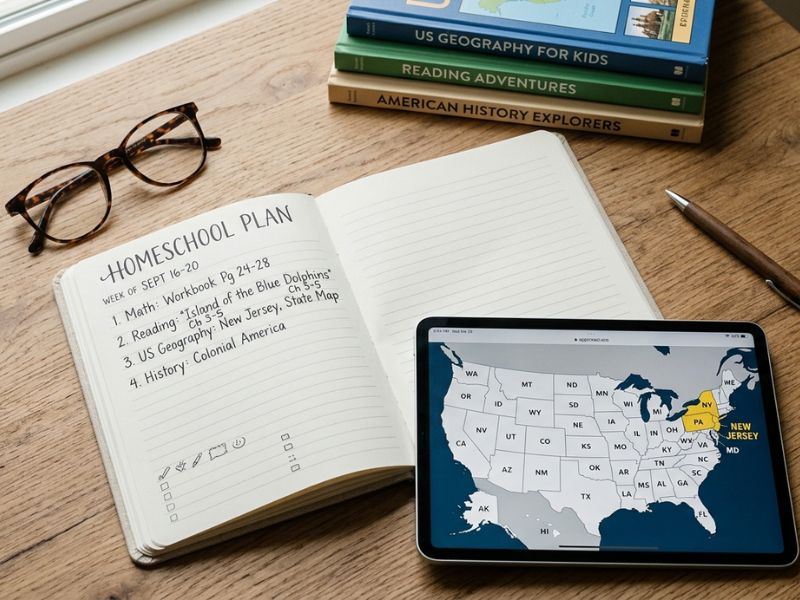
While researching New Jersey homeschool laws and reviewing real homeschool transition experiences, I noticed a pattern that appeared repeatedly. Parents were not only worried about academics. Many were emotionally exhausted from watching their child struggle with anxiety, burnout, bullying, or constant school pressure while feeling uncertain about the legal risks of homeschooling.
Through extensive research into homeschool regulations and parent experiences, New Jersey consistently stood out as one of the more flexible environments for home education. Families I studied were often surprised to learn that New Jersey homeschool laws do not require testing, curriculum approval, or teaching certification, which made the transition feel far more manageable and less intimidating than they originally feared.
- Key Takeaways: New Jersey Homeschool Laws
- Homeschooling in New Jersey Overview
- Understanding New Jersey Homeschool Laws
- New Jersey Homeschool Laws at a Glance
- How to Start Homeschooling in New Jersey
- Is New Jersey a Homeschool-Friendly State?
- New Jersey Homeschool Subject Requirements
- New Jersey Homeschool Attendance Requirements
- New Jersey Homeschool Record-Keeping Requirements
- New Jersey Homeschool Assessments and Evaluations
- Public School Classes for Homeschool Students in New Jersey
- Public Funding and Resource Options for Homeschoolers in New Jersey
- Sports Opportunities for Homeschoolers in New Jersey
- Homeschool Groups and Co-ops in New Jersey
- Homeschool Support Organizations in New Jersey
- New Jersey Homeschool Field Trips
- Special Education for Homeschoolers
- Homeschool High School Diplomas and Graduation
- How New Jersey Compares to Other Homeschool States
- Frequently Asked Questions
- Conclusion
Key Takeaways: New Jersey Homeschool Laws
- Homeschooling is legal in New Jersey.
- Parents do not need teaching certification.
- There is no notice of intent requirement.
- Standardized testing is not required.
- Children ages 6–16 must receive equivalent instruction.
- The law is based on New Jersey Statute 18A:38-25.
Homeschooling in New Jersey Overview
Homeschooling is legal in New Jersey. The law allows children to receive education outside public school as long as the instruction is equivalent to what students receive in school.
Unlike many states, New Jersey does not require parents to submit yearly paperwork, testing reports, or curriculum approval. Families have broad freedom to design their child’s education.
This flexibility is one reason many parents choose homeschooling in New Jersey.
Understanding New Jersey Homeschool Laws
New Jersey homeschooling is governed by New Jersey Statute 18A:38-25. This law states that children must attend school unless they receive equivalent instruction elsewhere.
This instruction can take place at home under the supervision of parents.
The law does not create a strict homeschool program structure. Instead, it focuses mainly on making sure children receive an education that is academically comparable to public school.
If you want to compare regulations across the country, you can explore our complete guide to homeschooling laws by state which explains how legal requirements differ from one state to another.
New Jersey Homeschool Laws at a Glance
| Requirement | New Jersey Rule |
|---|---|
| Legal status | Homeschooling is legal |
| Notice of intent | Not generally required |
| Parent qualifications | No teaching certification required |
| Standardized testing | Not required |
| Recordkeeping | Not required, but recommended for personal use |
| Compulsory school age | 6 to 16 |
| Governing law | N.J.S.A. 18A:38-25 |
Key Legal Cases That Shaped New Jersey Homeschool Law
Several court decisions helped clarify how homeschooling works in New Jersey.
One important case is State v. Massa. The court explained that homeschooling does not need to copy public school exactly. The education must only be academically equivalent, not socially identical.
Another case, State v. Vaughn, confirmed that parents may educate their children at home as long as the instruction meets the basic educational standard required by law.
These legal decisions helped establish the flexible homeschooling environment that families have in New Jersey today.
Age Requirements
In New Jersey, compulsory school attendance applies to children between ages 6 and 16.
Children within this age range must receive education through:
- public school
- private school
- homeschooling
Parents who choose homeschooling must provide equivalent instruction during these years.
Parent Qualifications
New Jersey does not require parents to hold teaching degrees to homeschool their children.
Parents do not need:
- a teaching license
- teaching certification
- state approval
This gives families the freedom to choose their own teaching methods.
Curriculum Requirements
New Jersey does not require homeschool families to use a state-approved curriculum.
However, the law requires that instruction be academically equivalent to public school education.
Most homeschool families include subjects such as:
- reading and writing
- mathematics
- science
- social studies
Parents may also include subjects like art, music, or computer skills.
Instructional Hours and Days
New Jersey law does not define a specific number of homeschool hours or school days.
Instead, families should provide regular instruction that supports steady learning progress.
Many families follow a traditional school schedule, while others use flexible learning routines.
Recordkeeping
Recordkeeping is not required by law, but many homeschool families keep basic records.
Helpful records may include:
- attendance logs
- lesson plans
- student work samples
- progress notes
Keeping records can be helpful if questions about your homeschool program ever arise.
Testing and Assessments
New Jersey homeschool laws do not require standardized testing.
Parents may choose to test their children for personal progress tracking, but the state does not mandate it.
This allows families to focus on learning instead of formal testing.
How to Start Homeschooling in New Jersey

Starting homeschool in New Jersey is relatively simple.
Most families follow these steps:
- Decide to homeschool your child.
- Withdraw your child from their current school if enrolled.
- Choose curriculum or learning resources.
- Create a learning routine.
- Begin teaching at home.
Is New Jersey a Homeschool-Friendly State?
Yes. New Jersey is considered a homeschool-friendly state because it has very few formal requirements. Parents do not need to submit yearly testing, curriculum approval, or regular reports. This gives families more freedom to choose how they teach while still meeting the state’s equivalent instruction standard.
While New Jersey offers a flexible legal environment, some families also compare regulations across different states. Our analysis of the Best states for homeschooling explains which states provide the most freedom and the least regulation for homeschool families.
Withdrawing Your Child From Public School
If your child is currently enrolled in public school, you should formally withdraw them before beginning homeschooling.
Many parents send a short withdrawal letter explaining that their child will receive equivalent instruction at home.
If the student is enrolled in high school, the district may require a transfer form for state recordkeeping purposes.
After withdrawal, parents may begin homeschooling.
Common Mistakes New Jersey Homeschool Parents Make
- Not officially withdrawing a child from public school.
- Keeping no records of learning progress.
- Misunderstanding what “equivalent instruction” means.
- Assuming all districts allow homeschool sports.
New Jersey Homeschool Subject Requirements
The state does not publish a required homeschool subject list.
However, since instruction must be equivalent to public education, many parents include core subjects such as:
- English or language arts
- mathematics
- science
- history or social studies
Elective subjects can also be included.
New Jersey Homeschool Attendance Requirements
The state does not require homeschool families to submit attendance records.
However, many parents still keep simple attendance logs for personal records.
New Jersey Homeschool Record-Keeping Requirements
Although not required, homeschool documentation can help demonstrate academic progress.
Many families keep:
- attendance records
- completed assignments
- reading lists
- course descriptions
- portfolios
New Jersey Homeschool Assessments and Evaluations
New Jersey does not require homeschool students to complete yearly evaluations.
Parents may track learning progress using:
- quizzes
- projects
- informal tests
- portfolios
Public School Classes for Homeschool Students in New Jersey
Some districts allow homeschool students to participate in specific programs.
Examples include:
- vocational programs
- technical education
- shared-time enrollment
Participation depends on local district policies.
Public Funding and Resource Options for Homeschoolers in New Jersey
New Jersey does not provide direct public funding for homeschooling.
Programs such as Education Savings Accounts (ESAs) or homeschool stipends are not currently available.
However, some districts may allow homeschool students to borrow:
- textbooks
- learning materials
- educational resources
This depends on district policy.
Sports Opportunities for Homeschoolers in New Jersey
Homeschool students may sometimes participate in school sports.
However, participation is not guaranteed and depends on district policies.
Families can also find sports opportunities through:
- community sports leagues
- homeschool teams
- recreation centers
Homeschool Groups and Co-ops in New Jersey
Homeschool groups and co-ops provide support for families.
These communities help with:
- group classes
- field trips
- shared teaching
- social activities
Homeschool Support Organizations in New Jersey
Several statewide organizations provide guidance for homeschool families.
These organizations help parents with:
- understanding homeschool laws
- finding curriculum resources
- connecting with local groups
- organizing homeschool events
New Jersey Homeschool Field Trips

Field trips are a common part of homeschooling.
Families often visit:
- museums
- science centers
- historical sites
- nature parks
These experiences make learning more engaging.
Special Education for Homeschoolers
Homeschooled students may still be referred to the local school district for special education evaluations.
If a child qualifies for services, the district must provide a free appropriate public education only if the child enrolls in the district.
If the student remains homeschooled, additional services may depend on district policy.
Homeschool High School Diplomas and Graduation
Homeschooled students in New Jersey do not receive a state-issued diploma from the local school district.
Many homeschool families create their own:
- homeschool diploma
- transcript
- graduation requirements
New Jersey also recognizes alternative diploma pathways, such as high school equivalency testing or certain college-credit programs.
How New Jersey Compares to Other Homeschool States
| State | Notice Required | Testing Required | Regulation Level |
|---|---|---|---|
| New Jersey | No | No | Very low |
| New York | Yes | Yes | High |
| Pennsylvania | Yes | Yes | Moderate |
| Texas | No | No | Very low |
Each state regulates homeschooling differently. For example, New York has stricter reporting and testing requirements, while Texas allows homeschooling with very few regulations. You can review the full legal details in our guides to texas homeschool laws
Frequently Asked Questions
Do parents need teaching certification?
No. Parents can homeschool their children without teaching credentials.
Can homeschool students get a diploma?
Homeschool students do not receive a state diploma from the school district. Many families create their own homeschool diploma and transcript.
Conclusion
Based on my research into homeschool laws, parent experiences, and state education requirements, New Jersey homeschool laws provide families with substantial educational freedom while still supporting meaningful learning. Many parents initially approach homeschooling with fear and uncertainty, but the families I reviewed often gained confidence quickly once they understood how flexible and practical New Jersey’s homeschool system actually is.