 Skip to content
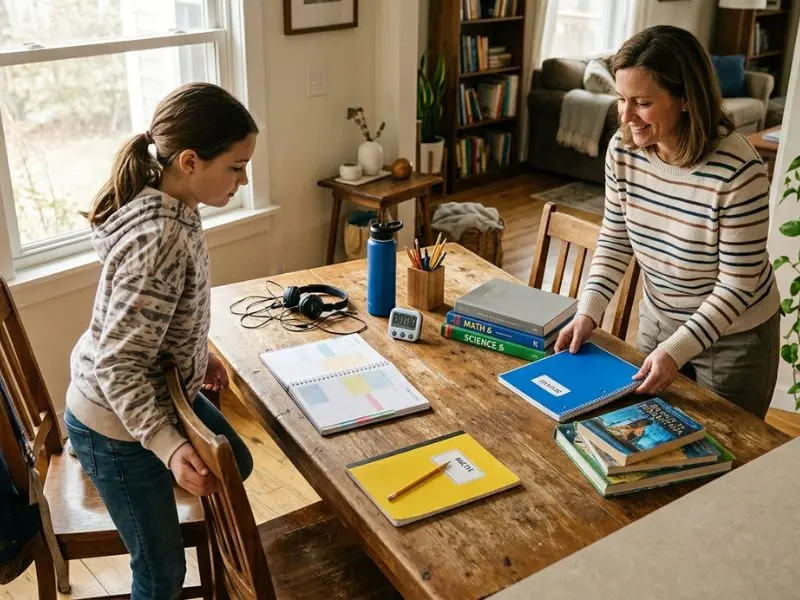
A 6th grade homeschool schedule can include a few hours of focused academics, with math, language arts, reading, science or history, breaks, and independent work. The exact routine should fit your child’s pace, curriculum, and state requirements.
I learned that filling every hour made our days harder, not better. A simpler routine with core lessons first, rotating subjects, and growing independence worked better for us. The sample schedules below give you a practical starting point you can adjust as needed.
- What a Typical 6th Grade Homeschool Day Looks Like
- Why a Schedule Matters in 6th Grade
- What to Include in a 6th Grade Homeschool Schedule
- How a 6th Grade Homeschool Schedule Changes From Elementary School
- Example 6th Grade Homeschool Daily Routine
- Sample Weekly 6th Grade Homeschool Schedule
- 4-Day vs 5-Day 6th Grade Homeschool Schedule
- How Long Should Each 6th Grade Homeschool Subject Take?
- How to Build a 6th Grade Homeschool Routine That Works for Your Family
- Challenges of Scheduling Middle Schoolers
- Best Practices for Middle School Schedules
- Disadvantages of Over-Scheduling
- What to Do When the Homeschool Schedule Falls Apart
- Tips for Keeping a 6th Grade Homeschool Routine Consistent
- How to Tell If Your 6th Grade Homeschool Schedule Is Working
- Frequently Asked Questions About 6th Grade Homeschool Schedules
- Conclusion
Quick Takeaway
A practical 6th grade homeschool schedule usually works best when you:
- Put important subjects during your child’s strongest focus time.
- Rotate science, history, projects, and electives instead of forcing everything into every day.
- Give your sixth grader more independent work gradually.
- Leave open space for breaks and lessons that run long.
- Adjust the routine when unfinished work keeps piling up.
- Check your state’s homeschool requirements before setting the final schedule.
What a Typical 6th Grade Homeschool Day Looks Like
A typical day can begin with subjects that require the most focus. For many children, that means math or language arts. Reading, science, history, projects, and electives can follow later.
You do not need to copy a traditional school day. Homeschooling has fewer transitions and allows lessons to move at your child’s pace.
Here is one realistic starting point:
| Time | Activity |
|---|---|
| 8:30–9:00 | Breakfast and daily planning |
| 9:00–9:45 | Math |
| 9:45–10:30 | Language arts |
| 10:30–10:45 | Break |
| 10:45–11:15 | Independent reading |
| 11:15–12:00 | Science or history |
| 12:00–1:00 | Lunch and movement |
| 1:00–1:45 | Writing, project, or elective |
| 1:45–2:00 | Review and plan for tomorrow |
Treat these times as examples, not rules. Some children work faster. Others need longer when a lesson is difficult.
If your child understands the lesson and finishes early, there is no need to add busywork simply to fill the time.
How Independent Work Changes the Daily Schedule
Sixth grade is often a transition toward independent learning. Your child may no longer need you sitting beside them for every subject.
Independent tasks may include:
- Reading an assigned chapter
- Completing familiar math practice
- Reviewing vocabulary
- Typing or handwriting practice
- Watching an assigned lesson
- Completing workbook exercises
- Updating a planner
- Working on a familiar project
New math concepts, writing instruction, science experiments, and complex projects may still require direct help.
Start with one or two tasks your child can manage alone. Add more responsibility when they show they are ready.
Why Homeschool Days Are Often Shorter Than Traditional School
A homeschool day does not need to match every hour spent inside a school building.
A traditional school day includes attendance, announcements, class changes, waiting, lunch, group management, and other activities. At home, focused lessons can often move more efficiently.
More hours do not automatically mean more learning. Pay attention to understanding, progress, effort, and completed work instead of judging the day only by the clock.
Why a Schedule Matters in 6th Grade
Sixth grade often brings longer assignments and greater responsibility. A simple routine helps your child know what comes next without depending on you for every step.
The goal is not a strict timetable. It is a predictable rhythm that helps your sixth grader practice planning, manage assignments, and gradually take more ownership of learning.
A visible schedule can also reduce repeated questions about what to do next. Your child can check the plan, complete familiar work, and ask for help when needed.
What to Include in a 6th Grade Homeschool Schedule
A sixth grade schedule usually includes core academic subjects along with independent learning, movement, and time to explore interests.
Common subjects may include:
- Math
- Language arts
- Writing
- Reading
- Science
- History or social studies
- Physical activity
- Art, music, technology, or another elective
Not every subject needs to appear every day. Math and language arts may happen more often, while science, history, projects, and electives can rotate during the week.
This keeps you from trying to squeeze every subject into every school day.
Homeschool requirements differ across the United States. Check your state’s rules when deciding which subjects, instructional time, records, or assessments may apply.
Independent Study With Check-Ins
Independent study can help a sixth grader learn to manage time without removing parent support.
Instead of checking every answer immediately, set clear expectations and let your child complete suitable assignments before you review them.
A quick morning check-in can answer three questions:
- What needs to be completed today?
- Which work can be done independently?
- Which lessons will need parent help?
A short check at the end of the day can catch unfinished work and problems before they build up.
As your child becomes more capable, move gradually from managing every task to reviewing progress.
| Often Ready for Independent Work | May Still Need Parent Support |
|---|---|
| Independent reading | New math concepts |
| Familiar math practice | Difficult math problems |
| Vocabulary review | Writing instruction and feedback |
| Typing practice | Science experiments |
| Planner or checklist updates | Complex projects |
| Familiar workbook exercises | Difficult reading discussions |
Keep in mind: These are examples, not age-based rules. Give your child more independence when they can follow directions, complete work accurately, and ask for help when needed.
Collaborative Projects and Discussions
Not every middle school lesson needs to happen alone.
Discussion works well with literature, history, science, and subjects that encourage questions. Projects can also combine several skills.
For example, a history project could include research, reading, writing, art, and a short presentation.
Siblings, homeschool co-ops, local classes, and suitable online groups can provide other opportunities for collaborative learning.
Movement and Wellness Breaks
Sixth graders still need opportunities to move during the day.
After one or two demanding subjects, your child might walk outside, stretch, ride a bike, play with a pet, or simply have a snack away from the books.
Breaks do not have to be long. A short reset can make it easier to focus on the next lesson.
Creative and Exploratory Time
A useful homeschool schedule for a 6th grader should leave room for personal interests.
That might include:
- Drawing
- Music
- Coding
- Cooking
- Gardening
- Building
- Photography
- Crafts
- Foreign languages
Not every interest needs a formal curriculum. Sixth grade can be a good time for children to explore skills and discover what they enjoy.
Reflection and Planning
Set aside a few minutes at the end of the day or week to review what happened.
Ask what worked well. Look at what took longer than expected. Check unfinished assignments and upcoming projects.
Your child can also help plan the following week. This simple habit builds organization and gives them more ownership of their schedule.
How a 6th Grade Homeschool Schedule Changes From Elementary School

Sixth grade often marks a gradual move toward greater independence.
Your child may begin handling more reading, planning, note-taking, and familiar practice alone. You can remain available for new concepts, difficult lessons, feedback, and larger projects.
The change does not need to happen overnight.
A simple progression can look like this:
- Parent creates and manages the daily plan.
- Child begins following a daily task list.
- Child completes familiar lessons independently.
- Child checks off completed assignments.
- Child starts managing some deadlines.
- Parent reviews progress and provides support.
Your child may move through these steps faster or slower. Independence is a skill that develops with practice.
Example 6th Grade Homeschool Daily Routine

There is no single schedule that works for every sixth grader.
Some children like exact start and finish times. Others work better when they know the order of their subjects without watching the clock.
Instead of searching for the perfect routine, choose a starting model that fits your child’s learning style and family life. For another real-life example, you can see this 6th grade daily homeschool schedule from Confessions of a Homeschooler, which shows how one family organizes subjects and activities throughout the day.
Sample Structured Homeschool Routine
A structured routine can work well for students who like predictability.
| Time | Subject or Activity |
|---|---|
| 8:30–9:00 | Breakfast and preparation |
| 9:00–9:45 | Math |
| 9:45–10:30 | Language arts |
| 10:30–10:45 | Break |
| 10:45–11:15 | Reading |
| 11:15–12:00 | Science |
| 12:00–1:00 | Lunch and movement |
| 1:00–1:45 | History |
| 1:45–2:15 | Elective or project |
| 2:15–2:30 | Review and planning |
The time blocks should remain flexible. If math takes 35 minutes instead of 45, your child does not need extra work just to stay on schedule.
Sample Flexible Homeschool Routine
A flexible routine can be better for children who dislike strict clock times.
Instead of assigning a time to every lesson, keep a predictable order.
Morning
- Math
- Language arts
- Short break
- Independent reading
Midday
- Science or history
- Lunch
- Outdoor activity
Afternoon
- Writing, project, or elective
- Independent work
- Daily review
This approach gives the day structure while allowing a difficult lesson to run longer or an easier lesson to finish early.
Example Block Schedule for 6th Grade Homeschool
Block scheduling can work well when your child prefers fewer subject changes or needs longer periods for experiments and projects.
| Monday & Wednesday | Tuesday & Thursday | Friday |
|---|---|---|
| Math | Math | Catch-up |
| Language arts | Language arts | Independent reading |
| Science | History | Projects |
| Science project | Writing | Electives |
| Reading | Reading | Field trip or co-op |
Longer blocks can be especially useful for science experiments, writing projects, history research, and hands-on work.
Sample Weekly 6th Grade Homeschool Schedule
Trying to teach every subject every day can quickly make the week feel crowded.
A weekly schedule lets you spread the workload while keeping important subjects consistent.
| Subject | Monday | Tuesday | Wednesday | Thursday | Friday |
|---|---|---|---|---|---|
| Math | Lesson | Lesson | Lesson | Lesson | Review |
| Language Arts | Lesson | Lesson | Lesson | Lesson | Review |
| Reading | Read | Read | Read | Read | Read |
| Science | Lesson | — | Lesson | — | Project |
| History | — | Lesson | — | Lesson | Project |
| Writing | Lesson | — | Lesson | — | — |
| PE/Movement | Yes | Yes | Yes | Yes | Yes |
| Elective | — | Elective | — | Elective | Optional |
| Catch-Up | — | — | — | — | Yes |
Friday can stay lighter when the week’s main work is finished. Use it for projects, co-op classes, field trips, appointments, independent reading, or unfinished lessons.
A weekly view also helps prevent electives from disappearing whenever core lessons take longer than expected.
4-Day vs 5-Day 6th Grade Homeschool Schedule
A five-day schedule spreads lessons across more days. This can keep the daily workload smaller.
A four-day schedule may use longer lessons while leaving one weekday available for co-op classes, projects, field trips, appointments, or catch-up work.
| 4-Day Schedule | 5-Day Schedule |
|---|---|
| Longer daily lessons | Smaller daily workload |
| One flexible weekday | Work spread across five days |
| Helpful for regular co-op days | Helpful for steady routines |
| Requires careful weekly planning | More room to spread difficult subjects |
Neither approach is automatically better.
A four-day routine may suit a family with a regular co-op or activity day. A five-day routine may suit a child who handles smaller amounts of daily work better.
Choose based on workload, family life, and your child’s learning needs. Also check your state’s homeschool requirements before deciding how many instructional days or hours to schedule.
How Long Should Each 6th Grade Homeschool Subject Take?
One of the hardest questions is whether you are scheduling too much or too little.
There is no universal lesson length for every sixth grader. Time varies by curriculum, subject, learning pace, assignment, and applicable state requirements.
For planning purposes, you might start with these ranges:
| Subject | Example Lesson Length |
|---|---|
| Math | 40–50 minutes |
| Language arts | 40–60 minutes |
| Independent reading | 20–30 minutes |
| Science | 30–45 minutes |
| History or social studies | 30–45 minutes |
| Writing | 30–45 minutes |
| Elective | 30–45 minutes |
| Physical activity | 30+ minutes |
These are planning examples, not requirements.
If your child understands a math lesson in 30 minutes, another 20 minutes of busywork is not needed simply because the schedule says 50 minutes.
The opposite is also true. A difficult concept may need more time.
Look for understanding and steady progress rather than forcing every lesson into the same time block.
How to Build a 6th Grade Homeschool Routine That Works for Your Family
The best schedule is not always the one that looks perfect on paper. It is the one your family can follow consistently.
Start with your real life.
Think about work schedules, younger children, appointments, co-op classes, sports, energy levels, and your sixth grader’s learning habits.
Step 1: Start With Your Family’s Natural Rhythm
Pay attention to when your child learns best.
Some students are ready for challenging work early. Others focus better after breakfast, reading, or some movement.
Whenever possible, place demanding subjects during your child’s strongest learning period.
You do not have to start at the same time as a traditional school.
Step 2: Identify Core Subjects
Place important academic work into the week first.
For many families, this includes math, language arts, reading, science, and social studies. Your exact subjects should reflect your curriculum and applicable homeschool requirements.
Then add electives, projects, movement, and enrichment.
Do not fill every open space simply because it is available.
Step 3: Leave Room for Real-Life Learning and Adjustments
A schedule without extra space can fall apart after one difficult lesson.
Leave some margin.
If a science experiment takes longer because your child is engaged and learning, the whole day should not feel ruined.
Appointments, illness, family events, and other interruptions will happen.
A useful schedule can bend without breaking.
Challenges of Scheduling Middle Schoolers
Sixth graders are becoming more independent, but they may still struggle with organization, motivation, and judging how long assignments will take.
Expect to make adjustments.
A routine that works at the beginning of the year may need to change as the workload, curriculum, or family schedule changes.
Uneven Subject Loads
Not every school day requires the same amount of work.
A familiar math lesson may take 30 minutes. A new concept may take much longer. A science experiment can also require more time than a normal reading assignment.
Look at the whole week instead of expecting every day to be identical.
If Tuesday becomes heavy, Wednesday can be lighter.
Sibling Conflicts
Teaching several children can make a strict timetable difficult.
Use your sixth grader’s independent work strategically.
For example, your sixth grader can read or complete familiar practice while you teach a younger child’s math lesson. Later, the younger child can play or work independently while you help your sixth grader with writing.
This reduces the pressure to teach everyone at the same time.
Best Practices for Middle School Schedules
A strong middle school homeschool schedule gives direction without creating unnecessary pressure.
Keep the routine simple enough that you and your child can understand what comes next.
Schedule Harder Subjects During Strong Focus Times
Some families prefer math first because it requires concentration. That works well for some children, but it is not a rule.
If your child thinks more clearly later in the morning, schedule demanding work then.
Match difficult subjects to your child’s energy instead of following someone else’s timetable.
Chunk Reading and Larger Assignments
Long assignments can feel overwhelming.
Break reading into smaller sections. Your child might complete part in the morning and finish later.
The same method can help with research, writing, and larger projects.
Smaller steps make long assignments easier to manage.
Use a Loop Schedule for Extras
Electives are often the first subjects to disappear when a week becomes busy.
A loop schedule can prevent that.
For example:
- Art
- Music
- Coding
- Geography
Complete the next subject whenever an elective period becomes available.
If Tuesday gets busy, you have not permanently “missed” music. Continue with music during the next available elective period.
Keep Fridays Lighter
A lighter Friday can give your week some breathing room.
You might use it for:
- Catch-up work
- Field trips
- Co-op classes
- Projects
- Art
- Experiments
- Library visits
- Independent reading
- Weekly review
When everything is complete, the extra time can go toward interests, outdoor activities, or family time.
Disadvantages of Over-Scheduling
A detailed planner can look impressive while making real homeschool days difficult.
Avoid scheduling every minute.
A 6th grade homeschool routine needs enough structure to keep learning moving and enough space for questions, difficult lessons, and unexpected events.
Lost Spontaneity
A rigid timetable can make it harder to take advantage of unexpected learning opportunities.
Your child may want to continue an experiment, explore an interesting question, visit a museum, or spend longer on a project.
Leave enough space for curiosity when it leads to meaningful learning.
Guilt Cycles
An unrealistic schedule can make ordinary days feel like failures.
You miss one lesson and move it to tomorrow. Tomorrow becomes overloaded. More work gets pushed forward, and soon everyone feels behind.
If this happens regularly, adjust the schedule instead of continually chasing unfinished work.
No Time to Recharge
Sixth graders need downtime too.
A child should not move from academics to activities to evening work every day without enough time to rest.
Hobbies, outdoor activity, family time, and sleep all need space.
A sustainable routine leaves room for life outside formal lessons.
What to Do When the Homeschool Schedule Falls Apart

Real homeschool days rarely follow a planner perfectly.
Math may take twice as long as expected. A younger sibling may need attention. An appointment may take half the morning. A science experiment may become more involved than planned.
One disrupted day does not mean the whole week has failed.
First, identify what really needs to be completed. Move flexible subjects, projects, or electives when necessary.
Avoid pushing every unfinished task into tomorrow. That can turn one difficult day into two.
Instead, look for the reason behind the problem. If math regularly needs more time, increase its time block. If every day feels overloaded, reduce the number of scheduled tasks.
The schedule should support learning. Your family should not have to serve the schedule.
Tips for Keeping a 6th Grade Homeschool Routine Consistent
Consistency does not mean doing exactly the same thing at exactly the same time every day.
It means creating patterns your child understands.
A predictable morning routine may be enough to start the day without a minute-by-minute timetable.
Keep Expectations Simple
Your child should know what needs to be completed.
A short daily checklist can be easier to follow than a complicated planner filled with small tasks.
Separate essential work from optional enrichment. When the day becomes busy, the priorities remain clear.
Use Visual Reminders
A planner, whiteboard, printed schedule, or checklist can reduce repeated questions.
Your sixth grader can see what has been completed and what remains.
Over time, let your child take more responsibility for updating the schedule and tracking finished work.
Stay Flexible When Needed
A schedule is a tool, not a rulebook.
If your child is sick, exhausted, frustrated, or deeply involved in a useful project, adjust the plan.
One unusual day will not define the school year.
Look for consistent progress across weeks and months.
Build Routines Around Habits, Not Only Times
Exact times are not necessary for every family.
You can connect one activity to another:
After breakfast → Math
After math → Language arts
After language arts → Break
After lunch → Science or history
These simple patterns create predictability without forcing everyone to watch the clock.
How to Tell If Your 6th Grade Homeschool Schedule Is Working
A schedule is successful because it works in real life, not because it looks organized on paper.
Give a new routine enough time to reveal patterns. Then adjust the parts that repeatedly cause problems.
Does Your Student Usually Finish?
Your child does not need to complete every planned task perfectly every day.
However, unfinished work should not pile up week after week.
If several subjects regularly carry into the next day, your schedule may contain too much work or unrealistic time blocks.
Are Mornings Usually Manageable?
Notice how your homeschool day begins.
Constant rushing, arguments, confusion, or searching for materials can signal that the morning routine needs attention.
Prepare books and supplies ahead of time. Keep the first few tasks predictable.
A smoother start can make the rest of the day easier.
Is There Energy Left After Lessons?
Some demanding days are normal. Constant exhaustion is different.
If your child regularly has no energy left for hobbies, outdoor activity, friends, or family time, take another look at the workload.
The goal is meaningful learning and steady progress, not maximum hours.
Frequently Asked Questions About 6th Grade Homeschool Schedules
How Many Hours Should a 6th Grader Homeschool Each Day?
There is no single number that fits every sixth grader. Focused academics may take several hours, but the total varies by curriculum, learning pace, breaks, projects, and state requirements. Understanding and steady progress matter more than copying the length of a traditional school day.
Should I Schedule Every Minute?
No. Leave room for breaks, difficult lessons, questions, and unexpected events. Some children prefer exact times, while others do better with an ordered list of subjects.
Does Every Subject Need to Be Taught Every Day?
Not necessarily. Some families teach math and language arts more often while rotating science, history, electives, and projects. Your final plan should also reflect your curriculum and any applicable state requirements.
What About Sibling Interruptions?
Use independent work strategically. Your sixth grader can complete reading, familiar practice, or other suitable independent tasks while you teach a younger child. Then switch when your sixth grader needs direct help.
How Do I Handle Schedule Resistance?
Start by finding the cause. The workload may be too heavy, lessons may be too long, or your child may want more control over the day.
Allowing a sixth grader to choose the order of some subjects can build ownership while you keep the important priorities in place.
Can We Homeschool Four Days a Week?
A four-day homeschool schedule can work for some families, but your overall plan still needs to meet any instruction, subject, attendance, or other homeschool requirements that apply in your state.
The fifth weekday can also become a lighter day for projects, field trips, co-op classes, catch-up work, reading, or electives.
Conclusion
Conclusion
Through trial and adjustment, I found that our 6th grade homeschool schedule worked best when I planned around my child’s actual pace instead of an ideal day on paper. Keeping priorities clear, allowing independence to grow, and changing what repeatedly caused stress gave us a routine that felt manageable while still keeping learning on track.