 Skip to content
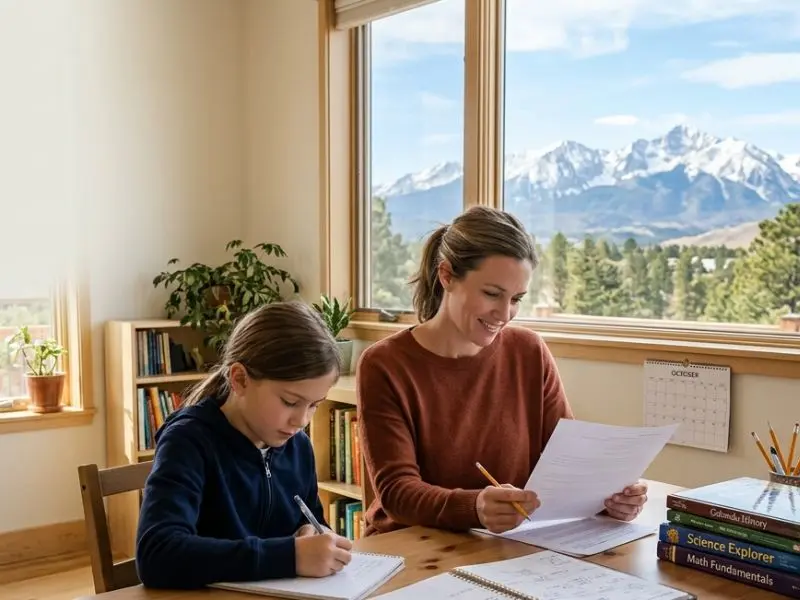
Colorado homeschool laws allow parents to legally teach their children at home through several options. Under the standard home-based route, families generally file an annual Notice of Intent, complete 172 instructional days, teach required subjects, keep permanent records, and evaluate students in grades 3, 5, 7, 9, and 11.
After reviewing Colorado’s current requirements, I found that choosing the correct legal route is the step that prevents most confusion. Once that is clear, deadlines, testing, attendance, and record keeping become easier to manage. This guide walks through each requirement in the order parents need it.
- Key Takeaways
- Colorado Homeschool Laws at a Glance
- Three Ways to Homeschool Legally in Colorado
- Colorado Homeschool Notice of Intent
- Colorado Compulsory Attendance Age
- Colorado Homeschool Attendance Requirements
- Colorado Homeschool Timeline
- Required Subjects for Colorado Homeschoolers
- Colorado Homeschool Curriculum Requirements
- Parent and Teacher Qualifications
- Colorado Homeschool Testing Requirements
- Colorado Homeschool Record-Keeping Requirements
- Grade Level Assignments and Changes
- Colorado Homeschool Graduation Requirements
- Sports and Extracurricular Activities for Homeschoolers
- Part-Time Public School Programs
- Homeschooling a Student With Truancy Issues
- Homeschooling a Child With Special Needs in Colorado
- How to Start Homeschooling in Colorado
- Frequently Asked Questions About Colorado Homeschool Laws
- Conclusion
Key Takeaways
- Homeschooling is legal in Colorado.
- Families can homeschool through different legal options.
- The standard home-based option generally requires an annual Notice of Intent.
- The notice is normally submitted at least 14 days before starting.
- Students need at least 172 days of instruction.
- Instruction must average four contact hours per day.
- Colorado requires several core subjects.
- Parents can choose their curriculum under the home-based option.
- Student evaluations are required in grades 3, 5, 7, 9, and 11.
- Required homeschool records must be kept permanently.
Colorado Homeschool Laws at a Glance
The table below shows the main requirements for families using Colorado’s nonpublic home-based education option.
| Requirement | Colorado Rule |
|---|---|
| Homeschooling legal? | Yes |
| Main homeschool law | C.R.S. § 22-33-104.5 |
| Notice of Intent | Required under the home-based option |
| Notice deadline | At least 14 days before starting |
| Annual notice | Yes, while the program continues |
| Instructional days | At least 172 days |
| Daily instruction | Average of 4 contact hours |
| Required subjects | Yes |
| Teaching license | Not generally required for a parent |
| Student evaluation | Grades 3, 5, 7, 9, and 11 |
| Records | Must be maintained permanently |
| Curriculum | Chosen by the parent |
These rules mainly apply to the home-based education option. Families using another legal route may follow different requirements.
Three Ways to Homeschool Legally in Colorado
Colorado gives families more than one legal way to educate a child at home. Choose your route before filing paperwork because the requirements change depending on the option.
Colorado Homeschool Options Compared
| Legal Option | Notice of Intent | Testing or Evaluation | Best For |
|---|---|---|---|
| Home-Based Education | Generally required each year | Required in grades 3, 5, 7, 9, and 11 | Parents who want to manage homeschooling independently |
| Independent School | Standard home-based NOI rules do not apply in the same way | Follow the applicable independent-school requirements | Families who want an independent-school structure |
| Colorado-Licensed Teacher | Standard home-based NOI not required under this route | Standard home-based assessment rules do not apply | Families using a qualifying Colorado-licensed teacher |

Option 1: Home-Based Education Program
This is what many parents mean when they talk about homeschooling in Colorado.
A parent establishes a nonpublic home-based educational program and takes responsibility for the child’s education. Families using this option follow rules for notification, attendance, required subjects, evaluations, and record keeping.
Colorado’s home-based education law, C.R.S. § 22-33-104.5, outlines the main requirements for homeschooling under this option, including notification, instructional time, record keeping, and student evaluations.
This route works well for parents who want to manage their child’s education independently while meeting Colorado’s home-based education requirements.
Option 2: Independent School
Families may also educate their children through an independent or private-school arrangement.
Colorado treats this option differently from a parent-run home-based education program. Families using an independent school follow the requirements connected to that school.
Do not assume that every Notice of Intent, testing, or record-keeping rule for the home-based option applies in exactly the same way.
This route may suit families who want to homeschool while receiving support or oversight through an independent-school structure.
Option 3: Homeschooling With a Colorado-Licensed Teacher
Another option is available when a child’s instructor holds a current Colorado teaching license.
Under this route, the standard home-based Notice of Intent, assessment, and related requirements do not apply in the same way.
Before choosing this option, make sure the instructor meets Colorado’s current licensing requirements.
Colorado Homeschool Notice of Intent
If you choose the standard home-based education route, the Notice of Intent is one of the first requirements to understand.
The NOI tells a Colorado school district that you are establishing a home-based educational program. It is a notification, not a request for the district to approve your curriculum.
When to File the Notice of Intent
Parents generally need to submit the Notice of Intent at least 14 days before establishing the home-based education program.
The notification is not a one-time requirement. It must be submitted again each year while the program continues.
Add the filing date to your homeschool calendar so it does not get overlooked the following year.
Where to File the Notice of Intent
Colorado allows parents to provide the notification to a school district within the state. Current state guidance explains that the notice may be submitted to any Colorado public school district office.
Keep a copy of the notice and proof that it was received.
If you file with a district other than the one where your child lives, Colorado guidance advises notifying your resident district as well. This can help prevent confusion about your child’s attendance status.
What to Include in the Notice of Intent
The written notice includes basic information about the child and homeschool program.
Include:
- Child’s name
- Child’s age
- Place of residence
- Number of hours of attendance
Colorado does not require every family to use one standard statewide Notice of Intent form. A written notification can be used as long as it contains the information required by law.
Keep a copy with your permanent homeschool records.
Do You Need to File Every Year?
Yes. Families continuing under the nonpublic home-based education option generally submit the written notification each year while the program continues.
Think of the NOI as an annual homeschool requirement rather than paperwork you complete only once.
Colorado Compulsory Attendance Age
Colorado’s age rules can be confusing because the general compulsory attendance law and the home-based education law work together.
For families using the standard home-based route, three ages are especially important.
Age 6
Colorado’s notification requirement can begin when a child reaches the applicable age. The child’s age by August 1 can matter when determining whether the requirement applies for that school year.
Age 7
Although notification can become relevant earlier, Colorado’s home-based education guidance explains that the home-based program itself generally does not have to be established until the child is 7.
This distinction is important for parents starting with younger children.
Age 16
Under the home-based education statute, parents are generally not required to continue the program or submit the annual homeschool notification after the child turns 16.
Colorado’s broader compulsory attendance rules can cover children through age 17 unless an exemption applies. Because these rules overlap, parents with children near the age limits should check current state guidance for their situation.
Colorado Homeschool Attendance Requirements
A nonpublic home-based educational program must provide at least 172 days of instruction each year.
Instruction must average four instructional contact hours per day.
The word average matters. Your homeschool schedule does not have to look exactly the same every day.
One day may include longer lessons while another may be shorter. Families still need to meet the overall legal requirement.
Keep track of instructional days and hours throughout the year. A simple attendance sheet, homeschool planner, or spreadsheet can make this much easier.
Colorado Homeschool Timeline
Before Starting
- Choose the legal homeschool option that applies to your family.
- Check your child’s age and current school enrollment.
- Prepare the Notice of Intent if your homeschool option requires it.
At Least 14 Days Before Starting
- Submit the Notice of Intent when required.
- Keep a copy and proof that the notice was received.
During the Homeschool Year
- Work toward at least 172 instructional days.
- Average four instructional contact hours per day.
- Teach the required subject areas.
- Maintain attendance and other required homeschool records.
Grades 3, 5, 7, 9, and 11
- Complete the required nationally standardized test or professional evaluation.
- Submit the results as required.
- Keep a permanent copy of the results.
Each New Homeschool Year
- Submit a new Notice of Intent when required.
- Review current Colorado homeschool requirements before the new year begins.

Required Subjects for Colorado Homeschoolers
Colorado gives parents flexibility in how they teach, but the home-based program must cover certain academic areas.
Required subjects include:
- Reading
- Writing
- Speaking
- Mathematics
- History
- Civics
- Literature
- Science
- Regular instruction in the Constitution of the United States
The program is not limited to these subjects.
Families can also teach art, music, technology, foreign languages, life skills, physical education, or other subjects that fit their child’s education.
Colorado sets the required core areas, but parents still have considerable control over how those subjects are taught.
Colorado Homeschool Curriculum Requirements
Parents using the standard home-based option generally choose their own homeschool curriculum.
What Colorado Requires vs What Parents Choose
| Colorado Requires | Parents Can Choose |
|---|---|
| Required subject areas | Curriculum provider and teaching materials |
| At least 172 instructional days | Daily homeschool routine |
| Average four instructional contact hours per day | How lessons are organized during the day |
| Evaluations in required grade levels | Qualifying standardized test or professional evaluation |
| Required homeschool records | How those records are organized and stored |
| Notice of Intent when applicable | Teaching approach and learning resources |
Colorado sets the basic legal requirements, but parents still have flexibility in how they organize and deliver their child’s education.
This allows you to select materials based on your child’s:
- Grade level
- Learning style
- Strengths
- Areas needing improvement
- Interests
- Daily routine
Families can use textbooks, workbooks, online programs, library resources, hands-on activities, or a combination of different methods.
You do not have to copy a public-school classroom. The goal is to provide a real educational program while covering Colorado’s required subjects.
Do You Need an Accredited Homeschool Curriculum?
Colorado does not require families using the standard home-based option to buy one specific state-approved curriculum.
Homeschooling itself is not accredited by the Colorado Department of Education or a local school district.
Accreditation may still matter to some families. This is especially true when considering high school transfers, credits, college plans, or a particular educational program.
However, using an accredited curriculum and meeting Colorado homeschool law are two different things.
Parent and Teacher Qualifications
Parents often wonder if they need a teaching degree before homeschooling in Colorado.
Under the standard home-based education option, a parent does not generally need a Colorado teaching license.
Instruction may be provided by the child’s parent, legal guardian, or an adult relative designated by the parent.
This rule is different from the separate legal option for instruction provided by a Colorado-licensed teacher.
Before asking another person to take responsibility for instruction, make sure that arrangement fits the legal option you are using.
Colorado Homeschool Testing Requirements
Colorado does not require students in a home-based program to complete a homeschool evaluation every year.

Instead, academic progress must be evaluated in:
- Grade 3
- Grade 5
- Grade 7
- Grade 9
- Grade 11
An easy way to remember the evaluation years is:
3 → 5 → 7 → 9 → 11
Parents can generally meet the requirement through a qualifying nationally standardized achievement test or an evaluation by a qualified person.
Which Grades Require Testing?
Evaluations are required in 3rd, 5th, 7th, 9th, and 11th grades.
Mark these grades in your homeschool records early. This is especially helpful if you are teaching several children at different grade levels.
Standardized Test or Professional Evaluation
Parents generally have two ways to meet the evaluation requirement.
Nationally Standardized Achievement Test
The child can take a qualifying nationally standardized achievement test.
Colorado-specific state assessments and the nationally standardized homeschool testing requirement are not the same thing. Do not assume that taking a state assessment automatically satisfies the homeschool evaluation requirement.
Professional Evaluation
Instead of using a standardized achievement test, parents may choose an evaluation completed by a qualified person.
The evaluator reviews the child’s academic progress and determines whether the student is making sufficient progress based on the applicable standard.
Who Can Perform the Evaluation?
A qualified evaluator may include a person who:
- Holds a Colorado teacher license
- Teaches at an independent or parochial school
- Is a licensed psychologist
- Holds a master’s degree in education
Parents can select a qualified person who meets Colorado’s requirements.
Where to Submit Test or Evaluation Results
Test or evaluation results may generally be submitted to:
- The school district that received your homeschool notification, or
- An independent or parochial school in Colorado
If you submit the results to an independent or parochial school, provide that school’s name to the district that received your Notice of Intent.
Always keep your own copy of the results.
What Happens If Your Child Scores Below the Required Level?
A low standardized test score does not automatically mean a child must immediately return to traditional school.
If the child’s score is at or below the applicable 13th-percentile threshold, Colorado provides an opportunity to retest. The child may use another qualifying test or an alternate version of the test.
If the new result still does not meet the legal standard, additional placement requirements can apply until the next testing period.
A professional evaluation works differently. It considers whether the child is making sufficient academic progress according to the child’s ability.
If your child receives a result near or below the required level, check the current state requirements before deciding what to do next.
Colorado Homeschool Record-Keeping Requirements
Good records make it easier to show that your homeschool program meets Colorado requirements.
Required records under the home-based option must be maintained permanently.

Attendance Records
Keep a clear record of instructional days and hours.
Your records should make it easy to show that the student completed the required 172 days and average instructional time.
Record attendance throughout the year instead of trying to recreate it later.
Test and Evaluation Results
Keep copies of every required standardized test or professional evaluation.
These records may also become useful when a student changes schools, enters high school, applies to college, or needs proof of academic progress.
Immunization Records or Exemptions
Colorado’s home-based education law includes applicable immunization information among the records maintained for the child.
If your family uses an applicable exemption, keep the proper documentation with the rest of your homeschool records.
Can a School District Request Your Records?
Yes, in certain circumstances.
The district receiving the homeschool notification may request the required records when the superintendent has probable cause to believe that the program is not following the statutory guidelines.
Colorado law provides for written notice in this situation.
Keeping complete records from the beginning makes this much easier to handle if a request is ever made.
Grade Level Assignments and Changes
Grade placement becomes especially important when a homeschooled child enters or returns to public school.
A Colorado school district may test a previously homeschooled student to determine appropriate grade placement.
Homeschool transcripts can also be reviewed when credits are transferred.
For high school students, keep detailed records of:
- Courses
- Credits
- Grades
- Completed work
- Test results
Good records can make a future school transition much smoother.
Colorado Homeschool Graduation Requirements
Colorado does not set one statewide list of graduation requirements for students educated under the standard home-based homeschool option.
Parents should create clear high school requirements based on the student’s education and future plans.
Important high school records may include:
- Courses completed
- Credits earned
- Grades
- Transcript
- Graduation date
- Diploma
Think about the student’s plans after graduation.
A college-bound student may need specific courses that go beyond the basic subjects required under Colorado homeschool law. A student entering technical training or the workforce may have different goals.
Planning before 11th or 12th grade gives families more time to meet those needs.
Sports and Extracurricular Activities for Homeschoolers
Homeschooling does not automatically mean giving up school sports or extracurricular activities.
Colorado gives qualifying home-based students access to certain public-school extracurricular and interscholastic activities under applicable rules.
Students may still need to meet the same eligibility, association, academic, and participation requirements that apply to other students.
Contact the appropriate school or district before the activity or sports season begins. Ask about eligibility, deadlines, enrollment rules, and any required paperwork.
Part-Time Public School Programs
Some Colorado homeschool students can participate in public education for part of the school day.
This area deserves extra attention during the 2026–27 school year because Colorado changed requirements affecting certain publicly funded part-time programs for homeschool students.
Publicly funded part-time programs and a private home-based homeschool program are not the same thing.
Recent changes also do not mean that every ordinary part-time public-school opportunity has disappeared.
Check current Colorado Department of Education and district guidance before enrolling because the rules can depend on the type of program.
Homeschooling a Student With Truancy Issues
Starting homeschooling requires extra care when a child already has attendance problems.
Simply keeping a child home does not automatically create a legally compliant home-based education program.
Colorado has an additional requirement for certain students with recent truancy problems. If a child was habitually truant during the six months before entering a home-based program, the parent must submit a written description of the curriculum with the required homeschool notification.
If the child already has a truancy case, court order, or attendance dispute, other requirements may also apply.
Homeschooling a Child With Special Needs in Colorado
Having a child with special needs does not create a separate basic set of Colorado homeschool requirements.
Families still follow the requirements connected to the legal education option they choose.
Some homeschooled students may also qualify for special education services. Eligibility for those services is a separate issue from basic homeschool compliance.
Parents interested in services should contact their school district to ask what may be available and what steps are required.
How to Start Homeschooling in Colorado
Starting homeschooling becomes easier when you follow the requirements in a logical order.
Step 1: Choose Your Legal Homeschool Option
Decide whether your child will be educated through:
- A nonpublic home-based education program
- An independent or private-school arrangement
- A qualifying Colorado-licensed teacher arrangement
Choose your route before assuming which paperwork applies.
Step 2: Check Your Child’s Age and Enrollment
Look at your child’s age and current school status.
If your child already attends a public or private school, make sure the move to homeschooling is handled properly.
Avoid creating an unexplained attendance gap during the transition.
Step 3: File the Notice of Intent When Required
Families using the standard home-based education option generally submit the written notice at least 14 days before establishing the program.
Keep a copy and proof of submission.
Step 4: Choose Your Curriculum
Select materials that fit your child’s learning needs while covering Colorado’s required subjects.
Remember that required subjects do not mean the state chooses your curriculum.
Step 5: Set Up an Attendance System
Before you begin, decide how you will track:
- Instructional days
- Instructional hours
- Attendance
A simple system that you use consistently is usually better than a complicated one.
Step 6: Begin Instruction
Work toward at least 172 instructional days with an average of four contact hours per day.
Your daily homeschool routine can still be flexible.
Step 7: Maintain Required Records
Keep attendance records, evaluations, applicable immunization documentation, and other important homeschool records in one safe place.
Digital backups can help protect important documents.
Step 8: Complete Required Evaluations
Remember the required evaluation grades:
3, 5, 7, 9, and 11.
Plan ahead for either a qualifying nationally standardized achievement test or a professional evaluation.
Step 9: Review the Rules Each Year
Complete the annual notification when required and check current Colorado guidance before starting another homeschool year.
State laws and administrative guidance can change over time.
Frequently Asked Questions About Colorado Homeschool Laws
Is Homeschooling Legal in Colorado?
Yes. Homeschooling is legal in Colorado when families follow the requirements of the legal education option they choose.
Do You Need Permission to Homeschool in Colorado?
Under the standard home-based option, parents provide written notification rather than asking the school district to approve their curriculum.
Do You Need a Teaching Degree to Homeschool in Colorado?
No. A parent using the standard home-based education option does not generally need a teaching degree or Colorado teaching license.
Does Colorado Pay Parents to Homeschool?
No. Colorado does not provide public funding directly to parents for a private home-based homeschool program.
Parents are generally responsible for curriculum, books, supplies, testing, and other homeschool costs. Publicly funded part-time programs are a separate situation.
How Many Days Do You Have to Homeschool in Colorado?
A nonpublic home-based educational program must provide at least 172 days of instruction, averaging four instructional contact hours per day.
Do Colorado Homeschoolers Have to Take Standardized Tests?
Students must be evaluated in grades 3, 5, 7, 9, and 11. Parents can generally choose between a qualifying nationally standardized achievement test and an evaluation by a qualified person.
Do Homeschoolers Have to Take CMAS?
Colorado homeschool students are not generally required to take CMAS simply because they are homeschooled.
Colorado-specific state assessments also do not automatically satisfy the separate homeschool requirement for a nationally standardized achievement test.
Can You Choose Your Own Homeschool Curriculum in Colorado?
Yes. Parents using the standard home-based option generally choose their curriculum while making sure the required subject areas are covered.
Do You Have to Keep Homeschool Records in Colorado?
Yes. Required records must be maintained permanently under the home-based option. These include attendance information, test or evaluation results, and applicable immunization records.
Can a Colorado Homeschooler Return to Public School?
Yes. A homeschooled child can return to public school. The district may use testing to determine grade placement, and homeschool transcripts may be reviewed when transferring credits.
Conclusion
After working through Colorado’s current homeschool requirements, one point stands out: compliance is much simpler when you separate the rules by legal option. I recommend keeping filing dates, attendance, records, and evaluation years in one system, then checking current state guidance each year. That approach makes important requirements much harder to overlook.